


LNG, Metals & Mining Theme, Agriculture, Non-Ferrous, Oilseeds, Meat
October 28, 2025
COMMODITY TRACKER: 4 charts to watch this week
Markets await the outcome of the upcoming US-China talks and how these could impact trade, particularly in soybeans. The International Maritime Organization's decarbonization framework faces delays. S&P Global Energy editors also focuses on the lean beef market.
1. US soybean traders look at Trump-Xi talks
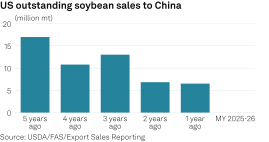
What's happening? US soybean traders are looking forward to the meeting between US President Donald Trump and his Chinese counterpart Xi Jinping at the Asia-Pacific Economic Cooperation summit Oct. 31-Nov. 1 in South Korea. The last Chinese purchase of US soybeans was in May, according to the latest US Department of Agriculture data. According to key traders familiar with US-China flows, China has not purchased or locked in any shipments for US soybeans over the past few weeks as well, amid the ongoing trade rift.
What's next? Most market participants are expecting a breakthrough during the talks to ensure China's purchases of US soybeans. China may start buying US soybeans in late December to early January if the talks are positive, several trader sources said. According to Jack Larimar, principal crops analyst at S&P Global Energy, China may start purchasing US soybeans in January, with US shipments to China reaching 8.5 million metric tons for the marketing year 2025-26. In MY 2024-25, China bought over 22.6 million mt of soybeans from the US, according to USDA data.
2. IMO decarbonization rules face delay
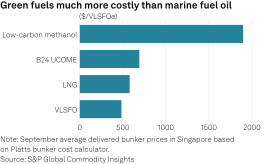
What's happening? The International Maritime Organization has postponed the adoption of its Net-Zero Framework, aimed at helping the maritime industry transition from oil-based fuels to low-carbon alternatives like methanol and ammonia. This delay, resulting from a vote earlier in October, has created uncertainty among shipping and bunker companies. Energy estimates oil-based fuels made up 97% of the global bunker mix in 2024, followed by LNG at 2%. The regulation, which would impose costs on bunker fuels' greenhouse gas emissions from 2028, is now uncertain, potentially affecting the industry's energy transition.
What's next? The IMO member states are expected to continue developing implementation guidelines to address concerns over the framework, including carbon revenue usage and lifecycle assessment methodologies. However, geopolitical factors could influence the framework's adoption, as some countries, including the US, have expressed opposition, citing high carbon costs and stringent requirements. Industry associations like SEA-LNG plan to support the IMO's work through scientific studies.
Further read: INTERACTIVE: Platts global bunker fuel cost calculator
3. Americas' lithium sector's slow but steady progress
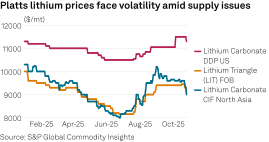
What's happening? Regional collaboration in the Americas' lithium sector is advancing amid a challenging pricing environment. According to the US Department of Commerce, the US imported 15,465 mt of lithium carbonate in 2024, primarily from Argentina and Chile. From January to July 2025, imports increased to 12,031 mt, a 34% year-over-year rise. South America is actively investing to enhance its role in the lithium supply chain, holding 30% of global lithium output and half of the world's reserves, as reported by the US Geological Survey. On Oct. 27, Platts assessed the FOB Lithium Triangle price at $9,100/mt and Lithium Carbonate DDP US at $11,300, reflecting a 9% decrease and stability, respectively, since the start of the year.
What's next? Energy analysts forecast that US lithium consumption will grow by an average of 40% annually from 2024 to 2029, with Canada's consumption expected to rise by 74%. Argentina is set for rapid production growth with multiple projects underway. The US Department of Energy continues to support battery recycling to enhance supply chain sustainability. Collaborative regional pricing is seen as essential by market participants to maintain supply chain continuity and address the growing demand for lithium in North America.
4. Lean beef market faces supply challenges
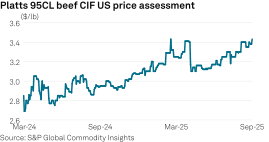
What's happening? The Platts assessment for 95CL beef CIF US rose 2 cents/lb to $3.50/lb, or $7,716/mt, on Oct. 27, breaking its previous highest value since Oct. 22 and its highest value since the assessment began in March 2024. Lean beef trimmings trade volume is thin due to low demand, yet the limited supply continues to support prices. According to a trader, domestic spot prices are pressured by weak demand. Uncertain geopolitics and tariff news are slowing forward sales, while the US plans to buy beef from Argentina have raised concerns among producers.
What's next? Caleb Hurst, principal proteins analyst at Energy, states that the gap between domestic and imported beef prices narrows further as Brazil remains absent from the market. He highlights that tariffs on Brazilian beef keep prices elevated, with limited offers for end-of-year shipments.
Reporting and analysis by Sampad Nandy, Max Lin, Anne Barbosa, Katharine De Senne, Noah Vasquez, Sergio Alvarado

Editor: