
S&P Global Energy
Establishing a West Africa reference fuels market
West African fuels demand is on the rise spurred by population growth and economic development. This market has put the region on a pathway to establishing a regional reference market that reflects market fundamentals in West Africa.
Contributors: Gary Clark, Matthew Tracey-Cook, Franceso Di Salvo, Frank Zeng, Dumdisi Awanen
Design: Content Design
Published: December 2025
Introduction
S&P Global Energy in partnership with the Nigerian Midstream and Downstream Petroleum Regulatory Authority (NMDPRA) held the inaugural Abuja West Africa Refined Product and Markets Conference in July 2025 at the Transcorp Hilton Hotel in Abuja, Nigeria.
The conference welcomed Africa’s energy leaders and policy makers with the aim of creating a road map to establish a refined fuels reference market in West Africa. The region’s increased production of oil products and reduced dependence on imports are accompanying the development of an active regional West African spot market in which independent and transparent price benchmarks that reflect local supply and demand fundamentals are essential.
West African fuels demand is on the rise spurred by population growth and economic development. Nigeria’s new Dangote refinery has the capacity to meet the majority of the region’s needs in the short-term reducing its import reliance on Europe and elsewhere. This market, albeit in flux, has put the region on a pathway to establishing a regional reference market that reflects market fundamentals in West Africa.
The conference highlighted key actionable themes which are instrumental to establishing a West African reference market:
- Transparent and robust refined product market pricing for West Africa;
- The building and maintenance of refinery capacity and supply capabilities in the region;
- Excellence in logistics network and operations;
- Regional regulatory alignment.
In this White Paper, Platts sets out how it aims to support the growth of the West African downstream sector with the goal of establishing a reference market through the publication of independent, transparent and verifiable information for all stakeholders committed to the region’s fuel markets.
Platts pricing in West Africa
Refined product imports to West Africa have long been traded and priced with reference to established European price benchmarks. These prices, spanning the entire refined products spectrum, have provided transparent and liquid benchmark assessments reflecting the value of European-grade material traded with the bulk of refined products bound for West Africa originating in Europe.
The hub of Amsterdam-Rotterdam-Antwerp (ARA) in Northwest Europe and the Mediterranean basin provide the location of refined product price benchmarks in Europe because they are refining, shipping and trading hubs with active and transparent spot markets where price formation is observable. Buyers and sellers load, blend and discharge significant volumes of oil products across a range of ports in these regions with the value of bids, offers and trades adjusted to the basis location, informing and creating the benchmark price for the region and beyond.
Platts European refined product price benchmarks typically referenced in West Africa
| Gasoline | ||
| Refined Product | Location | Symbol |
| Platts Premium Unleaded 10ppm FOB Rotterdam Barges | Netherlands | PGABM00 |
| Platts Premium Unleaded 10ppm FOB Med Cargoes | Italy | AAWZA00 |
| Platts Gasoline Eurobob FOB AR Barge | Netherlands | AAQZV00 |
| Diesel / Gasoil | ||
| Refined Product | Location | Symbol |
| Platts 0.1% FOB MED Gasoil Cargoes | Italy, France | AAVJI00 |
| Platts 0.1% CIF NWE Gasoil Cargoes | France | AAYWS00 |
| Platts 10ppm FOB ARA Diesel Barges | ARA | AAJUS00 |
| Jet Fuel | ||
| Refined Product | Location | Symbol |
| Platts CIF NWE Jet Cargoes | NWE | PJAAU00 |
| Platts Jet FOB Rdam Barge | FARAG | PJABA00 |
These benchmarks are providing the West African refined product market with transparency, spot market liquidity and relevant risk management tools. They also link regional markets effectively into global trade flows.
The West Africa refined products market is now changing with increasing local supply and trading amid rising demand in the region – conditions which allow for the formation of a reference market akin to ARA or the Mediterranean. As such, Platts has launched new regional price assessments which track the value of waterborne material traded in the region itself. These assessments reflect material directly traded in the Gulf of Guinea.
Regional markets like offshore Lome have grown in size and importance, with multiple buyers and sellers transacting on an STS Lome basis. Meanwhile, as the main source of local refined product supply in the region, Dangote (Lekki) has become an important pricing reference location in Nigeria. Material from the Dangote refinery is exported in large volumes into Lagos, Lome, and further afield, and forms a major source of refined products markets in West Africa.
In early 2025 Platts launched a number of regional West African price assessments to reflect these markets:
| Gasoline | ||
| Refined Product | Location | Symbol |
| Gasoline FOB West Africa | Lagos & Lekki, Nigeria | AWFRC00 |
| Gasoline FOB West Africa Diff (NWE) | WAF vs. NWE | AWFRD00 |
| Gasoline FOB West Africa Diff (Med) | WAF vs. Med | ABNWE00 |
| Gasoline STS Lome | Lome, Togo | ABNWG00 |
| Gasoline STS Lome Diff (NWE) | Lome vs. NWE | ABNWH00 |
| Gasoline STS Lome Diff (Med) | Lome vs. Med | ABNWI00 |
| Diesel / Gasoil | ||
| Refined Product | Location | Symbol |
| Low sulfur diesel FOB West Africa | Lagos & Lekki, Nigeria | AWFRA00 |
| Low sulfur diesel STS Lome | Lome, Togo | ABNWF00 |
The methodology underpinning all of Europe and West Africa’s price benchmarks can be found in Platts Specifications Guide for Europe And Africa Refined Oil Products.
Information collection: A Hierarchy
Platts is a price reporting agency which publishes benchmark price assessments across a variety of commodities. Its methodologies and assessment specifications are publicly available, under regular review to ensure their relevance and those used as benchmarks with associated derivative contracts are reviewed by an external auditor on an annual basis.
Its assessments are trusted by the market for their consistency and robustness and are widely referenced in physical and financial contracts.
Platts collects information from the market on a daily basis to inform its benchmark price assessments. Platts receives information from a variety of market sources whose input is analysed and evaluated to inform the price assessment.
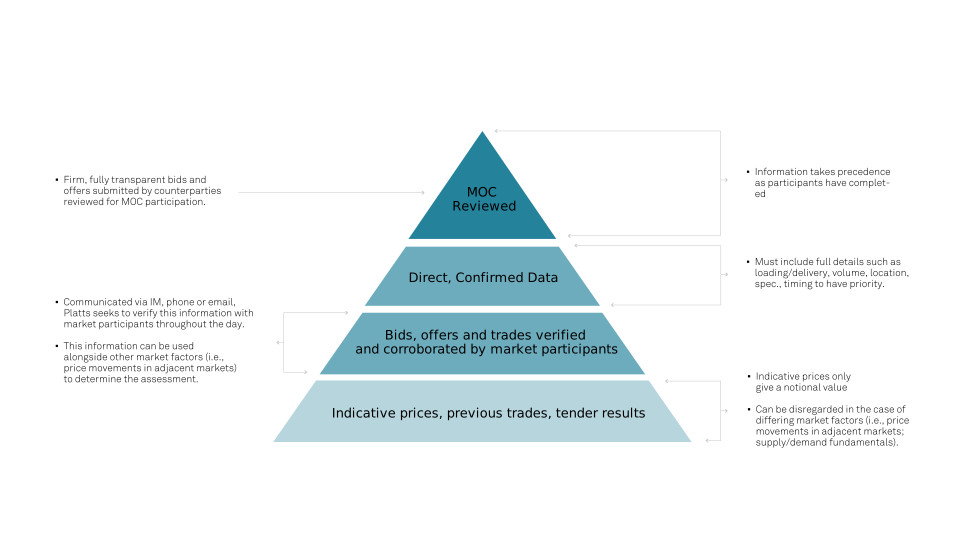
Transparency underpins Platts assessment processes, just as it does Platts data publishing processes. When determining a final market assessment, Platts gives the greatest priority to fully verifiable and transparent market information.
The granularity of information collected varies, and with any new assessment typically evolves and matures to more transparency over time. Platts has a robust methodology which allows to arrive at the most informed assessments in periods of low and high liquidity, in emerging and in mature markets. Information can range from indicative prices from individual sources, to firm, detailed and fully transparent bids and offers which demonstrate value in the Platts reviewed Market on Close (MOC) assessment process. The reviewed MOC is the highest tier of information quality considered by Platts for its assessments and it underpins all of the established Platts refined product benchmarks in Europe and globally. Further details concerning Platts MOC Participation Guidelines can be found online.
As part of the development of Platts West Africa price assessments, the movement toward increased transparency is critical. One of the methods which improves data quality input is called Direct, Confirmed Data.
Direct, Confirmed Data is a methodology that allows participants to submit to Platts fully confirmed and transactable bids and offers open to the marketplace as a whole. Direct, Confirmed Data should include full details around the specified bid and offer, such as loading terminal/s, loading dates, volume and specifications. These are then published to the wider market, where participants can express interest to trade the published bid or offer. The bid, offer or trade is then used to inform and evaluate the day’s price assessment, and they are prioritised over indicative values or other reported transactional activity heard across the market on the day.
Named examples of Direct, Confirmed Data:
XYZ Refining Company reports OFFER at $722/mt [details of offer: 20,000 mt; loading April 7-11; Lekki terminal; maximum 50 ppm sulfur, minimum 91 RON, a maximum RVP of 9 Pounds per Square Inch (PSI) and a reference density of 0.745 kg/l at 15 degrees Celsius].
ABC Trading reports BID at $710/mt [details of bid: 20,000 mt; loading Sep 1-5; Dangote terminal; maximum 50 ppm sulfur, minimum 91 RON, a maximum RVP of 9 Pounds per Square Inch (PSI) and a reference density of 0.745 kg/l at 15 degrees Celsius].
Unnamed examples:
Company A reports OFFER at $722/mt [details of offer: 20,000 mt; loading April 7-11; FOB Lekki terminal; maximum 50 ppm sulfur, minimum 91 RON, a maximum RVP of 9 Pounds per Square Inch (PSI) and a reference density of 0.745 kg/l at 15 degrees Celsius].
Company B reports BID at $710/mt [details of bid: 20,000 mt; loading May 1-5; FOB West Africa; maximum 50 ppm sulfur, minimum 91 RON, a maximum RVP of 9 Pounds per Square Inch (PSI) and a reference density of 0.745 kg/l at 15 degrees Celsius].
Platts accepts any reasonable method of delivery/communication of Direct, Confirmed Data provided for publication in real time. Platts market reporters typically communicate with market participants through phone, email, Platts approved public instant messaging systems, and other relevant communication tools including Platts eWindow.
To understand this process further with our pricing team, please feel free to reach us:
Pl_MidDistEurope@spglobal.com (Gasoil and Jet Fuel)
The West Africa refined products markets
Before the launch of the Dangote refinery, the refined product landscape in West Africa was marked by low refinery production and a significant dependence on imports. Among the 16 countries in the region, only five had refining capacity: Côte d’Ivoire, Ghana, Niger, Nigeria, and Senegal.
Although the nameplate capacity of the region’s refineries was approximately 620,000 barrels per day (b/d), actual refined product output sat well below those volumes due to inefficiencies and low utilization rates. In 2020, all four state owned refineries in Nigeria, along with Ghana’s Tema oil refinery, were shut down for rehabilitation, leaving just three West African markets with operational refinery facilities.
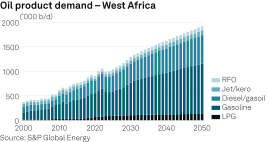
West Africa’s demand for refined products, on the other hand, has been on a near-vertiginous ascent since the turn of the century, driven by strong demographic and economic tailwinds. Demand for refined products—namely LPG, gasoil, gasoline, jet fuel, kerosene, and RFO—rose from 370,000 b/d in 2000 to just under 1,000,000 b/d in 2023. While demand grew steadily, regional supply moved in the opposite direction. From a high of just under 380,000 b/d in 2005, refinery output fell to approximately 200,000 b/d by 2023.
.svg)
Insufficient production, coupled with ever-growing demand, resulted in a situation where, in 2023—the year before the launch of the Dangote refinery—West Africa’s demand for refined products exceeded regional supply by nearly 800,000 b/d. Most of the shortfall was filled through imports, predominantly sourced from Northwest Europe, particularly from the Amsterdam-Rotterdam-Antwerp (ARA) refining and storage hub, as well as from markets such as Russia, India, and Spain.
The 2024 launch of the Dangote refinery led to a significant reconfiguration of regional refined product dynamics. West Africa now produces more LPG, jet fuel, kerosene, and residual fuel oil than it consumes. Additionally, while the region as a whole remains a net importer of gasoline and diesel—its two most consumed refined products—the supply shortfall for both has seen a sharp reduction over the past year and a half. For context, the supply deficits for gasoline and gasoil were 475,000 b/d and 240,000 b/d, respectively, in 2023. In 2025, these deficits are projected to fall to 365,000 b/d and 112,000 b/d.
The Dangote refinery is already supplying products to West African markets such as Togo, Côte d’Ivoire, and Ghana, in addition to exports to Asia, Europe, and the Americas. Its role in supplying the region is expected to expand further as it continues ramping up towards full capacity. As of July 2025, the refinery was operating at nearly 65% of its capacity and is projected to reach full capacity by the second half of 2026. However, scheduled and unscheduled maintenance, which are normal for a refinery of Dangote’s size and complexity, could slow down the ramp-up timeline.
Despite the substantial and long-awaited capacity that the Dangote refinery brings, long-term demand is expected to far outstrip supply, as West Africa is not expected to add significant additional refining capacity at this stage. While a handful of greenfield refinery projects have been announced over the years, their realization continue to face significant financial hurdles. Meanwhile, rehabilitation efforts at Nigeria’s four state-owned refineries have proven more challenging than anticipated, casting a shadow over their long-term prospects.
Against this backdrop, imports into the region are expected to reach a low point in 2027, coinciding with maximal output from Dangote, before progressively increasing over the long term due to rising demand and limited new refining capacity additions. By 2050, S&P Global Energy project that, in the absence of significant refinery additions, refined product import requirements will exceed 1,000,000 b/d, more than 200,000 b/d above pre-Dangote refinery levels.
Unless regional refineries are rehabilitated and new refineries built given the trends in demand for gasoline and diesel/gasoil West Africa will still depend on imports of these fuels in addition to local refinery production in the medium-to-long term.
It will be critical for regional West African and global refined product benchmarks to evolve and complement each other effectively in order to provide the fast-growing West African market with the most relevant reference prices and hedging tools that allow for effective trading and financing.
Roadmap: Towards establishing West Africa as a market reference
The West Africa petroleum products market has evolved in its refining capacity and availability of storage infrastructure. The creation of a viable Reference Trading and Price Hub for West Africa is contingent upon coordination across a number of interdependent pillars:
A. Transparent and robust refined product market pricing
B. Building and maintenance of refinery capacity and supply capabilities
C. Logistics network and operational excellence
This White Paper provides a foundation for regular updates by Platts on West Africa’s move towards becoming a regional fuels price reference market.
A. Transparent and robust refined product market pricing
Regional reference price hubs are generally centered around a liquid and transparent market. This in turn facilitates the development of robust benchmarks through the adoption of independent, verifiable and transparent market price assessments which facilitate transparent pricing for buying, selling and trading of refined products in the region.
Platts is committed to price transparency in the region by:
- Publishing price assessments relevant to the region of West Africa, including recently launched Gasoline FOB West Africa (AWFRC00) and Low Sulfur Diesel FOB West Africa (AWFRA00) assessments;
- Developing a robust and transparent methodology reflective of the prevailing regional market standards in West Africa;
- Seeking to increase confidence and robustness in regional price assessments through the use of Direct, Confirmed Data as a precursor to the adoption of a Reviewed Market on Close (MOC) assessment process.
B. Building and maintenance of refinery capacity and supply capabilities
The Dangote Refinery and other functional upcoming refineries in West Africa are changing the supply dynamics of refined product markets in the region. To ensure a thriving West Africa product market the region needs to work towards the operational stability of its refineries.
Platts is committed to offering its expertise in the region by:
- Seeking and publishing information on the status of West African refineries in Platts’ role as a provider of verifiable and transparent real-time market information;
- Facilitating country-level refined product ‘buy’ or ‘sell’ tenders, which can be conducted transparently by Platts in its MOC process;
- Providing market insights to the West African refining community and other market stakeholders.
C. Logistics network and operational excellence
Reliable logistics and surrounding infrastructure are needed to nurture a robust trading hub. Nigeria can improve its physical and commercial logistics framework through port, pipeline and transportation infrastructure upgrades, and the development of storage capacity in key trading hubs.
Platts is committed to offering expertise in the region by:
- Seeking and publishing information on the status of West African infrastructure and storage capabilities and investment in Platts’ role as providers of verifiable and transparent market information.
Platts West Africa Fuels Assessments
Access daily Platts price assessments for West African refined products, including gasoline, diesel, LPG (butane), and jet fuel. Track real-time market movements across STS Lome, FOB West Africa, DAP Lagos, and CFR South Africa delivery points with transparent, market-based pricing data updated every trading day.