Refined Products, Maritime & Shipping, Fuel Oil, Bunker Fuel, Diesel-Gasoil
December 15, 2025
COMMODITIES 2026: Oil bunker trades face soft demand growth, peak VLSFO

By Max Lin
HIGHLIGHTS
Lackluster demand environment despite IMO delay
Peak consumption of VLSFO likely reached
Trade patterns to shift if Red Sea traffic resumes
Global conventional bunker markets are set to endure lackluster growth in the coming year, with potential downside from the resumption of Red Sea traffic and peaking consumption of 0.5% sulfur fuel oil, currently the most used grade.
Geopolitical conflicts have prompted ships to sail longer distances and resulted in healthy ton-mile demand growth in recent years, but some energy analysts anticipate the positive effects on marine energy demand being offset by improvements in energy efficiency.
The world's consumption of oil-based marine fuels is expected to fall from 11,891 petajoules in 2024 to 11,787 Pj this year before recovering to 11,813 Pj in 2026, according to classification society DNV's latest long-term energy outlook.
"Our base case is for a muted demand environment next year. The market remains long oil, long liquidity, long assets and suppliers -- and short demand growth," bunker trader Monjasa CEO Anders Østergaard told Platts, part of S&P Global Energy.
"We expect 2026 to be a relatively slow and competitive year where players will need to adjust their commercial expectations."
The International Energy Agency has forecast global bunker demand could flatline at around 5 million b/d by 2030, despite an above-trend growth of 140,000 b/d in 2024 mainly due to ship diversions.
With Yemen-based Houthi militants attacking merchant shipping since the Gaza war broke out in October 2023, vessel operators have been diverting their ships from the Suez Canal to take the longer route around the Cape of Good Hope due to safety concerns.
IMF PortWatch data shows ship transits via the Bab al-Mandab Strait have remained half of the pre-war level after the Iran-backed rebel group paused their attacks as part of an Israel-Hamas ceasefire in October 2025, even as many shipping companies are planning to return to the Red Sea if safety concerns can be addressed.
"This will affect [fuel] consumption of the vessels," said Guido Cardullo, head of marine at bunker supplier Fratelli Cosulich. "The closing of the Suez Canal was positive in terms of volume consumed."
'Peak VLSFO'
Cardullo, like many other industry participants, is predicting a slower-than-expected marine energy transition to alternative fuels due to the delay of International Maritime Organization's Net-Zero Framework, originally designed to place a cost on greenhouse gas emissions from bunker use from 2028.
But the UN agency has lowered sulfur limits of marine fuels to 0.5% to 0.1% in the Mediterranean since May 2025, while similar rules will take effect in Canadian Arctic and Norwegian waters from March 2026.
The Emission Control Area regulations have resulted in a switch from very low sulfur fuel oil with 0.5% limits to 0.1%S marine gasoil in most cases, but a growing number of shipping companies are ramping up scrubber installations to consume cheaper 0.5%S high sulfur fuel oil or opting for LNG or biofuels for decarbonization benefits, according to consultancy 2050 Marne Energy owner Adrian Tolson.
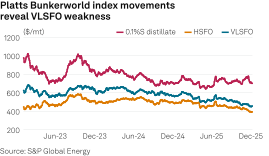
"We have seen peak VLSFO ... it has become a distressed product due to oversupply," Tolson said.
The premium of Platts Bunkerworld Marine Fuel 0.5% Sulfur Index for VLSFO to Platts BW380 Index for HSFO averaged $65.60/metric ton in the first 11 months of 2025, compared with $98.90/mt for the whole of 2024 and $120.90/mt for 2023.
DNV data showed the number of scrubber-fitted ships grew from 5,469 in 2023 to 6,168 in 2024, and is expected to reach 6,712 by the end of 2025.
Rotterdam recorded 2.1 million mt of VLSFO sales and 2.6 million mt of HSFO in January-September 2025, putting Europe's largest marine refueling hub on track to see lower deliveries of the 0.5%S grade for the second consecutive year.
Based on its test results, fuel surveyor VPS said the share of VLSFO in the Mediterranean ECA's bunker mix dropped to 30% in May-October 2025 from 53% in November 2024-April 2025, MGO increased to 30% from 16%, HSFO to 29% from 28%, ultra low sulfur fuel oil with 0.1% limits to 8% from 2%, and biofuels to 4% from 1%.
"The supply chain needs to adapt for VLSFO as a secondary/tertiary demand product," Tolson said.
Trade patterns
Singapore, the world's largest bunker port -- which recorded all-time high sales of 54.9 million mt in 2024, reported a 1.7% year-over-year gain to 46.4 million mt in the first 10 months of 2025.
Ship diversions from the Red Sea have benefitted bunker sales in Singapore and African ports in recent quarters at the expense of refueling ports in Egypt, the East Mediterranean and the Middle East, but the demand patterns could be reversed if vessels return to the waterway, several bunker industry participants said.
"The diversion of ships over the past two years boosted demand in places like Port Louis and the Canaries ... If Red Sea transit returns to normal, we're likely to see traditional hubs such as Fujairah naturally pick up again," said Philip Wang Balke, senior trader at bunker trading house Integr8 Fuels.
Monjasa's Østergaard sees downside for bunker volumes in Singapore, West Africa and South Africa if Red Sea traffic normalizes, but stressed that a general weak demand picture tends to hurt suppliers at major ports more.
"These conditions will hit major flow ports harder than smaller regional ports, simply because the large hubs -- Singapore included -- are most exposed to the competitive pressure created when too many suppliers chase limited incremental demand," the CEO added.
