Refined Products, Maritime & Shipping, LNG, Agriculture, Fuel Oil, Bunker Fuel, Biofuel, Wet Freight
December 15, 2025
COMMODITIES 2026: Marine LNG, biofuel demand to grow on tighter EU GHG rules
By Max Lin and Megan Gildea
HIGHLIGHTS
LNG demand prospects strong despite methane inclusion
Biofuel use to grow despite Rotterdam's competitiveness worries
Green methanol uptake constrained by high costs, limited supply
This is part of the COMMODITIES 2026 series, where our reporters bring you key themes that will drive commodities markets in 2026.
Tightening EU rules on greenhouse gas emissions are expected to prompt demand for alternative marine energy, but European suppliers are not necessarily well-positioned to harness the additional requirements due to a complex regulatory landscape.
The EU's FuelEU Maritime rules on marine energy's GHG intensity have been in force since January 2025, and Brussels will increase the coverage ratio of maritime emissions from 70% in 2025 to 100% in 2026 under its Emissions Trading System, while also including methane and nitrous oxide in emissions accounting.
Many shipping and bunker industry participants expect shipping companies to consume more LNG and biofuels for compliance requirements, and that their bunkering points will be driven by pricing and logistical needs.
The two fuels are more available than other forms of energy with lower GHG emissions than conventional oil-based fuels, and Albrecht Grell, managing director of consultancy OceanScore, said their popularity will only grow due to increased financial incentives.
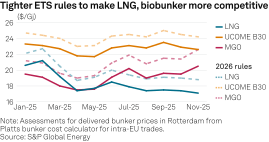
Average delivered bunker costs in Rotterdam were $18.3/Gigajoule for LNG, $19/Gj for 0.1%-sulfur marine gasoil and $22.8/Gj for B30 bioblend with 30% used cooking oil methyl ester in intra-EU trades over January-November, according to the Platts bunker cost calculator, when the ETS was taken into consideration.
If the 2026 rules were to apply, MGO -- the preferred compliance option among conventional fuels in EU waters due to sulfur limits -- would be priced at a wide premium to LNG of $1/Gj assuming the ship has a slow-speed, two-stroke engine and a narrower discount to B30 of $3.3/Gj.
"We see an increasing uptake [of the fuels] throughout this year," Grell told Platts, part of S&P Global Energy. "The increased commercial benefit will help to further support this trend."
Globally, classification society DNV expects LNG demand from the shipping sector to grow from 906 petajoules in 2024 to 1,032 Pj in 2025 and 1,196 Pj in 2026, and biomass demand to increase from 52.5 Pj in 2024 to 80.4 Pj in 2025 and 115 Pj in 2026.
LNG
Europe's LNG bunker market has seen strong activity through 2025, buoyed by calmer sentiment in the wider LNG complex, keeping prices competitive aside from FuelEU Maritime.
LNG bunker sales at the Dutch port of Rotterdam, Europe's largest refueling hub, set a quarterly record in the third quarter of the year at 270,254 cu m, according to the port authority. Volumes were up by 34% from the second quarter and by almost 23% from Q3 2024.
"Companies with vessels that have installed dual-fuel, LNG propulsion will have an advantage," said Guido Cardullo, head of marine at bunker supplier Fratelli Cosulich.
Despite methane slip worries concerning LNG-powered ships, Bunker Holding's head of LNG, Edward Glossop, said the inclusion of methane in the ETS accounting from 2026 is "no game changer" for LNG bunkering's business case.
Total fuel and compliance costs for the worst environmentally performing ship with a four-stroke LNG-fueled engine would still be $120-$150/metric ton lower than one burning MGO in intra-EU trades, according to Glossop's estimates made when applying the 2026 rules to early-December fuel prices.
"Global LNG supply is of course increasing rapidly, and all forward curves suggest that prices will be even more competitive for the coming years," said Glossop, adding that the forecast LNG barge tightness has yet to manifest in Europe.
Meanwhile, market participants said bio-LNG bunker demand has also been on the rise, and burning the low-carbon fuel could generate large quantities of FuelEU Maritime surplus units, which could be sold to other shipping companies via a pooling arrangement. Gas supplier Gasum quoted the surplus unit at Eur233/mtCO2e ($270/mtCO2e) on Dec. 15.
While this year was the first for the FuelEU regulation, traders anticipate a continued uptick in demand for the fuel as EU decarbonization rules become stricter, which could lead to shipowners more widely implementing bio-LNG into their fossil LNG marine fuel use.
Low-carbon energy
Conventional ships can only burn biofuels to meet EU compliance requirements, often on a drop-in basis. Bunker trader KPI OceanConnect estimates FuelEU Maritime alone has led to a gain of 600,000-700,000 mt/y in biobunker demand on a B100 basis.
"Drop-in biofuels cut ETS costs and FuelEU penalties, creating a powerful incentive to switch," a spokesperson for marine fuel supplier Peninsula said.
But Europe's biobunker markets are facing a shake-up, with the EU's Renewable Energy Directive III transposed into national laws across member states.
The Netherlands, home to the largest European biobunkering port, Rotterdam, is set to implement an Emission Reduction Units system as part of RED III from Jan. 1, 2026, with regulatory designs that, traders said, could drive up marine biofuel prices.
Further complicating the matter is that Belgium and the Netherlands have planned together to treat UCOME, the most popular feedstock in biobunker fuels, as a fossil fuel under their RED III implementation, but Belgium's transposition date has not been fully confirmed. In Germany, the international shipping sector is excluded from RED III.
"Predicting what effect RED III will have on the market is tricky," said Jesper Lindegaard Sorensen, global head of alternative fuels at KPI OceanConnect. "We will have to wait and see."
Singapore has overtaken Rotterdam as the world's largest biobunkering hub with its ability to offer more lower prices to container lines in Asia-Europe trades, and Sorensen said the world's largest bunker port is "the obvious candidate" to take more volumes should Rotterdam's competitiveness be eroded.
The monthly average delivered bunker price for B30 with 30% UCOME and 70% very low sulfur fuel oil was $709/mt in Singapore in November, and $756/mt in Rotterdam, according to Platts assessments.
For intra-EU trades, other bunker traders said the Amsterdam-Rotterdam-Antwerp region will remain a top biobunkering center due to a well-established logistics network that allows suppliers to offer grades up to B100, but ports in Spain, Italy, France and Turkey are also increasing their capabilities.
"Other locations are setting up a biofuel supply chain ... we will be more diverse," Cardullo said.
Among other fuels, a growing number of ships that can run on green methanol are hitting the waters, but shipping professionals said their uptake remains constrained by high prices and limited availability.
Shipbroker Braemar estimated 87 methanol-capable ships were in operation as of Dec. 10, while at least another 300 are due for delivery in the coming years.
Meanwhile, green methanol costs three times more than MGO, and its production currently stands at 2.2 million mt/y compared with the 60 million mt/y projected to be required by 2040, according to MPC Containerships.
"Together with the EU ETS, FuelEU Maritime supports certain business cases for lower GHG solutions by providing clearer long-term regulatory signals," the shipowner's group sustainability officer, Sebastian Ebbing, said. "However, its impact on scaling the production of low-emission fuels remains limited."

Editor: