Crude Oil, Maritime & Shipping, Wet Freight
October 13, 2025
WEST OF SUEZ DIRTY TANKER QUARTERLY: Production increases lend support to larger ship sizes

By Alec Kubekov
HIGHLIGHTS
WAF, Black Sea freight rates hit multiyear highs on rising global inquiries
Q4 outlook steady to firm: shipbrokers
The West of Suez Very Large Crude Carrier market saw levels firm to multi-year highs toward the end of the third quarter of 2025, as the progressive unwinding of OPEC+ production cuts, strong demand for cargoes loading in the Atlantic basin, and the limited number of newbuilds entering the market helped tip the scales in favour of owners.
Rates for the key 260,000 mt West Africa-Far East experienced significant volatility during this period, averaging $18.46/mt for July and $20.84/mt in August, before jumping to a 30-month high of $30.94/mt in September.
WAF VLCC volumes were broadly stable during the period, with the September spike in rates largely brought about by support from firmer market dynamics in adjacent load zones.
In the East, increased Chinese appetite for stock building and discounts for Saudi crude grades led to a significant uptick in activity on the benchmark Persian Gulf-China VLCC route. In the India-bound segment, trade-tariff pressure from the administration of US President Donald Trump led to Indian charterers temporarily reducing their take of Russia-origin crude, and therefore requiring more imports from the Persian Gulf to keep refinery operations on an even keel.
In the Americas region, elevated inquiries in the Brazilian and US Gulf markets also absorbed a large portion of the tonnage pool, leaving charterers inquiring for WAF cargoes with fewer options.
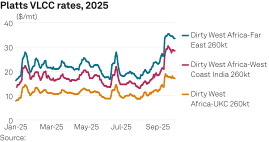
Looking toward the end of the year, sources familiar with the VLCC market said that the market was unlikely to see cargo demand rise significantly higher than the levels observed recently. However, rates could be bolstered by a potential tonnage crunch generated by the Chinese government's decision to impose escalating special port fees on ships with US affiliations starting Oct. 14, in response to US trade restrictions targeting Chinese maritime and shipbuilding sectors.
"The next month should be OK rates-wise, but I think November onwards will be quiet -- we won't see too much of an increase in cargo movement," an Asia-based VLCC broker said.
"The floor across the board is going to be higher as we move into next year," a London-based VLCC broker said. "But the peaks and troughs we see will also be greater."
On the tonnage side, a markedly longer order book from 2026 onward, compared with the limited number of newbuilds scheduled for 2025, could put some pressure on rates.
"In 2026, there will be deliveries in the second half, and in 2027 I think the number of newbuilds will be too much [for inquiry levels]," the Asia-based broker said.
"There are a handful more newbuilds on the way, although the VLCCs are quite an old market in terms of fleets and tonnage, which should keep things interesting," the London-based broker said. "Charterers are still going to use 2010 builds as we move to next year, and Indian charterers especially will definitely be willing to use 15–16-year-old tonnage."
Busier Suezmax segment
The West of Suez Suezmax market also experienced rapid growth in Q3, amid lengthier monthly stem lists for voyages loading from the Caspian Pipeline Consortium terminal and robust inquiries from the WAF region.
Following a bearish period in July, when the average rate for the benchmark 130,000 mt WAF-UK/Continent route stood at $14.34/mt, the market soared to hit a 20-month high monthly average of $19.09/mt in August, before inching up to an average of $19.49/mt in September.
The Black Sea market followed a similar trajectory, although rates were even higher in historical terms, with the 135,000 mt CPC-Med route firming to a 29-month high of $16.58/mt in September.
Suezmax owners active in the Black Sea trade have benefited from sharp production increases of CPC blend in 2025, following the completion of a major expansion of the Chevron-led Tengiz oil field in January. A record 54 Suezmax cargoes loaded from the CPC terminal in September, more than double the monthly average of 23 cargoes for the year 2024, according to S&P Global Commodities at Sea data.
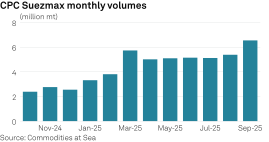
Shipbroking sources said the Suezmax market trajectory for the fourth quarter of 2025 was difficult to call, but the general consensus was that the outlook is steady to moderately bullish.
"Q4 is usually firm, but Suezmaxes are already quite high, so if they rise it'll be pretty spectacular -- I don't think they'll go up by too much," a London-based Suezmax broker said. "Suezmaxes also have quite a healthy forward order book, so we'll see a bit more pressure on that front maybe."
"It's looking positive overall, if Q4 is going to be somewhat active, which I think it will be, as in Q4 there's usually more oil to be moved," a Europe-based Suezmax broker said. "Rates are already at multi-year highs, so I think they could keep steady -- not sure how much higher they could go."
"We're at decent levels already, but you've got to expect things will go up as the weather gets worse," a second Europe-based Suezmax broker said.
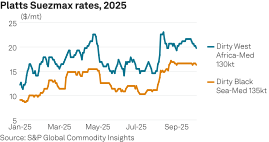
The London-based broker also noted that Suezmaxes and VLCCs are currently the highest performing size class in the dirty tanker market, with Aframax earnings sliding from the stronger levels seen in recent years.
"It's a top-down market now -- post [the start of the Russia-Ukraine war] it's been mostly Aframaxes which were the biggest-earning class of ships, but this year Afras have been [weaker] owing to various factors, mainly production increases in areas which favour the larger ships," the broker said.

Editor: