Crude Oil, Maritime & Shipping, Refined Products, Wet Freight
October 10, 2025
US sanctions to disrupt Sinopec's Rizhao crude hub, raising supply concerns
HIGHLIGHTS
Rizhao Shihua Terminal serves 1.55 million b/d of Sinopec refineries
About 1.33 million b/d of crude to be discharged in October
Jincheng Petrochemical sanctioned despite halting Iranian imports
The latest US sanctionson China's Rizhao Shihua Crude Oil Terminal -- imposed for importing Iranian crude -- are likely to causesignificant operational disruption at the hub, Sinopec's main logistics center for regular crude deliveries to its refineries in east and central China, port, refining and shipping sources told Platts, part of S&P Global Energy, on Oct. 10.
The new measures also targeted 8.9-million mt/year Jincheng Petrochemical, making it the sixth independent refinery sanctioned by the US for buying Iranian crude. However, Chinese independent refineries' imports of Iranian barrels are expected to continue.
The port disruption would lead to a regional shortage in oil product supplies, encouraging neighboring refineries to boost production, particularly independent refineries in Shandong, Jiangsu and Zhejiang, analysts added.
The US Treasury Department sanctioned the Rizhao terminal, as it accepted more than a dozen shadow fleet ships that have collectively transported several million barrels of Iranian oil, including the newly sanctioned Voy, Treasury Secretary Scott Bessent said in an Oct. 9 statement.
S&P Global Commodities at Sea data showed that the last time Voy called at Rizhao was in May.
Busiest crude terminals
Rizhao Shihua is one of the busiest crude terminals in China, so sanctions are likely to have a stronger impact on China's refining industry than on other terminals previously included on the list.
It owns three of the four VLCC terminals in the Rizhao Lanshan area of Shandong province. The terminal recorded an annual turnover of55.88 million mt in 2024, compared with its capacity of 56 million mt/year, including 40.23 million mt, or 804,000 b/d, of the crude that was handled for Sinopec refineries,according to a port source close to the company.
CAS data estimated that about 1.33 million b/d of crude would be discharged into the terminals in the Rizhao Lanshan area in October 2025, with the inflows led by those from Brazil, Angola and Oman, accounting for about 11.8% of the total arrivals to China in the month.
Moreover, local trading and shipping sources said Iranian arrivals to the area had slumped in recent months to around 100,000 b/d, from as high as 493,000 b/d in November 2024, according to CAS data.
Five out of the six Chinese terminals already sanctioned by the US for accepting Iranian crude -- including Qingdao and Yantai in Shandong province, as well as Yangshan in Shanghai -- subsequently suspended operations, with only Dongying, which was sanctioned in May, still operating, according to shipping and port sources.
A source close to the matter said Rizhao Shihua was studying the situation to find a solution.
"Whether the terminal can remain in operation depends on its operator and shipowners, if they are willing to transact regardless of the sanctions," a source with a neighboring port said.
Sinopec plants likely to cut runs
More importantly, Sinopec holds a 50% stake in Rizhao Shihua via a subsidiary under its listed storage and terminal arm Sinopec Kantons Holdings.
Neither Sinopec nor Sinopec Kantonswere available when Platts reached out for comment.
The Ministry of Foreign Affairs spokesman said during the press conference on Oct. 10 that "China will do what is necessary to ensure its energy security and safeguard the lawful rights and interests of Chinese companies and citizens" regarding the US sanctions.
Leveraging the good location in the middle of China's coastline and close to the developed Yangtze River Delta, Sinopec imports crude via the Rizhao Shihua terminals to send to its refineries along the Yangtze River and central China through the 800,000 b/d Rizhao-Yizheng pipeline and 200,000 b/d Rizhao-Dongming pipeline, according to refining sources and port sources.
The Rizhao-Yizheng pipeline connects about 1.35 million b/d of Sinopec refining capacity along the Yangtze River, including Jinling Petrochemical, Yangzi Petrochemical, Wuhan Petrochemical, Jiujiang Petrochemical, Hunan Petrochemical and Jingmen Petrochemical. The 200,000 b/d Luoyang Petrochemical facility is the leading Sinopec refinery served by the Rizhao-Dongming pipeline, according to the refining sources.
"We don't have an immediate plan yet, [we] may shift the coming cargoes to Ningbo to send to the plant. All these are about higher cost and longer delivery," a source with one of the affected refineries said.
Another Sinopec refiner in another region expected product supply shortages in eastern and central China, which may boost oil product prices until the logistics issue is addressed.
"While we expect near-term risk of run cuts (up to 250,000 b/d), we don't expect this to sustain as flows are rerouted, with some vessels already having diverted to other Chinese ports," Sun Jianan, a senior analyst with Energy Aspects, said.
A Singapore-based analyst said the neighboring independent refineries in Shandong, Jiangsu and Zhejiang provinces would take the opportunity to boost their runs to compensate for the reduction.
"Alternative feedstocks like straight-run fuel oil are a choice to lift utilization when crude import quota availability is running low," the analyst added.
The average utilization at Shandong independent refineries was 51.6% as of Oct. 8, down 0.44 percentage point from a week earlier, according to data from JLC.
Jincheng to run as usual
Meanwhile, the latest move by the US against the Jincheng petrochemical refinery indicated that a plant can be sanctioned even if it has stepped away from Iranian crude buying, the Singapore-based analyst said.
"If the result is the same, why stop buying," the same analyst said.
Jincheng has been one of the few independent refineries that has refrained from buying Iranian crude cargoes since early 2025 due to the potential risks of being sanctioned.
The refiner has largely relied on other crudes ever since, including those from Brazil, Angola and Russia, as well as Venezuela, according to Platts data.
"We haven't bought any Iranian crude cargoes for more than half a year," a source with Jincheng said, adding that the refinery would run as usual after some administration work changes.
All the refineries that were included in the sanction list in 2025 remain in operation, according to refining sources.
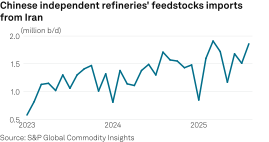
Chinese independent refineries are sharply reducing imports of Iranian crude to around 1 million b/d in September from 1.86 million b/d in August due to exhausted annual import quotas, Platts reported previously.
| Chinese refineries sanctioned by the US | ||
| Refineries | Sanctioned date | Capacities (million mt/year) |
| Jincheng Petrochemical | 9-Oct-25 | 8.9 |
| Hebei Xinhai Petrochemical | 8-May-25 | 11 |
| Shengxing Petrochemical | 16-Apr-25 | 3.8 |
| Luqing Petrochemical | 20-Mar-25 | 8 |
| Haiyou Petrochemical | 1-May-22 | 3.5 |
| Qiwangda Petrochemical | 1-Jan-20 | 1 |
| Source: US Treasury Department, S&P Global Energy | ||
| Chinese storage and terminals sanctioned by the US | ||
| Rizhao Shihua Terminal | 9-Oct-25 | Three VLCC berths |
| Qingdao Port Haiye Dongjiakou Oil Products Co | 22-Aug-25 | One VLCC berth |
| Yangshan Shengang | 22-Aug-25 | One 100,00 dwt berth and one 2,000 dwt berth, with storage capacity of 1.067 million cu m |
| Baogang (Dongying Donggang) Logistics and Warehousing Co., Ltd. | 8-May-25 | 100,000 dwt berth |
| Guangsha Zhoushan Energy Group | 10-Apr-25 | One VLCC berth |
| Huaying Huizhou Daya Bay Petrochemical Terminal Storage | 20-Mar-25 | One VLCC berth |
| Shandong United Energy Pipeline Transportation | 10-Jan-25 | 540 km crude pipeline, with 400,000 b/d transportation capacity |
| Source: US Treasury Department, S&P Global Energy | ||

Editor: