Maritime & Shipping
October 10, 2025
China to impose port fees on US-linked ships in tit-for-tat move with short notice
HIGHLIGHTS
China imposes retaliatory port fees on US-linked ships
Fees escalate annually, mirroring earlier move by Washington
Higher expenses for ships more than 25% owned by US entities
China is set to introduce special port fees on ships owned, operated, or built by US interests starting Oct. 14 in retaliation for new US trade restrictions on Chinese maritime, logistics and shipbuilding industries, the Ministry of Transport said Oct. 10.
The move comes after the Office of the US Trade Representative announced Section 301 investigation measures against China's shipping sector on April 17, which include new port service fees for Chinese-owned, Chinese-flagged and Chinese-built ships calling at US ports.
The Chinese government said these US actions violate international trade principles and the China-US Maritime Shipping Agreement, causing "serious damage" to trade between the two countries. In response, with approval from the State Council, China will require its maritime authorities to collect special port dues from US-linked ships calling at Chinese ports.
The new fees will apply to ships owned or operated by US companies, organizations or individuals; ships in which US entities hold 25% or more equity; ships flying the US flag; and ships built in the US.
The special port fee will be implemented in stages. From Oct. 14, ships will be charged Yuan 400 ($56.16) per net ton. The fee will rise to Yuan 640 per net ton from April 17, 2026, Yuan 880 per net ton from April 17, 2027, and Yuan 1,120 per net ton from April 17, 2028.
In comparison, the USTR will initially impose extra fees on Chinese ships, ranging from $18-$50 per net ton, effective on Oct. 14, as Washington seeks to counter what it describes as China's maritime dominance amid ongoing trade tensions between the two countries.
The fee will be collected only at the first Chinese port of call per voyage, and it will apply to no more than five voyages per ship per year. The Ministry of Transport said it would announce further implementation details at a later date.
Shipping impact
While Washington has gone through several rounds of open consultations and announced their fees on Chinese ships almost six months in advance, Beijing has only given shipping companies with US ships days to prepare.
"The Chinese side had all the time to get prepared," said S&P Global Energy tanker analyst Fotios Katsoulas. "But the US side won't."
US-built ships are usually flagged in their home country and engaged in domestic Jones Act trades. Figures from International Chamber of Shipping show fewer than 100 US-flagged ships are trading internationally.
However, China will impose fees on ships 25% owned by US entities or more. The New York Stock Exchange and Nasdaq are the most popular among shipping companies seeking equity finance. Listed shipping companies whose shares are over 25% owned by US investors could face the fees in China, the world's largest seaborne trading nation, in liquid, dry bulk and containers.
"Container trade activity is likely to feel the initial and most visible impact," said Maria Bertzeletou, a market analyst at ship operator Signal Group. "That said, other vessel segments could also be affected over time."
"The final quarter of the year will likely be decisive in determining how these fee measures influence freight and trading activity."
LPG loadings stand to be affected. China imported 587,000 b/d of LPG in 2024, and the volume fell to 250,000 b/d in September, according to data from S&P Global Commodities at Sea.
Crude loadings have already declined, but these were affected by China's 25% retaliatory tariffs on US crude imports and so stand separate from port tariffs.
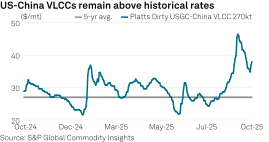
Platts, part of S&P Global Energy, assessed the rate to carry a 270,000 metric ton cargo of crude from the US Gulf Coast to China at $37.96/mt on Oct. 9, above the five-year average of $26.97/mt.
Rising costs
Industry experts said the tit-for-tat port fees could increase costs for US shipping companies and disrupt established trade flows between the two countries.
"This escalation adds uncertainty to global shipping routes and may prompt carriers to reassess their port call strategies," one market analyst said.
Meanwhile, a Singapore-based analyst said it was also part of China's move to "add bargain chips for the negotiations when Chinese President Xi Jinping meets US President Donald Trump later this month."
Market participants will be watching closely for further guidance from Chinese authorities and potential impacts on freight rates and supply chains in the coming months.
"If both parties recognize the mutual losses from this escalation, we may see a partial retreat or easing of tensions," Bertzeletou said.
The Ministry on Oct. 1 amended a key maritime law to establish legal grounds for future countermeasures against what Beijing considers unfair treatment of Chinese ships or treaty violations by foreign governments that harm Chinese interests.
The Ministry of Commerce late on Oct. 9 announced sweeping new export controls on rare earth and "superhard" materials, which can be used in high-tech products, and placed controls on items related to lithium batteries, as a response to Washington's recent restriction on semiconductor exports.

Editor: