Maritime & Shipping, Crude Oil, Refined Products, Wet Freight
October 06, 2025
Denmark tightens ship checks at Baltic Sea chokepoint in shadow fleet clampdown

By Max Lin
HIGHLIGHTS
Denmark tightens environmental checks on ships at Skagen
Targets older ships posing risks to marine environment
Intensifies controls on Russian shadow fleet transporting sanctioned oil
Denmark will tighten environmental checks of ships at a top maritime chokepoint in the Baltic Sea, the Ministry of Environment said Oct. 6, highlighting the country's latest efforts in clamping down on the shadow fleet.
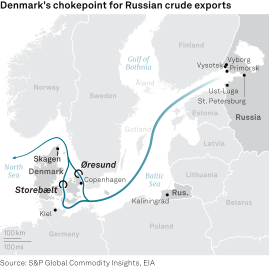
The ministry said the Danish Maritime Authority will collaborate with the Danish Environmental Protection Agency to conduct more frequent inspections on ships at the anchorage of Skagen, which connects the North Sea with the Baltic.
"We know that there is a lot of traffic consisting of older ships sailing through Danish waters, and they pose a particular risk to our marine environment," Environment Minister Magnus Heunicke said in a statement. "That is why we are now tightening controls with very basic environmental rules so that we can take more effective and consistent action against tankers and the Russian shadow fleet."
In recent years, Russia and some other countries have acquired a larger number of aged tankers to transport sanctioned oil via state interests or partnering with opaque shipping firms, resulting in heightened maritime operational risks.
A recent study by S&P Global Market Intelligence and S&P Global Energy identified 940 tankers that were either confirmed by Western authorities to have violated sanctions or at high risk of breaching them as of May, whose average age was 20 years -- significantly higher than the industry average.
"We know from our safety checks at Skagen Red that among these ships there are old and worn-out ships sailing around," Minister of Industry and Trade Morten Bødskov said. "That is why our authorities are now intensifying the controls so that we look after Denmark and Danish waters."
More inspections
Since 2024, northwestern European countries like Norway and Finland have tightened checks on ships transporting Russian oil but stopped short of arresting them en masse due to geopolitical risks and constraints by international law.
Ukraine has alleged that Russia is using shadow fleet tankers to launch drones against NATO members in Europe in recent weeks. In early October, French authorities briefly arrested the captain of a tanker suspected of transporting sanctioned Russian oil, according to media reports.
Denmark is bound by the Copenhagen Treaty to provide freedom of navigation via the Danish Straits, where total oil flows amounted to 4.5 million b/d in the first half of 2025, predominantly Russian crude and products, based on S&P Global Commodities at Sea estimates.
Russia exported 1.6 million b/d of crude from the Baltic in September, or 41% of its total seaborne exports, according to CAS. Russian clean product exports from the Baltic reached 649,000 b/d, 57% of Russia's total, CAS data showed.

Editor: