Agriculture, Metals & Mining Theme, Coal, Maritime & Shipping, Non-Ferrous, Dry Freight, Grains, Ferrous
October 02, 2025
DRY BULK QUARTERLY: Atlantic Supramax market firms amid stronger demand

HIGHLIGHTS
Minor bulk sector and agribulk shipments lead the segment
Market sentiment shifts amid stronger demand
The Atlantic Supramax market saw firmer levels in Q3 2025 driven by strong minor bulk and agribulk shipments, but while market sentiment improved amid stronger demand it continued to face policy and geopolitical risks.
Supramax trade starting from the Atlantic Basin to both Atlantic and fronthaul Far East destinations increased significantly quarter-over-quarter, gaining 23% compared with Q2, and was up by 17% year-over-year, according to S&P Global Commodities at Sea data.
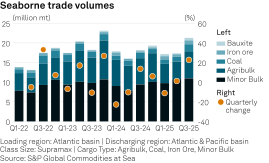
Minor bulk and agribulk cargo types accounted for 51% and 33% of the total volumes, respectively, while coal accounted for 8%, iron ore 5% and bauxite 3%, according to CAS data.
Compared to Q3 2024, minor bulk gained by 16% and agribulk cargo ticked up 3%, while coal increased by 32%, iron ore cargoes surged by 145% and bauxite by 87%.
Meanwhile, the Atlantic Supramax weighted average index of the six key time-charter equivalent assessments on 0.5%S bunker fuel basis (ASI 6 Index 0.5% VLSFO TCE $/d) was up by 46% quarter-over-quarter compared to the Q2 average, and down by 22% year-to-date, according to Energy data.
USGC demand lower, volatility high amid tariffs
In the North Atlantic and the US Gulf Coast, the Supramax market continued to see high volatility and lower demand while US tariffs policy reduced tonnage supply in the region, which contributed to freight rising towards the end of Q3.
Transaction volumes heading through the Panama Canal accounted for 77% of the total, with the Cape of Good Hope accounting for 20% and Suez Canal making up the rest, according to CAS data.
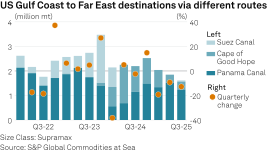
In the USGC region, total seaborne volumes pushed down by 13% quarter-over-quarter in Q3, with agribulk and minor bulk transaction volumes dropping by 16% and 4% respectively, according to CAS data.
Platts New Orleans to Kashima 50,000 mt grains route spot time-charter equivalent rates were up by 60% quarter-over-quarter in Q3 but down by 28% year-to date, according to Energy data.
"[US tariffs] policy is gradually reducing suitable tonnage in the Atlantic basin, particularly in the US Gulf Coast, amid rising US-China tensions. By the end of Q3, the market seemed well-positioned for recovery, with tonnage supply becoming increasingly constrained as September concluded," a shipbroker source based in London said.
South Atlantic grains volumes increase seasonally
In the South Atlantic, the grains market on the East Coast of South America saw demand in Q3 due to seasonal factors. Strong fundamentals in the region, along with support from trans-Atlantic business and significant demand for fronthaul runs, bolstered the segment.
Supramax loading in the ECSA region for trans-Atlantic trips accounted for 63% of the total volumes while fronthaul trips represented 37%, according to CAS data.
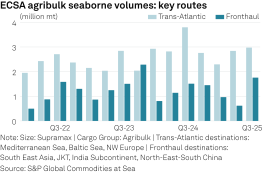
Volumes for trans-Atlantic trips increased by 5% compared to Q2 2025 while for fronthaul trips they surged by 184% on seasonality, according to CAS data. Year-on-year they were up by 6% for trans-Atlantic trips and up 54% for fronthaul.
"East Coast South America performed well in Q3, with downside risks from muted US-China trade benefiting the market. Notably, there is a strong preference for agribulk shipments from Brazil and Argentina," a chartering broker source based in London said.
Meanwhile, significant contributions to fronthaul trips came from the Brazilian and Argentinian agribulk shipments, which increased by 17% and 56% respectively compared to Q3 2024, according to CAS data.
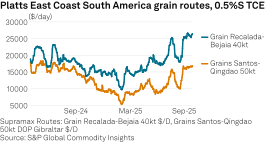
The Platts Recalada to Bejaia 40,000 mt trans-Atlantic grains route time-charter equivalent assessments on 0.5%S bunker fuel basis was up by 30%, with the Santos to Qingdao 50,000 mt fronthaul grains route time-charter equivalent assessments on 0.5%S bunker fuel basis up by 36% quarter over quarter.
Strengthening scrap cargo demand in the Continent and Baltic Sea
The Supramax segment in the Continent and Baltic Sea regions witnessed stronger demand for scrap cargoes, supported by solid fundamentals amid balanced cargo demand and a tighter tonnage supply.
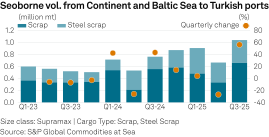
Scrap and steel scrap volumes from Northwest Europe and the Baltic Sea to the Mediterranean Sea and Turkish ports surged by 56% compared to Q2 2025, and was up by 18% year on year, according to CAS data.
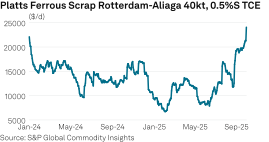
Platts Rotterdam to Aliaga 40,000 mt scrap route spot time-charter equivalent rates were up by 54% quarter-over-quarter in Q3.
"The increasing volume of scrap cargoes, along with limited spot tonnage supply and vessels ballasting to other strong regions, drove up spot rates. By the end of the quarter, spot levels remained healthy due to tight tonnage supply, although the ballasting created tonnage imbalances," according to a scrap shipbroker based in Geneva.
Tariffs and policy uncertainty continue to pose challenges
Geopolitical uncertainty is expected to persist in shaping global trade and significantly impacting effective vessel supply, while concerns about further tariff increases are raising concerns in the market, according to a shipbroker source in Athens.
The Supramax market is benefiting from geopolitical developments that enhance ton-miles, but uncertainty continues to linger.
"With strong fleet supply growth anticipated, imbalances between supply and demand may result in increased volatility," noted a Greek-based shipowner.

Editor: