LNG, Maritime & Shipping, Wet Freight
September 26, 2025
Indian LNG importers seek discounted spot deals with 2026-2027 put options

By Suyash Pande
HIGHLIGHTS
BPCL concludes put option deals to cut 2025 cargo prices
Suppliers give spot market discounts for rights to sell at fixed prices in 2027
Buyers risk 2027 spot prices being lower than put option prices
Indian LNG importers are exploring structured deals that enable the purchase of spot cargoes at steep discounts to prevailing spot prices in exchange for put options exercisable in 2026 or 2027, suppliers, traders and end-users based in India, Singapore and Europe told Platts, part of S&P Global Energy.
Torrent Power and Bharat Petroleum Corp. Ltd. completed such transactions in 2025, involving spot cargoes with put options exercisable in 2026 or 2027.
A put option is a common financial instrument that gives the holder the right, but not the obligation, to sell an asset at a predetermined price. It is typically used to hedge against a decline in price, allowing the holder to sell at a price above the prevailing spot price when the option is exercised.
In a tender that closed Sept. 1, BPCL purchased a cargo for mid-November delivery at around $10.20/MMBtu, with an option allowing the seller to deliver a cargo over January-June 2027 at the same price, LNG traders based in Singapore and Europe with knowledge of the tender said.
Additionally, BPCL purchased two more cargoes for November and December 2025 delivery at mid-$10/MMBtu, with options allowing the seller to deliver cargoes over April-June and July-September 2027 at the same prices, and with the right to cancel 60 days before the delivery window, according to LNG traders in Singapore and Indian importers.
Torrent Power purchased a cargo in March for June delivery at Platts JKM minus 60 cents/MMBtu, with a put option allowing the seller to deliver in 2026 at a fixed price of $10/MMBtu.
Torrent Power and BPCL did not respond to requests for comment.
Indian companies have previously explored JKM-linked structured deals as well, Platts reported earlier.
A structured deal differs from a standard purchase or sale because it includes conditions that can adjust the price, volume or delivery windows based on dynamic variables. In the LNG market, companies use structured deals to create flexibility tailored to specific end-users or market conditions.
Deal implications
Indian companies are looking to reduce their costs for 2025 cargo purchases, as LNG spot demand was subdued earlier in the year due to cheaper domestic gas and alternative fuels such as naphtha, fuel oil and LPG.
In such structured deals, when Indian companies link prices for November-December 2025 deliveries to cargoes for April-September 2027, the cost of the 2025 purchases is reduced, but the 2027 cargoes' prices are effectively fixed.
Because the 2027 prices are fixed, buyers would still be obliged to take delivery at the price locked in September 2025, even if spot LNG prices in 2027 fall significantly below the mid-$10/MMBtu range.
If prices rise above this range, the seller will likely exercise the right to cancel the cargo(es) up to 60 days before delivery.
"For the right to cancel in 2027, the seller is paying with the discount that they are giving for 2025 cargoes," a Singapore LNG trader said. "Of course, there would be a risk that prices could be lower [in 2027], but at least they are getting the cargoes cheap now, and then who knows."
Mechanics
For traders in the options market, for instance, the $10.20/MMBtu price for 2027 represents the strike price -- the price at which the seller can exercise the option. The 60-day window before delivery serves as the option's expiry.
Market participants consider the time remaining until the option can be exercised, the expected price volatility between the current market and April 2027 and the risk-free rate as key factors in valuing the option.
Traders use these factors to determine the financial value of the option, which helps them assess the size of the discount and price the cargoes offered for November or December 2025 delivery.
Physical LNG sellers take into account the financial value of the option and the 2027 forward curve when setting prices for buyers in such structured deals.
The seller would earn a profit if LNG prices fall below $9.60/MMBtu in 2027, assuming a 2025 spot cargo discount of 60 cents/MMBtu off the $10.20/MMBtu price when the prevailing spot price is $10.80/MMBtu.
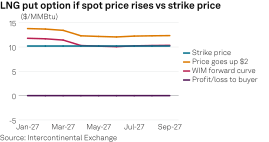
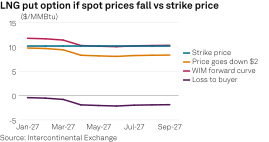
The example in the second chart illustrates a scenario in which the spot LNG price falls by $2/MMBtu. In this case, the seller's earnings from the structured deal remain high, as the buyer still takes delivery at the strike price despite the drop in the spot price. The buyer's loss is represented by the difference between the 2027 spot price and the strike price, shown as the "loss to buyer" portion in the negative territory on the chart.
If prices remain unchanged, the seller's loss would be limited to the 60 cents/MMBtu paid as a premium for the right to sell at the $10.20/MMBtu strike price in 2027. In this case, the buyer gains no benefit and would still need to purchase cargoes from the spot market in 2027, where prevailing prices are higher than the strike price, as indicated by the absence of "profit/loss to buyer" on the first chart.
Buyer consideration
Besides benefiting from lower prices for prompt cargoes compared with prevailing spot LNG prices, some Indian buyers appear willing to accept the risks embedded in the put options.
"By buying the cargo for 2027 at the fixed price, if the costs are fixed and given the forward curve for crude oil and the fixed price of mid-$10/MMBtu, refineries can accept the volume, even if LNG prices [move lower in the future]; that is a risk refineries can take," an Indian importer from an oil company said.
"Buyers in India are looking to reduce their costs and fix their costs. The buyers are not necessarily traders, and if at a price the economics work, they can absorb it," another Singapore-based trader said.
However, two Indian importers and a Singapore trader said that the risk of locking in 2027 LNG prices to secure a discount for 2025 cargoes should be managed more carefully, ideally by considering floating prices for both legs of the structured deal.
A Singapore-based source with knowledge of the Indian market said that this approach would at least help buyers protect themselves from potentially large gaps between 2027 LNG prices and the fixed strike price.
Platts assessed the West India Marker -- the price of LNG cargoes delivered to India and the Middle East -- for October at $10.90/MMBtu on Sept. 25 and the calendar year 2027 derivative at $10.425/MMBtu.

Editor: