Metals & Mining Theme, Maritime & Shipping, Chemicals, Non-Ferrous, Containers, Ferrous
September 05, 2025
India's export landscape in flux amid US tariffs, low demand
By Yash Gupta and Tanya Kalra
HIGHLIGHTS
Bearish outlook due to tariffs, inventories
US PMI increases, fueled by inventory build
Indian volumes rise 25% on year
Shippers opt for 'floating warehouse'
The Indian export market is experiencing turmoil after the US announced an additional 25% tariff on July 30.
While some products, such as pharmaceuticals and semiconductors, remain exempt, market sources expect exposure to textiles, gems and jewelry, footwear, chemicals and auto components, along with steel, aluminum and copper, which have different duties applicable.
According to market sources, while shippers tried to meet the Aug. 27 deadline for US-bound cargo, there was enough cargo to fill vessels departing from India. This was due to the additional roll pool that carriers had created in July and August as a result of blank sailings.
However, September does not bring the same certainty, as shippers are now adopting a wait-and-watch approach.
"Steel products and pipes are on hold; when I spoke to exporters, they said they were okay to absorb the 25% tariff, but the additional penalty makes exports difficult," a carrier said.
Carriers on this trade lane are opting for blank sailings, including two blank sailings for ONE, one for CMA and one for Hapag-Lloyd. Some sources also expect carriers to bring smaller vessels into this trade lane to compensate for lower volumes.
According to some market sources, CMA-CGM has added Charleston and Tanger Med to its Indamex Service.
"It is a way to get more cargo, so their vessels don't go light," a source said.
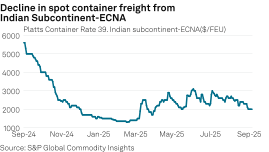
Spot rates from the Indian Subcontinent to East Coast North America have stabilized in September, but sources expect a correction.
Platts, part of S&P Global Commodities Insights, assessed PCR 39-Indian Subcontinent-to-East Coast North America at $2,000/FEU on Sept. 4, while spot rates during the same time in September 2024 stood at $5,300/FEU. While additional capacity on this trade lane has also affected the market since then, the highest spot rate assessed since January was $3,000/FEU on July 3.
As the month progresses, with lower exports from the Indian market, some sources showed concern about empty boxes accumulating at the port.
"It will affect the entire trade; maybe rates will drop for other sectors also due to the oversupply of containers in India," an NVOCC source said. "To conclude this, we need to understand the volume drop to the US from India."
Frontloading to US builds inventory
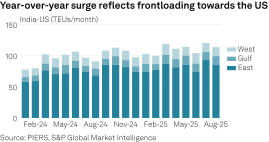
While Indian exports to the US in August declined by around 6% from July, overall, volumes increased 25% year over year, indicating a trend of front-loading. According to data from S&P Global Market Intelligence, India exported 17.77% more containers over January-August than in the same period last year.
Market sources are assuming a bearish outlook for the US market, and attributing it to the tariffs, the frontloading and the inventory buildup in the US.
"The demand in the US right now is for domestically made products, so we are using our manufacturing in the US to cater to demand there and using the Indian manufacturing for the domestic market here," a shipper said.
The S&P Global Purchasing Managers' Index for India rose to 59.3 in August from 59.1 in July.
"Underlying data showed a softer increase in international orders placed with Indian manufacturers," the report said. "The rise was the weakest for five months, though sharp by historical standards."
However, the report indicated robust domestic demand compared with the international orders.
On the US side, the PMI showed an increase to 53.0 in August from 49.8 in July.
"The upturn is in part being fueled by inventory building, with factories reporting a further jump in warehouse holdings in August due to concerns over future price rises and potential supply constraints," Chris Williamson, chief business economist at Market Intelligence, said. "Cost increases are being passed on to customers via widespread hikes in factory gate prices. The big question is the degree to which these price rises will then feed through to higher consumer price inflation in the coming months."
De minimis suspension affects e-commerce
Sources reported that some customers are also using warehouses in Canada or using a "floating warehouse" strategy.
"Shippers have opted for longer haul routes with higher transit times -- through which they can save on ocean freight, and also save on warehousing costs," a Canadian forwarder said.
Market sources are also concerned about the suspension of de minimis and its impact on e-commerce. The majority of de minimis shipments are made via air and express courier services such as UPS, DHL, and FedEx.
According to the US Customs and Border Protection, de minimis shipments account for 92% of all cargo entering the US.
"It is hitting the e-commerce sector the most; some companies like UPS, DHL and the Australian post have stopped delivering to the US," the Canadian forwarder said. "Some are also using Canada as their base."
An India-based shipper said: "This will also hit all Amazon, Walmart sellers in India."
