Refined Products, Maritime & Shipping, LNG, Fuel Oil, Bunker Fuel, Dry Freight
August 25, 2025
UAE opens door to ship recycling with more yards seen needed

HIGHLIGHTS
Last ship recycled in UAE in 2021
Demolitions fell to 324 ships in 2024
Scrap steel makes up 95% of ship value
The UAE needs to develop more recycling yards to meet demand from owners looking to scrap their old ships following new regulations that took effect in June, market analysts said.
The UAE ship recycling regulation for safe and environmentally sound ship recycling aims to encourage the growth of compliant ship recycling capacity, according to the UAE Ministry of Energy and Infrastructure. The rule, effective June 26, applies to all UAE-flagged ships and foreign ships recycled in the UAE, as well as foreign-flagged ships whose decision to recycle is made while in UAE waters. All state-owned ships, including warships, along with ships with a gross tonnage of less than 500 mt, are excluded from the rules.
Demand for ship recycling is at a low point, so now is a good time for the UAE to adopt the regulation to spur more recycling yards, according to Kiran Thorat, a trader at ship recycling giant GMS in Dubai, the world's largest cash buyer of ships and offshore ships for recycling.
Some 10 to 12 ships use UAE ports before going to a recycling yard, primarily Fujairah, Khalid, and Khor Fakkan, mostly for bunkering or a crew change, Thorat said. That may be a small damper on bunker demand in the UAE temporarily, he said.
DP World's Drydocks World shipyard has received certification for ship recycling and is "currently looking at different avenues to provide solutions to our clients," the company said when asked about the new regulations. The UAE energy ministry did not respond to a request for comment.
"There is growing interest in developing" a green ship recycling facility in the UAE that would comply with the new UAE regulation, Thorat said. At current rates, a 42,000 lightweight tonnage (LDT) VLCC could fetch $17.5 million for recycling, he estimated.
Bangladesh leads
The last known ship recycled in the UAE was the 500-mt barge Smit Borneo at Ras Al Khaimah in 2021, according to Gaurav Mehta, director of Best Oasis, one of the world's largest cash-buying companies for ships and energy assets based in Dubai. Bangladesh is the world's biggest ship-recycling nation, handling about 140 to 150 ships a year, followed by India with 120 to 130 ships and Pakistan with 40 to 45 annually.
The UAE and GCC have the potential to recycle between 300,000 and 600,000 LDT of capacity by 2030, but achieving this would require a drastic change in policies and significant investment, not only from the government but also from the private sector, according to Mehta.
Demand for recycling in the UAE is being pushed back as disruptions in the Red Sea have forced more ships to take longer routes around the Cape of Good Hope and then back up to Europe and the US, prompting ship owners to keep their ships at sea longer.
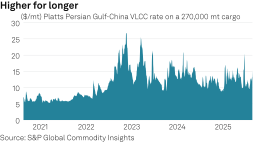
The Platts-assessed cost to ship 270,000 mt of cargo from the Persian Gulf to China on a VLCC was $14.86/mt on Aug. 25, up from $12.69/mt at the end of 2024. Platts is part of S&P Global Energy.
On the other hand, high metal prices make demolition more attractive, Mehta said. Scrap steel prices, which account for about 95% of a ship's value, climbed to a 14-year high in May 2022 but have since fallen by almost half, to around $450 per light displacement tonnage, he added.
Demolitions fell to 324 ships last year, or 4.6 million gross tonnage. "Owners are hanging on to old tonnage," Mehta said. "Strong rates linked to Red Sea diversions made even 25-year-old ships profitable to run."
Ships older than 25 years are typically ready to be recycled, or 20 years in the case of high-risk ships such as tankers, he said. Owners may also choose to recycle when repair costs or new regulations outweigh potential future earnings or when the ship fails to comply with the International Maritime Organization or other regulatory requirements, he added.
"In 2024, strong container and dry bulk earnings, partly driven by Red Sea rerouting, led to a sharp decline in demolition activity, particularly among boxships and tankers. Recycling activity usually rebounds only when charter rates fall below breakeven levels or when mandatory compliance costs rise significantly," Mehta said.
He noted that orders for dual-fuel ships by Qatar and Abu Dhabi National Oil as part of their LNG expansion plans may drive future demand for recycling in the UAE. These new dual-fuel, high-efficiency ships will replace older steam-turbine LNG carriers built in the 1990s. By the time these replacements are delivered, many of the legacy ships will be 35 to 40 years old. Consequently, around 20 to 30 older LNG carriers are expected to be retired and recycled after 2028, unless repurposed for FSU/FSRU service, he said.
