Crude Oil, Maritime & Shipping, Wet Freight, Dry Freight, Containers
July 09, 2025
FACTBOX: Red Sea transits in renewed focus following Houthis' first attacks in 2025

By Max Lin
HIGHLIGHTS
Houthi militants resumed attacks following months of hiatus
Tanker rates and insurance premiums rise on heightened risks
Already-low ship traffic not yet affected
Yemen-based Houthi militants resumed their attacks on merchant shipping in early July following months of hiatus, prompting renewed focus on maritime security in the Red Sea.
The Iran-backed rebel group's latest attacks are the first in 2025 and among their worst, with initial industry reports suggesting two Greek dry bulk carriers have sunk and at least three seafarers killed.
Since the Gaza war broke out in October 2023, the Houthis have claimed to attack more than 130 ships linked to Israel, the US and UK in support of the Palestinians.
Most ship operators have diverted their ships away from the Red Sea since the initial months of the Israel-Hamas conflict to sail around Africa, supporting bunker use and ton-mile demand for vessels.
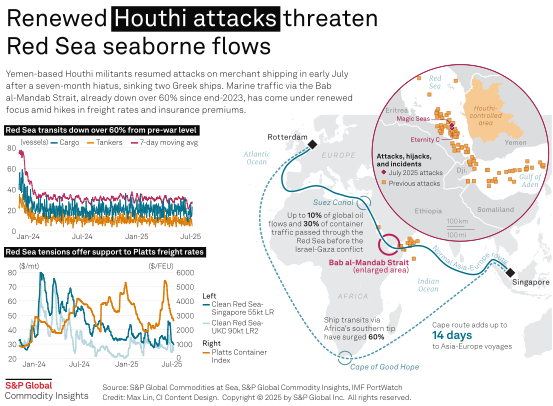
Freight rates and insurance premiums are rising following fresh Houthi attacks, though Bab al-Mandab ship transits, already down over 60% from the pre-war level, have not yet fallen further, with Greek operators still sending tankers with Indian products through the strait as of July 9.
Trade flows
- Houthi attacks in the Red Sea since late 2023 have already forced many ships to reroute around the Cape of Good Hope, adding approximately two weeks to Asia-Europe voyages and increasing shipping costs substantially.
- Latest IMF PortWatch data showed the average daily ship transits via the Bab al-Mandab Strait stood at 28 in the week ended July 6, down from the usual level of more than 70 before the Gaza war.
- S&P Global Commodities at Sea data shows Suez Canal transit volumes of crude oil and petroleum products halved from 7.9 million b/d in 2023 to 3.9 million b/d in 2024 and have stayed lower than normal this year.
- The Bab al-Mandab Strait saw 2.5 million b/d of crude, condensate and refined petroleum products transit in 2024, nearly two-thirds lower than 6.9 million b/d in 2023.
- Oil flows through the Cape of Good Hope route rose to 8.4 million b/d in 2024 from 6 million b/d in 2023, according to CAS.
- LNG flows through the Red Sea have all but disappeared since late 2023, as cargo owners opted to steer away from the risky waterway and shipowners moved to protect their high-value ships.
Prices
- Platts, part of S&P Global Energy, assessed Dated Brent crude at $72.045/b on July 8, up from $70.730/b July 4 before the latest Houthi attacks.
- Product tanker rates spiked in the first half of 2024 before giving up the gains due to increased ship supply, but a refocus on Houthi attacks could inject upward momentum into the market.
- The MR tanker rate for transporting 40,000 mt of refined products from the Red Sea to UK/Continent rose to $40.63/mt on July 9 from $38.75/mt on July 7, and LR2 rate for shipping 90,000 mt increased to $27.78/mt on July 9 from $25.56/mt on July 8.
- The Suezmax rate on the Red Sea-China route was assessed at $29.28/mt on July 9, same as the level seen on July 7 and July 8, according to Platts.
- Container rates have yet to react to renewed Houthi threats. Platts Container Rate 3 -- PCR 3 -- cargoes to the Mediterranean from North Asia were assessed at $3,500/FEU on July 8, flat on the day.
- The additional war risk premium in hull and machinery coverage for ships moving through the Red Sea has climbed to at least 0.70% of hull value from 0.30% before the latest attacks. This compares with 0.05% before the Israel-Hamas war.
Infrastructure
- The 20-mile wide Bab al-Mandab Strait lies between the Horn of Africa and the Arabian Peninsula, connecting the Red Sea to the Gulf of Aden and the Arabian Sea and serving as a crucial waterway for Asia-Europe trades.
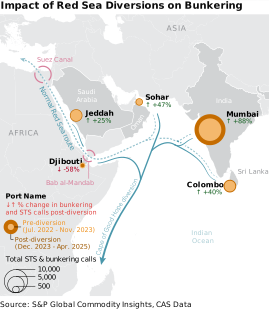
- Ship diversions have increased pressure on infrastructure at ports in the Mediterranean, East Africa, South Africa and the Indian Ocean, with ripple effects on supply chains and marine fuel logistics.
- Ship-to-ship and bunker activities have surged by 88% in Mumbai, 47% in Sohar and 25% in Jeddah, but have decreased by 58% in Djibouti, according to Bunkerworld and CAS.
- Bunker sales at Mauritius' Port Louis nearly doubled in 2024 to about 1 million mt from 500,000 mt in 2023, as ships diverted around the Cape of Good Hope amid Red Sea security risks, according to a Bunkerworld survey.
- The Red Sea is key for crude and oil product exports from the Persian Gulf to the Mediterranean via the Suez Canal or the SUMED pipeline. In the other direction, Russia ships significant volumes of Urals crude to Asia via the route.
- Export infrastructure in OPEC's largest Middle East producer, Saudi Arabia, has so far been little affected by the disruption despite the country's past conflicts with Houthis.

Editor: