Agriculture, Refined Products, Maritime & Shipping, Biofuel, Fuel Oil, Bunker Fuel
May 28, 2025
INTERVIEW: Biobunker demand struggles amid high costs, complex FuelEU Maritime rules

By Max Lin
HIGHLIGHTS
Biofuel demand from shipping yet to pick up: Seascale
Shipping firms still adjusting to changing regulations
Biobunker fuels much more expensive than VLSFO
Global biobunker demand has yet to increase significantly despite strong growth prospects, with shipping companies likely struggling to pass on additional costs and navigate the changing regulatory landscape, Seascale Energy co-CEO Peter Grünwaldt said.
The 50:50 joint venture between Hafnia and Cargill, which began operations May 19, expects biofuels to play a bigger role in its bunker agent business in the coming years amid the maritime decarbonization drive.
But "the uptake has been a bit slower than expected," Grünwaldt told Platts, part of S&P Global Energy, in a recent interview. "If you ask some of the biofuel suppliers, I don't think that they've seen the demand as they had hoped for at this point in time."
The comment echoed what many industry participants have observed, reflecting a disappointing demand reading for the alternative fuel deemed the most straightforward compliance option amid new EU shipping regulations on greenhouse gas emissions.
Bio-blended very low sulfur fuel oil sales fell 72% year over year to 49,263 mt in Rotterdam, Europe's largest refueling hub, data from the port authority showed. Bio-blended high sulfur fuel oil deliveries fell 34% to 28,271 mt, while bio-blended marine gasoil sales rose 19% to 15,640 mt.
Some market participants said the falling sales came as the Dutch government cut subsidies and failed to clarify associated policies, and that most shipping firms respond more to prices than regulations.
Price implications
While container lines are maintaining healthy biobunker usage to support their eco freight products, tramp operators have a more difficult time switching to the most costly biofuels, according to Grünwaldt.
Seascale, which buys 7.5 million-8 million mt/year of marine fuels for roughly 900 ships for its shareholders and external clients and charges a fee, mainly serves oil tankers and dry bulk carriers for now.
"In both tanker and dry bulk markets, it's a little hard to get the charterer to pay extra just to become green," Grünwaldt said. "It's not on everybody's agenda right now."
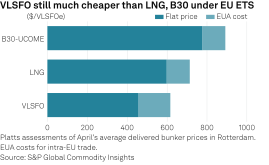
The April average delivered bunker price for 0.5% sulfur fuel oil, or very low sulfur fuel oil, the most common bunker type, was $456.80/mt in Rotterdam, according to the Platts global bunker cost calculator. The price for B30 with 30% used cooking methyl ester was $776.97/mtVLSFOe.
The EU has expanded its Emissions Trading System to cover maritime transportation since 2024, but industry participants suggest the regulatory change alone cannot prompt a switch to sustainable fuels. When the ETS was taken into account, the premium of B30 to VLSFO in Rotterdam for intra-EU trades shrank from $320.17/mtVLSFOe to $275.71/mtVLSFOe -- still a significant level.
"Price is a factor. I think everybody is looking at the most cost-efficient way to comply," Grünwaldt said.
New rules
Brussels has separately introduced the FuelEU Maritime rules at the beginning of this year, which require shipping companies to reduce the life cycle GHG intensity of their marine energy by 2% from 2020 levels until end-2029.
Under the regulatory scheme, conventional vessels would need to burn bioblends with low blending ratios to meet minimum compliance, bioblends with high ratios to generate compliance units that could be banked or sold, or pool with over-compliant ships. But their managers could also buy compliant units from others when opting to burn oil-based fuels.
"FuelEU has been very complicated to start out with," Grünwaldt said. "Eventually, more people will be confident about how to comply; then you will probably see the market getting a little more standardized."
B30 is emerging as the most commonly used bioblend grade, but B2, B5, B10, B24 and all the way to B100 have also been sold in marine fuel trades, according to market participants.
In terms of biocomponents, biodiesel has been the most popular, while hydrotreated vegetable oil is also favored by some. Vitol has used cashew nut shell liquid in co-processed, mass-balanced VLSFO; insurers Gard and Skuld said the waste-based fuel could be of low cost, but it might cause engine issues due to high acidity and the need to be vetted carefully.
"We need to establish very fast if CNSL is a problem or not, because we do see or hear about that being offered in the market," Grünwaldt said.
"Right now, we are very hesitant of buying any CNSL. Hopefully, it can be stamped as a good fuel."
Most analysts still expect biofuels to be among the most popular compliance options in shipping, with their ability to be used on a drop-in basis by conventional ships, which still dominate the global merchant fleet.
"We are still at quite early stages. But I also do think that in the third and fourth quarters, we'll see quite a big percentage hike in bio-products," Grünwaldt said.
The FuelEU compliance is calculated on a yearly basis, and shipping companies can decide whether they want to buy compliance units, pool with others or pay penalties if they have a compliance deficit this year by April 30, 2026.
Consultancy OceanScore has estimated that FuelEU could generate 300,000 mt/year of UCOME demand, which could be boosted further as Brussels tightens the ETS and the International Maritime Organization introduces global GHG standards for marine fuels from 2028.
Tasked with regulating global shipping, member states of the UN agency have voted for a two-tiered system to lower marine energy's GHG intensity in phases to accelerate the energy transition toward net-zero shipping by 2050.
