NGLs, Refined Products, Crude Oil, LPG
May 13, 2026
Trump-Xi summit to focus on fragile truce, energy trade

Editor:
HIGHLIGHTS
Energy trade emerges as easiest bilateral win
Iran conflict and sanctions dominate agenda
May touch China's investment in Venezuela, oil-for-debt arrangement
US President Donald Trump will arrive in Beijing this week for a summit with Chinese President Xi Jinping -- a visit postponed from late March following the eruption of conflict in Iran. While the optics suggest a high-stakes diplomatic moment, expectations remain decidedly modest.
"It's designed to implement and sustain the truce agreed upon last year because I think the focus will be mostly on maintaining this fragile truce between the US and China," Daniel Kritenbrink, partner at The Asia Group, said in a webinar on May 12. "I don't expect to see any major, earth-shattering outcomes from this visit."
Wu Xinbo, executive director of Fudan University's Center for American Studies, expects Trump to continue playing the tariff card, but said Beijing now feels confident confronting the challenge and will not treat it as a major concern.
There are four oil-centric issues that could come up: the future of energy trade between China and the US, the war in Iran, the volatile situation in Venezuela and bilateral sanctions.
Energy trade
Among all these agendas, "increasing US energy product imports will be the easiest win for both countries," said Grace Lee, a senior analyst with S&P Global Energy CERA AltView. Given the low base of China's energy imports from the US, "significant" increases would be easy to achieve, she said, but this would need to come with progress on tariffs for imports to be commercially viable.
"There has been a long gap in US energy shipments to China, and the US would like to see itself resume a role as a major supplier," Jennifer Schuch-Page, managing principal with The Asia Group, said at the same webinar.
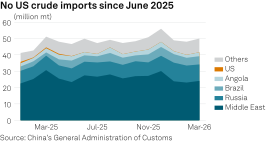
Beijing currently imposes 20% and 25% import tariffs on US crude and LNG, respectively. There have been no US crude oil or LNG imports for close to a year, even amid a supply disruption from the Middle East, according to Chinese customs data.
China's LPG Imports from the US declined sharply by 57.2% year over year to 1.75 million metric tons in the first quarter of 2026. Imports have been falling since April of last year because of the tariffs, which currently stand at 10%.
Ethane imports remained stable, as they are exempt from tariffs, since the ethane-to-ethylene plants along China's coast are fully dependent on US feedstocks.
Iran
"This summit is taking place against the backdrop of the ongoing Iran war. It's somewhat unusual," Kritenbrink said. "We will have to look carefully after the meetings to see what role Iran will play in the discussions. What demands might the US place on China regarding Iran?"
Iran will be a key topic at the summit as the conflict has led to an unprecedented global energy crisis, and China has also been affected, a Beijing-based senior official with a state-run oil company said, though China's energy resilience has helped it better absorb the shock.
China's crude imports dropped 20% year over year to a 45-month low of 9.4 million barrels/day in April amid supply disruptions in the Middle East.
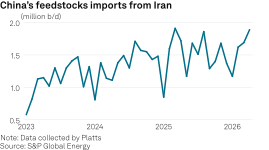
China is also the top buyer of Iranian crude. Its imports reached a 13-month high of 1.89 million b/d in April as the US issued a 30-day waiver -- known as License U -- allowing the purchase of Iranian oil and petroleum products at sea.
China is expected to receive some Iranian crude in May, though market sources expect the volume to be low due to a US blockade on Iranian vessels transiting the Strait of Hormuz.
However, as of May 12, there were still 63.51 million barrels of Iranian crude and condensate on waters outside the strait, according to S&P Global Commodities at Sea data. This includes moving cargoes and floating storage in Southeast Asian waters. This is equivalent to 40 days of imports based on average 2026 import of 1.57 million b/d, according to calculations by Platts, part of S&P Global Energy.
Sanctions
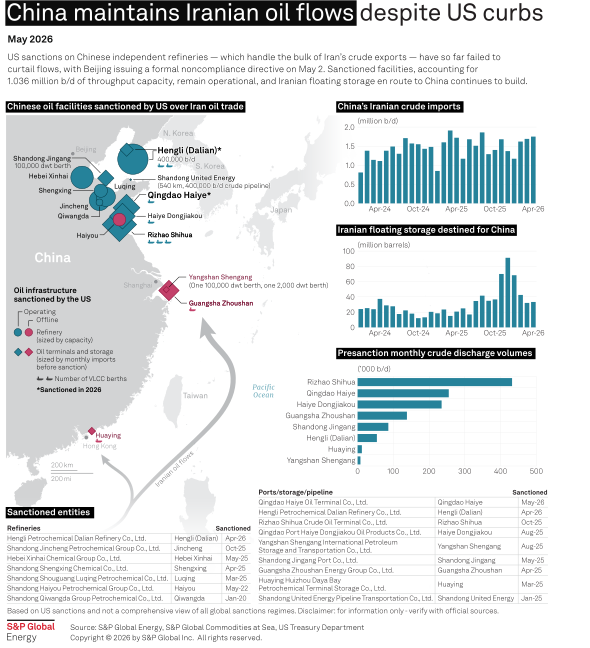
The US recently extended secondary sanctions to China's second-largest refinery and a key crude terminal in Shandong province over Iranian oil trades, while Beijing issued a formal non-compliance directive on May 2, Platts reported.
Even though five of the seven sanctioned refineries, all the sanctioned terminals in Shandong, and the pipeline in the same province remain operational, these sanctioned entities face banking difficulties due to banks' exposure to the US financial system, according to market sources.
Beijing opposes US sanctions, but "removing the Chinese entities from the sanctions list is unlikely to achieve because sanctions are linked to the Iranian nuclear issue and will remain until that issue is settled," the Beijing-based senior official said.
Venezuela
China's investment in Venezuela and the oil-for-debt arrangement may be included in the talks, Professor Wu from China's Fudan University told Platts.
"More broadly, Beijing is increasingly concerned about how to protect its overseas economic interests in the face of mounting US pressure," he said.
Lee from CERA said there is unlikely to be any major breakthrough over Venezuela "due to sharp political differences for now, though both sides could settle for a limited compromise to preserve stability."
China has significant investments in Venezuela, spanning the oil industry and other infrastructure, with an outstanding balance of $10 billion-$12 billion under the government-to-government oil-for-debt arrangement.
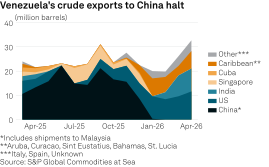
Due to oil-linked investments and loans, China was the top buyer of Venezuelan crude, mainly imported by the independent refining sector, before the US adjusted sanctions on Venezuela's oil sector in January, including a ban on the use of swaps as payment terms, threatening billions of dollars in loan reimbursements.
Venezuelan crude inflows to China dropped to 130,000 metric tons in April and possibly to zero in May, from as high as 2.72 million mt in July 2025, according data collected by Platts.
