Crude Oil, Maritime & Shipping, Wet Freight
May 11, 2026
G7 tankers help Russia lift April crude exports amid soft sanctions enforcement

By Max Lin
Editor:
HIGHLIGHTS
Nearly 30% of Russia's April exports on G7 tankers
Greek operators boost exports to 687,000 b/d
US issues new waiver amid Iran supply disruption
Russia managed to use G7-linked tankers to raise crude exports in April as Western authorities signaled softer sanctions enforcement amid a looming oil supply shortage.
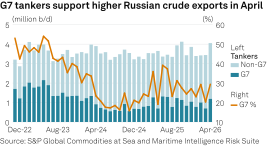
Tankers flagged, owned or operated by companies based in G7 countries and their allies, or insured by Western protection and indemnity clubs, lifted 29.4% of Russia's crude exports of 4.1 million barrels/day in April, according to data from S&P Global Commodities at Sea and Maritime Intelligence Risk Suite.
Comparatively, the share of G7-linked tankers lifting Russian barrels in March was 20.3% of around 3.4 million b/d exported, showing most of the incremental volume was lifted by tankers with access to Western maritime services. The G7 share in April was the highest in seven months as total Russian exports hit a six-month high.
The proposed ban, which had been in discussions for some months, reportedly faced opposition from some member states, including Greece -- Europe's largest ship owning country.
Greek tanker operators lifted nearly 687,000 b/d of Russian crude in April, rising from 379,000 b/d in March to reach the highest volume since October 2025, according to the CAS and MIRS data.
Platts, part of S&P Global Energy, assessed freight for a Suezmax tanker transporting 140,000 metric tons of Russian crude from Novorossiisk to West Coast India above $120/mt for much of April. The assessment stood at $78.57/mt on May 8, still higher than $50/mt at the beginning of 2026.
Another waiver
Brussels has instead prepared "the basis for" a future ban that would cover both crude and petroleum products, which, if enforced, would replace the price cap regime and be conducted in "full coordination" with G7 member states, according to an EU statement.
Maritime services companies can participate in Russian seaborne oil shipments if the barrels are sold at below certain thresholds. Currently, the EU, UK and Canada set the threshold at $44.10/barrel, Japan at $47.60/b, and the US at $60/b.
The monthly average price for Urals, Russia's flagship crude, jumped from $39.169/b in February to $71.254/b in March before a further hike to $90.4/b in April, according to Platts assessments.
But the US, whose sanctions are most effective among G7 members due to the dollar's dominant currency status, has been issuing sanctions waivers for Russian trades in recent months amid dwindling oil supplies from the Persian Gulf.
Following US and Israeli air strikes on Feb. 28, Iran has taken control of the Strait of Hormuz, which handles 20% of global oil trades in normal times, and has only provided access to its own tankers and a small number of ships.
The US Department of the Treasury authorized on April 17 the delivery and sale of Russian crude and petroleum products loaded on ships until May 16, including sanctioned tankers. The exemption came after similar waivers expired earlier in April.
Russia has retained access to a large size of non-G7 fleet, most of which are shadow tankers that could be used to circumvent Western sanctions, should supply worries ease and political winds change.
Shadow fleet operators have been acquiring more aged ships since late 2025, boosting secondhand prices and market liquidity, according to some market participants. Xclusiv Shipbrokers recorded 130 secondhand transactions for tankers aged 15 years or more in January-March.
"[This reflects] active portfolio reshuffling at the larger end of the fleet where shadow fleet buyers have been particularly visible," the brokerage's research analyst, Dimitris Roumeliotis, said.
