Maritime & Shipping, Wet Freight
May 09, 2025
EU navy urges ‘maximum vigilance’ among shipowners despite US-Houthi truce
HIGHLIGHTS
Truce only appears to cover US vessels
Shipping companies remain cautious
Freight little changed following announced truce
Shippers should remain vigilant when transiting the Bab al-Mandab strait, despite the recently announced truce in hostilities between the US and Yemen's Houthis, the commander of the EU's naval force in the region said May 9.
Recent discussions facilitated by Oman between the US and Yemen's Houthis have led to the announcement of an informal ceasefire aimed at de-escalation. According to public statements, this understanding includes a halt in mutual attacks, notably covering US vessels in key maritime corridors such as the Red Sea and Bab al-Mandab strait.
However, this declaration requires careful verification by all relevant actors, Rear Admiral Vasileios Gryparis, commander of Operation Aspides, told Platts, part of S&P Global Energy. "Given that the Houthis have explicitly excluded Israel from this arrangement and have continued hostilities in that context, the maritime threat picture remains volatile," he said.
"The maritime community is strongly advised to maintain maximum vigilance," Gryparis said.
Many shipping companies, including container line A.P. Moller-Maersk, remain skeptical about whether the ceasefire will enhance maritime safety in the region.
Houthis announced another attack on a US aircraft carrier via the social media platform X on May 7, a day after US President Donald Trump announced the truce, although it was not clear when the incident actually occurred.
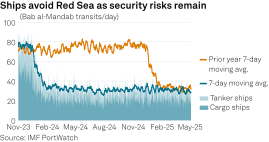
The latest IMF PortWatch data showed that average daily ship transits via the Bab al-Mandab Strait at the southern tip of the Red Sea were 29 in the week ended May 4, compared with a normal level of more than 70.
Shipping freight rates have shown little reaction. Platts assessed the rate to carry a 40,000-mt cargo of clean products on a Medium Range tanker from the Persian Gulf to the UK-Continent at $51.25/mt on May 9, unchanged from the start of the month.
At this early stage, it remains premature to make any definitive assessment regarding the ceasefire's durability or operational impact, Gryparis said.
The fact that the agreement only appears to cover US ships makes it "very curious," Richard Nephew, senior program director at the Center on Global Energy Policy at Columbia University and a former sanctions policy coordinator at the US Department of State, told Platts. As such, it does not guarantee freedom of navigation for any ship not under a US flag, meaning that other ships could be attacked, especially Israeli ones, for which the Houthis have a very expansive definition, he said.

Editor: