Energy Transition, Refined Products, Maritime & Shipping, Emissions, Fuel Oil, Bunker Fuel
April 21, 2026
Growing push for revisions adds uncertainty to IMO green bunker rules

By Max Lin
Editor:
HIGHLIGHTS
Net-Zero Framework in balance as support fragments
US wants to scrap landmark regulation altogether
UN agency's member states hold two-week talks
A growing number of countries are seeking to revise the International Maritime Organization's Net-Zero Framework during the latest round of negotiations, but critics said changing the previously approved rules will lead to further delays or put the regulation in jeopardy.
Following technical meetings in London over April 20-24, the UN agency's member states are scheduled to hold the 84th session of the Marine Environment Protection Committee over April 27-May 1 to discuss the rules framework for decarbonizing marine energy.
The framework, designed to place a cost on lifecycle greenhouse gas emissions from marine energy use from 2028, was first hammered through in a 63-16 vote in April 2025.
But opponents successfully prevented the regulation's adoption last October by winning a vote, 57-49, to delay the negotiation by a year.
Below are the current positions of some IMO member states towards the NZF, based on their submissions and public statements:
US: The fiercest opponent since Donald Trump's return to the White House in January 2025. Wants the framework to be scrapped, and against financial costs in GHG, restrictions on fuel types and regional carbon rules in any future emission regulation.
Algeria, Bahrain, Iraq, Kuwait, Russian Federation, Saudi Arabia, Somalia and UAE: Have opposed the framework in its existing form with the US. Calling for an alternative, consensus-based, technology-neutral framework without centrally set carbon prices.
Argentina, Liberia and Panama: Oppose establishing an IMO Net Zero Fund and instead propose a market-responsive fuel intensity system without revenue collection, and call for different decarbonization requirements from the current design. Panama, a top flag state, previously voted for the framework a year ago.
Japan: Suggests options to remove compulsory fund payments or revise decarbonization targets to make the framework more flexible and acceptable. Japan voted for the regulation in April 2025.
Brazil, Fiji, Kiribati, Nauru, Palau, Solomon Islands, Tuvalu, Vanuatu, Mexico and Solomon Islands: Support the adoption of NFZ in its current form or with minor amendments.
Greece: The EU's top shipowning nation is also one of the few dissenting voices in the bloc. The Greek government and the Union of Greek Shipowners said the framework needs to be revised for IMO member states to form consensus.
Industry concerns
A GHG cost could be essential to incentivize a low-carbon bunker transition, many shipping professionals have said, even as the competitiveness of conventional, oil-based fuels has eroded due to the Hormuz shipping crisis.
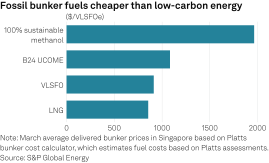
The monthly average delivered bunker price for very low sulfur fuel oil was $913.32/metric ton in Singapore last month, compared with $855.41/mt of VLSFO equivalent for LNG, $1,083.05/mtVLSFOe for B24 biobunker fuel with 24% used cooking oil methyl ester, and $1,964.19/mtVLSFOe for 100% sustainable methanol, according to the Platts bunker cost calculator.
Several environmentalist groups and think tanks said reopening negotiations over the NZF could derail the IMO's progress towards achieving its goals of cutting shipping GHG emissions by 20%-30% by 2030 and 70%-80% by 2040 from 2008 levels, before reaching net zero close to 2050.
"The IMO Net-Zero Framework is the product of decades of painstaking negotiations, scientific work and hard-won compromise," said Jamie Yates, climate and renewable energy manager at nonprofit Pacific Environment, adding that the regulation remains the clearest, most workable path to reaching decarbonization targets.
Changing the framework to win support from the US and other opposing member states might fail to promote the uptake of sustainable marine fuels while facing resistance from countries with higher decarbonization ambitions, according to a UCL Energy Institute study.
Dominik Schneiter, CEO of WinGD, one of the largest marine engine makers, said a GHG pricing element would be crucial to the IMO regulation for member states to meet their climate goals.
"Without robust, effective incentives to drive this transition, we allow our industry to further endanger the climate and the planet," Schneiter said in a LinkedIn post.
Without directly commenting on whether the NZF should be revised, some of the world's largest shipping industry associations issued a joint statement supporting the IMO in pursuing an effective global regulation to decarbonize shipping.
"The industry remains unified in its commitment to the value and effectiveness of the IMO as the global regulator for international shipping," BIMCO, Cruise Lines International Association, Intercargo, Interferry, International Chamber of Shipping, Intertanko and the World Shipping Council said.
"The IMO requirements should provide the global regulatory certainty that the maritime industry urgently needs and send sufficient signals to energy producers to accelerate production and supply."
