Crude Oil, Refined Products
April 16, 2026
US expands Iran blockade scope as initial enforcement proves largely effective

By Max Lin
Editor:
HIGHLIGHTS
All sanctioned ships would be targeted globally
US Navy turns back 14 ships within 72 hours
Focus on ships with Iranian crude in Southeast Asian waters
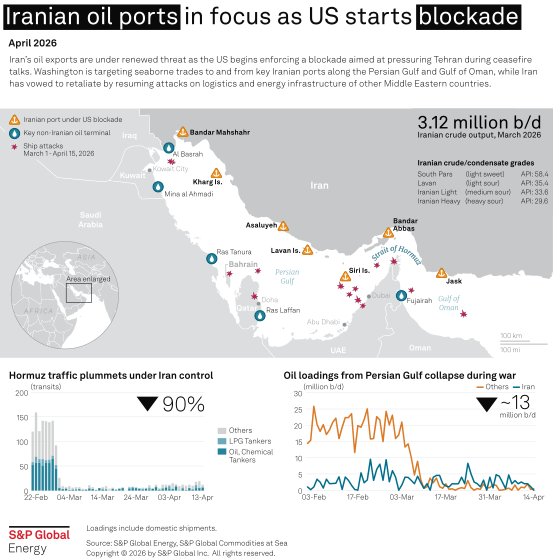
The US Navy has expanded the scope of its blockade on Iranian seaborne trades to cover all sanctioned ships, as vessel-tracking data shows Washington's initial enforcement is largely effective in controlling maritime traffic through the Strait of Hormuz.
In a notice dated April 16, the US Naval Forces Central Command said all ships linked to Iran and listed by the Office of Foreign Asset Control could now be seized "regardless of location" as part of the blockade.
Also targeted are ships carrying contraband goods to Iran, including crude, refined products, iron, steel, aluminum, energy equipment, weapons and others "at any place beyond neutral territory," according to the notice.
After the weekend peace talks between the US and Iran collapsed, CENTCOM has enforced a naval blockade of all Iranian ports and coastal areas since 1400 GMT April 13 and turned back 14 ships in the Gulf of Oman and the Arabian Sea within 72 hours, it said.
S&P Global Commodities at Sea data shows all 20 ships that transited through Hormuz between April 13 and April 15 remained west of, or within, the Gulf of Oman; of them, some made a U-turn when sailing westwards.
Eight ships crossed the Strait of Hormuz on April 15, compared with 18 transits a day earlier, according to CAS. "The decline in crossings suggests the US blockade on maritime traffic entering and exiting Iranian ports ... is largely holding," CAS analysts said in a note April 16.
CENTCOM has stated ships sailing to and from non-Iranian locations would not be targeted, as well as those deemed carrying humanitarian goods to Iran. It has declined to comment on whether there would be any enforcement within the Persian Gulf.
The US-sanctioned small gas carrier G Summer and VLCC Hong Lu, and the non-sanctioned Agios Fanourios I, transited Hormuz to enter the Persian Gulf on April 15, according to CAS.
Wider scope
Dan Caine, the chairman of the Joint Chiefs of Staff, said US forces could now pursue sanctioned tankers laden with Iranian oil as far as the Pacific Ocean following the expansion of the blockade.
The "Joint Force, through operations and activities in other areas of responsibility, like the Pacific area ... will actively pursue any Iranian-flagged vessel, or any vessel attempting to provide material support to Iran," General Caine said in a press conference. "This includes dark fleet vessels carrying Iranian oil."
Following US and Israeli strikes on Feb. 28, Iran took control of Hormuz -- a key chokepoint handling 20% of global oil trades -- and restrained exports of all Gulf states except its own. CAS data showed Iranian crude and condensate exports reached 2.26 million barrels/day in February and 1.50 million b/d in March, compared with a 2025 average of 1.68 million b/d.
Iranian exporters would frequently utilize offshore transshipments in Southeast Asian waters before transporting their cargo to China. As of the end of March, about 39.6 million barrels of Iranian crude and condensate were floated for more than seven days off the Strait of Malacca, all of which on sanctioned ships, according to CAS.
