


Crude Oil, NGLs
April 10, 2026
Iranian oil boosts SE Asian floating storage; China draws down Far East stocks
Editor:
HIGHLIGHTS
SE Asia's floating crude nears 50 mil barrels: CAS
Chinese teapot refiners' Iranian oil imports hit 7-month high
US sanctions relief increases cargo flows
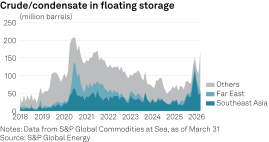
Buoyant Iranian exports led to increased volumes of crude and condensate in floating storage off Southeast Asian coasts in March, while significant drawdowns were recorded in Far East waters due to higher discharge activity at Chinese terminals, amid US sanctions relief.
Iran has emerged as the sole Middle Eastern producer maintaining exports through the Strait of Hormuz during its conflict with the US. S&P Global Commodities at Sea data show that Iranian exports reached 2.26 million barrels/day in February and 1.50 million b/d in March, compared with a 2025 average of 1.68 million b/d.
As of the end of March, about 49.6 million barrels of crude and condensate were floating for more than seven days off the Strait of Malacca, with 39.6 million barrels of Iranian origin, according to CAS. This compares with 45.2 million barrels a month earlier, when Iranian-origin volumes totaled 31 million barrels, CAS data show.
The increase follows a reduction in floating storage in the Far East, mainly off China's east coast, to 4.7 million barrels in March from 25.4 million barrels in February, due to a rise in cargo offloading into China's independent refining system, coinciding with a seven-month high in imports of Iranian crude.
China demand
Chinese independent refineries imported 7.16 million metric tons of Iranian crude in March, up from 6.19 million mt in February, according to data compiled by Platts. Russian crude imports rose in March to 6.36 million mt from 6.19 million mt in February, while Venezuelan crude imports almost halved month over month to 1.06 million mt.
The renewed accumulation of Iranian crude at anchorages near the Malaysia-Singapore Strait occurred following the start of the war in the Middle East on Feb. 28 that disrupted regular trade flows through the Strait of Hormuz.
Despite importing more Iranian and Russian crude in March, total imports by Chinese independent refiners fell 1.4% month over month to about 18.27 million mt, or 4.32 million b/d, as regular Middle Eastern supply was disrupted, data compiled by Platts show.
To boost oil supplies to global markets amid the war, the US issued a temporary waiver permitting Russian oil already loaded on vessels as of March 12 to be sold and delivered through April 11. Additionally, it lifted sanctions on Iranian barrels loaded before March 20 for 30 days.
The measures have expanded the buyer pool for previously discounted cargoes. Total Iranian crude and condensate liftings -- including those designated for domestic shipments but potentially destined for overseas buyers -- reached 2.81 million b/d in February and 2.57 million b/d in March, according to CAS.
The price of Russian ESPO Blend for May arrival was reported at a $10/b premium to ICE Brent futures on a DES Shandong basis, with differentials rising throughout March, according to Shandong-based market sources. In contrast, March-arrival ESPO cargoes in China were traded at discounts of $7-$8/b to Brent during January to early February, the market sources said, noting limited offers.
On April 8, Iranian Light crude was offered at a premium of $1-$2/b over ICE Brent futures on a DES Shandong basis for April delivery, while Iranian Heavy was offered at a discount of about $2/b to the same basis, unchanged from April 7, according to Shandong-based market sources. The sources cited an absence of offers for May arrival.
