Crude Oil, Refined Products, Maritime & Shipping
March 18, 2026
Trump administration suspends Jones Act for 60 days amid Iran war

HIGHLIGHTS
Waiver aims to combat rising energy prices
Foreign vessels can now serve US ports
The US government has issued a 60-day waiver of the Jones Act, a White House official confirmed to Platts, as the Trump administration attempts to combat rising energy prices and trade disruptions in the wake of the US-Israel war on Iran.
"President Trump's decision to issue a 60-day Jones Act waiver is just another step to mitigate the short-term disruptions to the oil market as the US military continues meeting the objectives of Operation Epic Fury," White House Press Secretary Karoline Leavitt said in a statement. "This action will allow vital resources like oil, natural gas, fertilizer, and coal to flow freely to US ports for sixty days, and the Administration remains committed to continuing to strengthen our critical supply chains."
The Jones Act, formally Section 20 of the Merchant Marine Act of 1920, requires that any goods shipped by water between two US ports be carried on ships that are US-built, US-owned, US-flagged and US-crewed. Suspending the law will allow foreign-flagged ships to transport products between US ports.
Jones Act waivers are rare and have typically drawn harsh political pushback from US maritime groups. The last waiver was issued in 2022, when the Biden administration suspended the law for a single BP tanker. The American Maritime Partnership responded that its members were "shocked and outraged."
A limited supply of Jones Act-compliant ships is available to transport crude oil from the US Gulf Coast to coastal refineries in other regions, which typically source imported barrels transported on cheaper, non-US tankers.
The US Gulf Coast regularly exports crude and refined products to international markets.
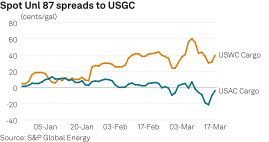
The move is "bearish for US West Coast and US Atlantic Coast refined product cracks, and effectively increases the available tanker fleet, reducing transportation bottlenecks," S&P Global Energy CERA analysts James Bambino and Richard Joswick wrote March 12, after Platts, part of S&P Global Energy, first confirmed the Trump administration was deliberating Jones Act waivers.
"This action will effectively cap USEC and USWC product prices at USGC levels plus freight on international-flagged vessels," the analysts said on March 12. "It will not push prices below USGC parity, but will merely keep coastal prices from excessively surging if imports become tight."
Trade flows, surging prices
The Jones Act, originally designed to promote US shipbuilding, has long made most refined product bookings to domestic ports from tankers originating on the USGC economically unviable.
Most Jones Act-compliant flows of fuel products currently supply Florida, which has no refineries and does not connect to the large Colonial or Products pipelines that supply much of the East Coast, according to a March 16 CERA Crisis Market Impact report.
"There is ample tanker capacity in the region that could rapidly be deployed to move refined products to the US East and West Coasts in the case of an imminent Jones Act waiver," the analysts wrote.
The benefits of the suspension could especially affect the US West Coast market, analysts found. Pipeline capacity to transport fuel from the USGC is limited, and the USWC's imports are sourced nearly exclusively from Asia.
The recent closures of two California refineries are projected to increase reliance on Asian imports. South Korea, which supplies 80%-90% of the USWC's jet fuel imports, receives roughly 80% of its crude from the Middle East.
On March 13, the South Korean government announced it would cap exports of some refined products to ensure a stable domestic supply.
Still, market sources remained uncertain about how much the policy move could impact US flows and energy prices in the short term. One trading source told Platts that the waiver "should make it easier to get CBOB and RBOB out of the Gulf," rather than transiting to the Borco Oil Terminal Port in the Bahamas first. Another said freight rates to the East Coast would remain "just too high" versus pipeline transit.
"This is not a supply crisis," one source with experience in Jones Act fuel shipments told Platts. "It is a pricing crisis created by crude price increases following reduction of export out of the Gulf. Hard to see how this will have any impact on prices paid at the pump."
Crude futures rallied in early March 18 New York trading in the wake of an attack on Iran's South Pars gas field. At 1410 GMT, NYMEX April West Texas Intermediate crude had risen $2.11/barrel at $98.32/b, with ICE May Brent trading $5.19/b higher at $108.61/b, up nearly 50% from Feb. 27, one day before the first US and Israeli attacks on Iran.
Shipping traffic through the vital Strait of Hormuz has remained effectively stopped amid the conflict. Traffic through the Strait -- through which over 20 million barrels/day of crude and petroleum products typically flow -- remained at a crawl on March 16, according to S&P Global Commodities at Sea data.
The Trump administration, alongside the International Energy Agency, agreed to release roughly 400 million barrels of crude and fuel products from strategic reserves.
According to a March 16 CERA analysis, those releases can mitigate "some pain in April and May, but only if the conflict is short-lived."
"The aggregate release volume is significant and does provide a material supply buffer to the system in the short-term, but as long as Hormuz remains shut, it will remain a race against the clock," the analysts wrote. "Unless flows resume, more strategic releases may be required to stave off a move into a more destructive demand crisis."
Editor:

Editor: