Crude Oil, Refined Products, Maritime & Shipping
March 12, 2026
US weighing Jones Act suspension to ease energy prices amid Iran war

HIGHLIGHTS
Move aims to lower energy, shipping costs
Decision could ease 172 million barrel SPR release
Unpopular with maritime unions
The US government is weighing a waiver of the Jones Act, a White House spokesperson confirmed on March 12.
In a statement provided to Platts, part of S&P Global Energy, White House Press Secretary Karoline Leavitt said the administration had not finalized any decision.
"In the interest of national defense, the White House is considering waiving the Jones Act for a limited period of time to ensure vital energy products and agricultural necessities are flowing freely to US ports," Leavitt said. "This action has not been finalized."
The Jones Act, formally Section 20 of the Merchant Marine Act of 1920, requires that any goods shipped by water between two US ports be carried on vessels that are US-built, US-owned, US-flagged and US-crewed. A limited supply of Jones Act-compliant vessels is available to transport crude oil from the US Gulf Coast to coastal refineries in other regions, which typically source imported barrels transported on cheaper, non-US tankers.
The US Gulf Coast regularly exports crude and refined products to international markets.
A spokesperson for the US Department of Transportation and the Maritime Administration also confirmed the agencies, which administer Jones Act compliance, were working on the decision.
"USDOT and MARAD are working closely with the White House and the Department of War to ensure America's supply lines remain strong," the Department of Transportation spokesperson said.
The move could facilitate faster, less expensive transport of crude barrels -- particularly the 172 million barrels the Department of Energy announced would be released from the US Strategic Petroleum Reserve in the next 120 days -- and ease domestic flows of gasoline and other refined products.
"It will be used more for gasoline, diesel and gasoline components," a gasoline market source told Platts. "And maybe crude. But the problem is that ocean freight is already sky high, so not sure it will really open up anything."
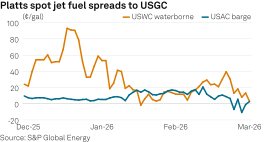
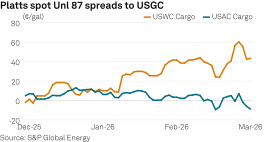
Spot US Gulf Coast Unl 87 prices have been trading at steep discounts to the West Coast, according to Platts data.
If the suspension goes forward, "it is BEARISH for US West Coast and Atlantic Coast refined product cracks, and effectively increases the available tanker fleet, reducing transportation bottlenecks," said S&P Global Energy CERA Analysts. "A typical Jones Act delivery to the USAC from the US Gulf Coast can be around $3-$4/b more expensive than employing a foreign vessel. And on the West Coast, the number of Jones Act vessels is limited, insufficient to fully cover potential losses in imports from Asia."
California is bracing for shortages of gasoline and jet fuel as it transitions from using fuel produced in-state by local refineries to imports to meet regional demand, as Asian exporters have reportedly cut refined products export volumes.
The White House's deliberation comes amid the US and Israel's war against Iran, which has significantly diminished Strait of Hormuz shipping traffic, caused steep increases in crude and gas prices, and disrupted other product supply chains.
On March 10, the American Farm Bureau urged the administration to waive the Jones Act to ensure imports of fertilizer and prevent "disruptions to the food supply chain not seen since 2022."
A White House spokesperson told Platts the administration "can assure that this will not impact American shipbuilding." The Trump administration has prioritized revitalizing the US shipbuilding sector and has proposed a variety of port fees, penalties, and tariffs on foreign-owned and built tankers.
US maritime trade groups, including the American Maritime Partnership, strongly lobby in support of the Jones Act. In 2022, when the Biden administration waived the Jones Act for a single BP tanker, the groups said they were "shocked and outraged."

Editor: