Maritime & Shipping, Refined Products, Wet Freight, Diesel-Gasoil, Gasoline, Jet Fuel
March 05, 2026
China slashes oil product exports to ensure domestic supply: sources
HIGHLIGHTS
All exports halted except bonded fuel, Hong Kong supply
New contracts frozen; existing deals face cancellation
Most March exports get permission to load
Jet fuel exports expected to stop in April, cracks hit high
China has temporarily suspended issuing export permission certificates for refining oil product exports since March 4, as the country's top planner directed refiners and traders to focus on ensuring domestic supply security amid rising concerns over crude oil availability from the Middle East, seven state-owned refinery sources, two analysts and two traders told Platts, part of S&P Global Energy, on March 5.
The export reduction in March is expected to be limited since most cargoes have been granted the certificates, while the outflow for April is expected to decrease significantly, refining and trading sources said, adding that the notice widened cracks in the international market.
It was circulated in the market that the National Development and Reform Commission's Department of Trade verbally directed companies at a March 4 meeting to halt all clean product exports, except for three categories: bonded jet fuel exports, bonded marine fuel exports, and supplies to Hong Kong and Macau. Bonded jet fuel and marine exports are intended for refueling carriers departing from China to overseas destinations.
The top planner required that, starting from March 4, signing new export contracts be suspended, while for contracts already concluded and with shipping schedules arranged, try to negotiate cancellations.
Furthermore, for contracts that have been concluded but do not yet have shipping schedules, it is advised not to export, according to sources with direct knowledge of the matter, who added that the general guideline is to avoid exporting if possible.
Sources who spoke to Platts confirmed NDRC's notice, adding that the requirement is an administrative freeze rather than a formal regulatory change, but it carries significant weight as oral guidance from the NDRC, which oversees China's energy policy.
"We reviewed the group's exports last night due to the notice," a Beijing-based source said.
NDRC and exporting oil firms did not respond to a request for comment from Platts, part of S&P Global Energy.
Within expectation
Despite the sudden instruction, the export cut was within expectations, considering the nation's priority of maintaining domestic supply security. If the war continues to disrupt crude oil flows from the Middle East, Chinese refiners have to cut product exports rather than draw from their abundant crude reserves, Platts reported earlier.
Five of the sources with exporting refiners said the government controls exports by issuing permission certificates for outflow. Only with a permission certificate is a cargo of clean oil products allowed to be loaded for export, they said.
"I usually apply for the permissions well ahead of loading, at the end of the previous month or at the very beginning of the loading month. For example, I have all the certificates in hand for my March-loading now, although some cargoes are to be loaded in the second half of March," one of the refining sources said, adding that they will continue with the loading with the permissions.
A second refinery source said they would cut exports in March but would ensure supply to Hong Kong and Macao, as well as fulfill the term deals with other countries.
A Shanghai-based analyst said the government mandate is a type of force majeure. "Once force majeure is declared, long-term contracts also become nothing but scraps of paper. But I believe refiners would prefer to export to catch the hefty margin," he said.
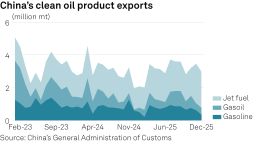
China was previously estimated to export about 490,000 mt of gasoline, 800,000 mt of gasoil and 2.51 million mt of jet fuel in March, including the barrels for bonded refueling. According to a London-based analyst, total clean product exports could fall as low as 2.5 million mt in March.
The country exported 41.41 million mt of clean oil products in 2025, including jet fuel barrels for bonded refueling, according to customs data. The volume averaged to about 3.45 million mt/month.
Cracks hit record high
"April exports will fall to a minimum level unless the supply crisis in the Middle East is eased," a third refining source said, adding that most Chinese oil firms are set to stop exporting jet fuel cargoes, leading to extreme tightness in the market. Jet fuel accounts for the majority of China's clean oil product exports.
The London-based analyst estimated only 1.18 million mt of jet fuel exports in April, almost all for bonded refueling, along with about 120,000 mt of gasoline and 300,000 mt of gasoil.
"Run cuts in Northeast Asia should be inevitable, and exports will likely be discouraged. Cracks are high, but Northeast Asian refineries cannot source feedstock, which will likely lead to cargo buybacks, run cuts, and export controls," said a jet fuel trader based in Northeast Asia.
The benchmark FOB Singapore jet fuel/kerosene outright price was at $231.42/b at the 0830 GMT Asian close on March 4, up $101.19/b, or 77.7%, from $130.23/b the previous day.
This set an all-time high, breaking the previous record of $173.74/b on June 21, 2022, Platts data showed.
Platts assessed the FOB Singapore jet fuel/kerosene cargo crack spread against front-month cash Dubai -- a measure of the product's relative strength to the crude it was refined from -- at $145.07/b on March 4, tripling from $47.88/b the previous day.
