Crude Oil, Maritime & Shipping, Wet Freight
March 02, 2026
Chinese refineries keep runs steady despite Strait of Hormuz closure amid hefty stocks
HIGHLIGHTS
Persian Gulf supplies account for 55% of China's inflows
Onshore crude stocks hit new high of 1.3 bil barrels: Ursa
Throughput, export targets unchanged
Expect no more discounted Iranian crude
Chinese refineries have kept their run rates steady and are expected to continue normal operations if the Strait of Hormuz can be reopened in 10 days, thanks to the hefty feedstock inventories built over the last year, refiners, trade sources, and analysts told Platts, part of S&P Global Energy, on March 2.
Two Beijing-based feedstock management sources at state-run refiners told Platts that they estimate the Strait of Hormuz to be shut for around 10 days. "It will take time to end the conflict. Iran is a big country," said one of the feedstock managers.
"We have some inventories, but if the strait remains closed for more than 10 days, it will be challenging to maintain normal production afterward, since we can't afford to completely deplete our stock," the second feedstock manager said.
Meanwhile, offers of Iranian crude to Chinese independent refineries, the main buyer of such barrels, have been suspended due to supply disruptions after Israel and the US launched air strikes on Iran on Feb. 28, which would raise the price of Russian barrels, private refining and trading sources added.
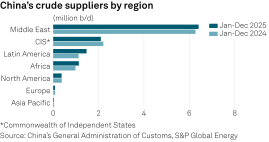
China imported about 6.4 million b/d of crude from the Persian Gulf in 2025, including about 1.5 million b/d of Iranian crude, which accounted for 55.3% of the country's total crude inflows (11.6 million b/d), according to data collected by Platts and Chinese customs data.
"After Iran hit some ships yesterday, no vessels have dared to cross the strait -- not even Chinese ships," said a Singapore-based crude trader with a Chinese state-run firm on March 2.
All refineries in China are required by the government to maintain crude oil inventories equivalent to at least 15 days of their designed daily processing capacity.
Moreover, the country keeps emphasizing energy security and has been building crude inventories with growing storage capacity, a London-based analyst said.
China's onshore storage reached a record high of 1.31 billion barrels in the week to Feb. 26, the first time levels had crossed the 1.3-billion-barrel mark, according to the Ursa Space System. This volume is the equivalent of 113 days of crude imports and 88 days of crude throughput in 2025, according to China's 2025 official data on imports and throughputs.
"The actual inventory level must be higher than the satellite data showed, as there is a massive amount of storage capacity underground," the analyst added.
In addition, three sources with exporting plants told Platts that they kept their clean oil product export targets unchanged as they kept their throughput targets stable.
Iranian crude price to rise
In the independent sector, which sources crude from Iran and Russia, no feedstock offers were available on March 2, amid upward pressure.
"Price increases are certain, but the extent of the rise is uncertain. Iranian oil is becoming increasingly scarce, so it must be sold at a high price," said a Beijing-based analyst with a trading firm.
Seven refining and trading sources in Shandong, home to independent refineries, estimated that no discount will be offered on Iranian crude, reducing its competitiveness against Russian crude.
Prior to the air strikes, Iranian Light was trading at a $10/b discount to ICE Brent Futures on a DES Shandong basis, while Russian ESPO was at a discount of around $8.5-$9/b on the same basis, according to two trade sources.
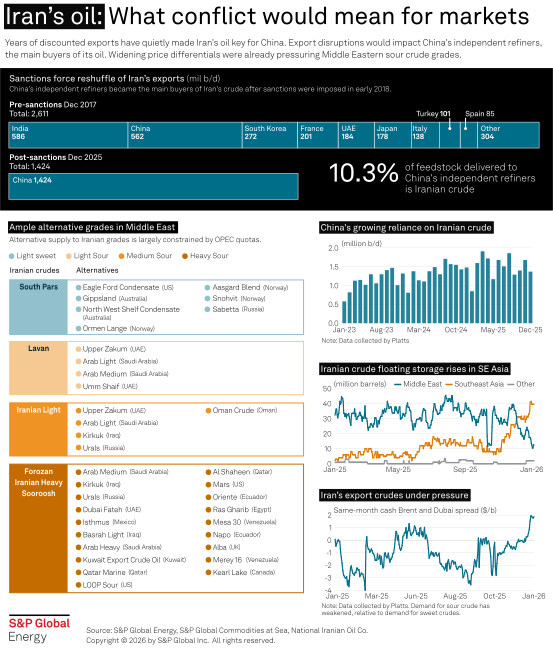
As of March 1, about 31 million barrels of Iranian crude and 16.3 million barrels of unknown crude cargoes were on water in Southeast Asia, according to S&P Global Commodities at Sea.
Some of the unknown cargoes were Iranian crude after ship-to-ship transfers in the region, while almost all the Iranian barrels in Southeast Asia are bound for China's independent sector, according to market sources.
The combination volume of Iranian and unknown barrels declined from the recent high of 75.8 million barrels as of Jan. 18 to about 44.7 million barrels as of March 1, CAS data showed.
Suppliers of Russian crude also suspended their offers, including for ESPO blend, a third trade source in Dongying said, adding that it expected Russian crude prices to increase.
"The Iranian crude buyers will take more Russian crude soon, pushing up the Russian crude price," the trade source said.
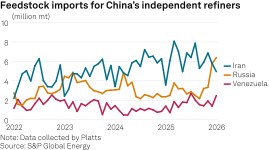
In January, the independent refineries reduced their Iranian crude imports by 14.4% from December to 4.95 million mt (1.17 million b/d), while increasing Russian crude imports by 11.7% month over month to a record high of 6.4 million mt (1.51 million b/d), data collected by Platts showed.
"Generally speaking, the discounted sanctioned crudes will generally become less and less, and the overall feedstock costs will increase for independent refineries," said a refinery source.
All the sources said the independent sector has sufficient feedstock to sustain operations.
Data from local information provider JLC showed that feedstock stocks in Shandong ports, comprising crude and fuel oil, were up 5.4% month over month at 10.76 million mt (78.87 million barrels) as of Feb. 26. In comparison, their monthly throughput stood at about 9.77 million mt (2.31 million b/d) in January.

Editor: