Crude Oil, Maritime & Shipping, Wet Freight
March 01, 2026
FACTBOX: Oil prices rally as US-Israel war with Iran disrupts Hormuz flows
HIGHLIGHTS
Crude vessel traffic nearly halted in Strait of Hormuz
Saudi Arabia's Ras Tanura refinery suspends operations
Global petroleum and tanker prices soared on March 2 as the US-Israel war with Iran continued, disrupting oil flows through the Strait of Hormuz and operations at Saudi Arabia's Ras Tanura refinery.
The Dated Brent benchmark was assessed by Platts, part of S&P Global Energy, at an eight-month high of $77.815/barrel, up $6.875/b from the previous session.
Diesel prices also rallied. A surge in attacks poses new risks to about 10 million-12 million b/d of refining capacity concentrated in the Middle East, which has taken on new prominence for Europe after its pivot away from Russian oil, according to analysts at S&P Global Energy CERA.
Saudi Arabia's largest refinery, the 550,000 b/d Ras Tanura, was forced to suspend its operations after an attack on March 2.
Ship traffic remained nearly halted in the Strait of Hormuz, while eight of the world's largest protection and indemnity clubs are rolling back war risk coverage for ships in the Persian Gulf and Iranian waters due to the war.
The Trump administration will roll out a program designed to "mitigate" against energy price spikes, Secretary of State Marco Rubio said March 2, with Energy Secretary Chris Wright and Treasury Secretary Scott Bessent leading the effort beginning March 3.
That followed news that South Korea said it is prepared to release crude and oil product reserves if needed.
Below are key facts being watched by the Platts news team:
Prices
- NYMEX April crude settled $4.21 higher at $71.23/barrel, and ICE April Brent climbed $4.87 to $72.48/b.
- Platts assessed West Texas Intermediate in Midland, Texas, 35 cents/b stronger at a 65-cent/b premium to cash WTI.
- Western Canadian Select at Nederland, Texas, was heard traded as strong as a $5.80/b discount to the WTI CMA, the strongest since Dec. 24.
- Clayton Seigle, senior fellow at the Center for Strategic and International Studies, warned the oil market could be "sleepwalking into triple-digit oil prices pretty soon."
- The NYMEX ULSD crack spread jumped $8.58 to $50.59/b on March 2 as the war threatened refining operations and pushed freight rates sharply higher, potentially redirecting more US distillate exports toward Europe amid tight Atlantic Coast inventories.
- A potential 1 million b/d supply disruption -- which corresponds to half of Iran's crude exports -- for 12 months would boost the fair value of oil by $8/b, according to Goldman Sachs analysts.
- Geopolitical uncertainty stemming from conflict in the Middle East saw VLCC rates in the Americas spike 14.5% on March 2, although trading activity was slow.

- Ship traffic remained nearly halted in the Strait of Hormuz on the third day of the latest large-scale military conflicts, even after oil loadings were observed at Persian Gulf states.
- Several tankers with Iranian or Western links came under attack in the Persian Gulf and Gulf of Oman on March 1, security and government officials said, as the International Maritime Organization urged shipping companies to avoid the conflict zones.
- Eight of the world's largest protection and indemnity clubs are rolling back war risk coverage for ships in the Persian Gulf and Iranian waters due to the war.
- Danish shipping giant AP Moller-Maersk has suspended sailings through the Strait of Hormuz and paused Trans-Suez sailings via the Bab al-Mandab Strait, forcing its ME11 and MECL services to take the longer Cape of Good Hope route, the company said in a statement.
- Japan's NYK Line and Mitsui O.S.K. Lines, among the world's largest ship operators, have halted all their ships from transiting the Strait of Hormuz amid heightened safety concerns following missile attacks, NYK and MOL spokespeople told Platts on March 1.
- The Trump administration will roll out a program designed to "mitigate" against energy price spikes in the wake of the war, Secretary of State Marco Rubio said March 2.
- The conflict could eventually prompt the US to sell crude from its Strategic Petroleum Reserve, only if there are significant price spikes linked to infrastructure damage or a closure of the Strait of Hormuz, experts said on Feb. 28.
- South Korea is prepared to release crude and oil product reserves if needed, as escalating geopolitical tensions in the Middle East could disrupt crude import logistics for Asia's third-largest crude importer, the Ministry of Trade, Industry and Resources said March 2.
- Japan's second-largest refiner, Idemitsu Kosan, sees Japan as having sufficient petroleum reserves for some time even if the Strait of Hormuz is closed, a company spokesperson told Platts on March 2.
- Thailand's Ministry of Energy ordered on March 1 to suspend all crude and petroleum product exports with immediate effect, noting that the country's oil reserves, including cargoes in transit, are sufficient to cover 60 days of domestic demand.
- The shipping disruption through the Strait of Hormuz has put the spotlight on India's strategic petroleum reserves, which are lower than the IEA's prescribed limit.
- The Philippine government has called an emergency meeting to address potential supply disruptions, while Malaysia's prime minister pledged to take measures to stabilize fuel prices.
- Airspace closure in the UAE, Qatar, Bahrain and Iraq entered a second day on March 1 amid missile attacks from Iran, causing hundreds of flights to be cancelled or delayed.
- The airspace closures have the potential to reduce jet fuel demand in the area "significantly," depending on how long they last, said Dong Wang, senior Middle East oil analyst at S&P Global Energy CERA.
- Eight core OPEC+ producers announced a 206,000 b/d production hike for April on March 1.
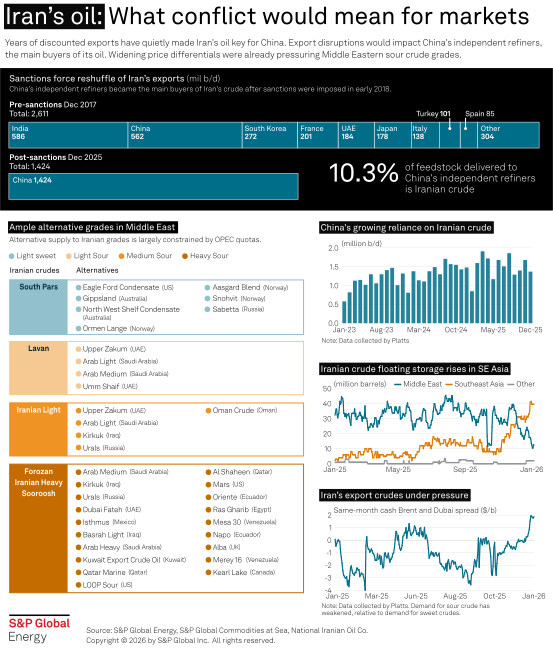
- Iran produced 3.19 million b/d of crude in January, according to the latest OPEC+ survey from Platts. That month, Iran exported 1.3 million b/d, predominantly to China, according to S&P Global Commodities at Sea data.
- In 2025, China's independent refineries raised their Iranian crude imports by 10.3% year over year to 1.5 million b/d, accounting for 35.6% of their feedstock share.
- Similar grades to Iranian crudes include Saudi Arabia's Arab Heavy, Arab Light and Arab Medium; Iraq's Basrah Light, Basrah Medium and Basrah Heavy; Russia's Urals; the UAE's Upper Zakum; Oman Crude Blend; Kuwait Export Crude; Venezuela's Mesa 30 and Merey 16; and Mexico's Maya.
Infrastructure
- Saudi Arabia's Ras Tanura refinery has temporarily halted operations as a precaution after drone debris fell on its site, according to several sources familiar with the matter March 2.
- Iran's oil export terminals at Kharg Island handle most of the country's crude exports, and damage to infrastructure there could significantly impact Iran's ability to generate revenue.
- Iran's Jask oil terminal bypasses the Strait of Hormuz and is connected to a 1,000-km, 42-inch pipeline able to transport heavy and medium crude oil from Goureh in the Bushehr province.
Israeli strikes in June 2025 damaged infrastructure at Iran's biggest gas field, South Pars. The field produced 725 million cubic meters/day late last year, which provided 75% of the country's total national supply.