Crude Oil, Maritime & Shipping, Wet Freight
January 16, 2026
G7 tankers return to Russia on weak Urals despite security worries

By Max Lin
HIGHLIGHTS
Price-capped trades account 32% of Russia's crude exports
Urals prices well below G7 threshold
Greek operators enjoy premiums but fear drone attcls
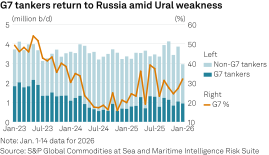
G7 tankers have recovered share in Russia's crude export market in recent weeks, according to ship-tracking data, as a slump in Urals prices provides trade opportunities within the price cap.
Tankers flagged, owned or operated by companies based in G7 countries and their allies, or insured by Western protection and indemnity clubs, lifted 31.9% of Russia's crude exports of 3 million b/d on Jan. 1-14, according to data from S&P Global Commodities at Sea and Maritime Intelligence Risk Suite.
The share was higher than 27.1% in December and 24.4% in November.
Amid tightening Western sanctions and oversupply worries, the price for Urals, Russia's flagship crude, plunged from $52.180/b Nov. 14 on a free-on-board Primorsk basis to $30.690/b Dec. 16 before recovering to $34.435/b Jan. 15, according to Platts assessments.
Platts is part of S&P Global Energy.
Under existing regulations, maritime services companies in the EU, UK and nearly all other G7 countries can participant in Russian seaborne oil shipments if the barrels are sold for no more than $47.6/b. The US set the threshold at $60/b.
The EU and UK have announced their cap will be lowered to $44.1/b from Feb. 1 to further undermine Russia's war chest against Ukraine, but it is not immediately known whether their allies will follow suit.
Security worries
Tanker operators in Greece, Europe's top shipowning nation, loaded 20.6 million barrels of Russian crude in December -- more than all other countries, and up from 12.2 million barrels in November -- according to CAS and MIRS data.
But two Greek tankers were hit by drones near the Russian Black Sea port of Novorossiisk earlier this month. Several tankers damaged by suspected limpet mine explosions last year were also operated by Greek firms.
Ukraine did not comment on the incidents. The ships suffered minor damage, and no casualties or oil spills were reported.
Following the recent attacks, the Union of Greek Shipowners has called on the EU to step in to protect Greek merchant ships that operate lawfully and said targeting such vessels is "completely illogical, unlawful and without political reason".
"Shipping is not a battlefield and it should not be used or targeted as a means of political pressure," the industry body said in an open letter Jan. 16. "Seafarers are civilians ... Shipping should be kept out of fields of geopolitical tension and military confrontation."
Freight and insurance rates for Black Sea trades have risen in recent days following the drone attacks, as shipping companies demand risk premiums due to security concerns.
The Suezmax rate for transporting 140,000 metric tons of Russian crude from Novorossiisk to West Coast India rose to $55.36/mt Jan. 15 from $50/mt Jan. 12, according to Platts. The additional war risk premium for crude increased to $0.95/b from $0.90/b in the same period.
Platts assessed Urals DAP West Coast India at an $8.15/b discount to Dated Brent Jan. 15, the steepest discount since July 2023, as Russian exporters sought to remain competitive amid rising logistics costs.
Non-G7 trade
Sweden and Finland are pushing for an EU-wide maritime services ban on Russian oil, which, if materialized, would prevent Greek companies from trading in Russia regardless of crude prices.
This would theoretically make Russia more reliant on non-G7 tankers, which transported 2.8 million b/d of Russian crude in December and 2 million b/d on Jan. 1-14, compared with 2.6 million b/d in November, according to CAS and MIRS.
Since December, the US has seized six tankers allegedly involved in Venezuelan crude shipments, including one flagged in Russia and another used to transport Russian crude over 2021-2024. German media reported that the Federal Police turned away a shadow fleet tanker in the Black Sea on Jan. 10.
On Jan. 13, Ukrainian President Volodymyr Zelensky said on Telegram that 20% of the shadow fleet tankers had "stopped" due to the country's "coordinated pressure measures" with "some states", without elaborating.
"Russia is trying to compensate for this loss by attracting new vessels," Zelensky said in a Telegram post. "All of them should be added to the sanctions lists."

Editor: