Metals & Mining Theme, Coal, Maritime & Shipping, Agriculture, Non-Ferrous, Dry Freight, Grains, Ferrous
January 02, 2026
DRY BULK QUARTERLY: Dry freight bull run may continue on expected trade growth
By Nicholas Zhang and Jun hao Ng
HIGHLIGHTS
Capesize market to sustain momentum amid increased West Africa output
Expected increase in seaborne grain trade flows may boost Panamax rates
Global dry bulk shipping rates experienced a strong run in the final quarter of 2025, defying the historical trend of seasonally lower freight levels in the fourth quarter when market participants wind down their business activities and trades ahead of the year-end holidays.
Several dry bulk sources expect this momentum to continue in Q1 2026 amid the positive outcome of trade discussions between the US and China in October, which might stimulate increased commodity trade flows.
The Platts Capesize T4 Index, a global ton-mile weighted average index of four Capesize routes, averaged $26,913 per day in Q4, surpassing the average performance of $16,373 per day in Q4 2024, according to S&P Global Energy data.
Similarly, the Platts KMAX9 Index, a global ton-mile weighted average of nine Panamax routes, averaged $15,810/d in Q4, a sharp improvement from $10,221/d across the same period in 2024.
In the Platts APSI 5 Index, a ton-mile weighted average of five Supramax routes in the Asia-Pacific region averaged $10,361/d for Q4 2025, a minor jump from the average of $8,514/d in Q4 2024.
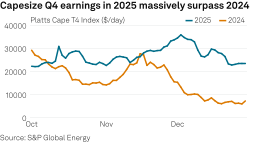
West Africa volumes bolster Capesize outlook
The Capesize market showed the strongest performance in terms of earnings across the various dry bulk shipping segments, with robust iron ore and bauxite trade volumes surpassing general market expectations in Q4, Platts analysis showed.
Most sources held a positive outlook for Q1, despite historical trends of a depressed Capesize market in the first quarter of the calendar year due to the seasonal rainy weather in South America, which in turn results in lower iron ore export output from Brazil.
"Sentiment will be upbeat with more West Africa [cargo] volumes," a shipowner source said, with increased bauxite and iron ore output from West Africa miners and the commencement of Guinea's Simandou project from November 2025 likely to play an instrumental role in preventing Capesize freight rates from falling in Q1 by compensating for the traditionally lower Brazilian iron ore export volume, as weather conditions are drier and more favourable in West Africa during the said period of the year.
According to a commodity analyst with S&P Global Energy, 2025 iron ore production at Guinea's Simandou project is forecast at 1.5 million mt, and this is expected to increase to around 20 million mt in 2026, before reaching around 100 million mt in 2030.
"Earnings volatility might be reduced to a certain extent with higher West Africa bauxite and iron ore volumes," a shipbroker said, indicating that Capesize shipping rates might smoothen out, potentially reducing the massive fluctuations during the peak and low seasons, and in turn, arbitrage opportunities.
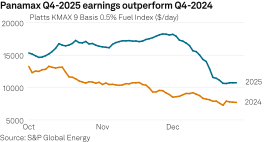
Bullish momentum in Panamax market may continue
Similarly, the Panamax segment mostly observed significant rate gains year over year in Q4 2025 before they started to ease in December, Platts data showed.
According to sources, this performance can be largely attributed to robust Indonesian coal demand and strong grain export volumes from the Pacific Northwest and Australia.
Additionally, the Pacific market witnessed inefficiencies due to adverse weather conditions in the Southeast Asia to South China region, which distorted tonnage supply with greater prevalence and further propped up rates in general, Platts analysis showed.
Market participants in the Panamax segment mostly expressed confidence for Q1 2026, anticipating the positive momentum across most of Q4 2025 to be carried forward into the new year.
"The market has been looking fairly strong for Q4. We should see a firmer Q1 than usual," a ship-operator source said.
Echoing the sentiment, a second shipbroker said: "Sentiment has definitely been bolstered by China's recent buying of US soybeans, and Brazil will begin the harvest and export of new [soybean cargoes] as early as February," making reference to the positive outcome of the trade discussions between China and the US in Q4.
The same source, however, added that some uncertainties linger with regard to Chinese purchases of US soybeans due to the comparatively cheaper cost of Brazilian-origin soybeans.
Nonetheless, market participants in the segment said Panamax rates could benefit from a positive spillover effect if firm rates continue to persist in the Capesize market in Q1 2026, suggesting the possibility of a cape-split phenomenon, where Capesize cargoes might be split into two Panamax stems.
"Panamax [vessels] might be able to compete with Capesize [vessels] for the Australian coal runs," a third shipbroker said, suggesting that Capesize charterers could choose to split their cargoes into Panamax stems if Capesize rates continue to surge, potentially bolstering tonnage demand in the Panamax market.
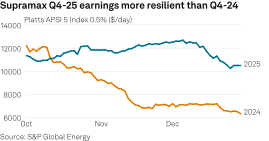
Pre-Lunar New Year demand in Supramax markets
In the Supramax segment, a majority of market participants conveyed a positive outlook for the first quarter of 2026.
"Chinese coal demand is expected to be supported throughout winter," a second ship operator said, adding that January 2026 is likely to continue seeing demand prior to the Lunar New Year.
Holding the same view, a third ship operator said: "[Coal] demand toward China is likely to continue and may cause some spike prior to the Chinese New Year."
Chinese market participants could remain active in mid-January as the Lunar New Year holidays will commence relatively later on Feb. 17, some sources said.
Meanwhile, A ship-chartering source with a commodity trader expressed cautious optimism regarding the outlook for Q1. "There will definitely be some buying before the Lunar New Year, but Q1 as a whole might not necessarily be that good of a quarter," the source said, suggesting that thermal coal demand alone might not be sufficient to support the Supramax market.

Editor: