Refined Products
December 29, 2025
COMMODITIES 2026: Asia, Europe ramp up base oil capacity, US market cautious
HIGHLIGHTS
New Asia/Mideast supply wave tests market balance
Europe distillate economics reshape base oil market
US exercises caution amid global supply shifts
This is part of the COMMODITIES 2026 series, where our reporters bring you key themes that will drive commodities markets in 2026.
The base oil market enters 2026 navigating a complex landscape of shifting demand patterns, evolving regulatory frameworks, and ongoing supply chain adjustments.
New supply wave to test market balance
In 2025, the Asia and Middle East base oil market navigated geopolitical and tariff uncertainties, yet underlying fundamentals continued to steer the direction.
The ExxonMobil Singapore plant expansion, a 2025 highlight, remains on the radar for potential added supplies in the spot market next year. "Supplies are tied up in term deals with key customers and distributors. I doubt any product has reached the spot market," said an Asia-based trader.
Surplus barrels potentially entering the spot market may increase pressure on current supplies, particularly Group I Bright Stock, sources said.
Asia's landscape diverges by country. China faces slowing lubricant demand due to EV growth and industrial consolidation, as it plans to add 400,000 metric tons per year of combined Group II and III capacity at the Taizhou refinery. Meanwhile, India is expanding mineral and semi-synthetic PCMO/HDEO production while adding Group II/III capacity at Koyali and Haldia refineries. "There are a lot of expansion projects in India; import demand will shift a bit," a regional trader shared.
Looking ahead, steady demand is anticipated with a continued focus on Group II and III products.
Asian Group I supply is expected to remain steady with no major planned turnarounds scheduled. Group II will see two key turnarounds: a 1.3 million mt/year South Korean plant in early April and a 625,000 mt/year Taiwanese facility in Q4. In the Group III/III+ segment, a Malaysian refinery is scheduled for mid-year maintenance.
Overall, in 2026, supply growth is anticipated from regional expansions and new plants, while demand is expected to remain modest, resulting in balanced fundamentals and minimal market fluctuations.
European distillate economics reshape market
European base oil markets faced persistent headwinds in Q4 as excess supply conditions met strong distillate economics, forcing producers to adjust their production strategies.
Oversupply conditions persisted across Group I, II, and III grades. Strength in distillate cracks created economic incentives for refiners to pivot away from base oils production.
"We're now seeing refiners maximizing diesel output over base oils production," a Europe-based trader told Platts. "Some light grades of base oil are even being blended into gasoil to capitalize on more favorable economics."
The historically healthy $200/mt margin between diesel and base oils has contracted significantly, sources said. Group III producers, despite their premium positioning, have not been immune to these pressures, with several facilities reportedly reducing run rates to balance supply with tepid demand.
A transformative development for the European Group II landscape isPoland's PKN Orlen's planned capacity addition of 400,000 mt/year at its Gdansk refinery, scheduled to come online in Q1 2026. This expansion could move Europe toward Group II self-sufficiency after years of import dependence.
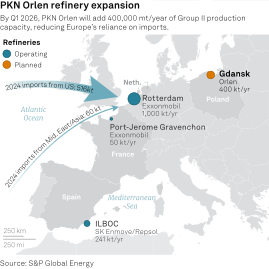
"Given the overall declining demand volume for lubricants within Europe, and the typical formulations used by local blenders, this additional 400,000 mt/year of Group II could bring the region close to self-sufficiency, strongly reducing the need for imports," said Lukasz Andrezj Lemke, principal research analyst at S&P Global Energy CERA.
Term contract buyers remain cautious, lifting only partial volumes as finished lubricant sales underperform. This reflects broader uncertainty about the market's direction as Europe balances immediate production economics against anticipated supply expansion, with ripple effects across all base oil groups, including the premium Group III segment.
US market cautious amid global shifts
Throughout 2025, global Group II supply was buoyed by US production, a trend expected to continue into 2026. A former refinery executive said refiners will keep producing while they believe they can clear excess volumes, but overseas demand for US product faces headwinds as new production sites come online.
As plants in Poland and Singapore begin operations, typical export markets in Europe and India are facing increased competition.
US blenders approach 2026 cautiously, with many preparing since mid-November. "Most deals will dry up in January," the former executive said. "Demand doesn't pick up until March."
"Honestly, if you get to talk to players in a quiet corner, they don't expect 2026 to be any better than 2025. Out on the floor, they'll talk in quarters, but alone they know they have got a couple of rough years ahead," a trader said, anticipating a challenging year for prices, producers, and demand overall.
The global base oil market in 2026 presents both challenges and opportunities. Capacity expansions in Asia and Europe, despite modest demand growth, create potential oversupply concerns, while evolving demand patterns in North America and sustainability initiatives in Europe are reshaping traditional market dynamics.

Editor: