Maritime & Shipping, Refined Products, Wet Freight, Fuel Oil
December 23, 2025
COMMODITIES 2026: Bunker demand to buoy Asia’s HSFO market; ample supply likely to cap major upsides
HIGHLIGHTS
Bunker demand lifts Asia's HSFO growth potential
Buoyed supply flows cap major HSFO price upsides
Hi-5 spread incentivize scrubber uptake
This is part of the COMMODITIES 2026 series, where our reporters bring to you key themes that will drive commodities markets in 2026.
The Asian high sulfur fuel oil market will likely garner some support in 2026, buoyed by persistently higher bunker sales on the back of growing numbers of scrubber-installed ships, but competition with cleaner alternative fuels and ample availability of sanctioned cargoes would continue to weigh on the fundamentals.
As Singapore is seen as a viable downstream resupply hub and a major outlet for HSFO consumption, elevated replenishment cargo arrivals from various origins could sometimes outstrip bunker demand to pressure calendar spreads and cash differentials, even as shipowners' requirements have increased over the years, multiple Asia-based market sources told Platts.
Meanwhile, macroeconomic uncertainties such as tariff-induced volatilities and port dues, upended trade flows, and shipping markets, where the spot bunker demand choppiness could extend into next year, were expected to likely keep injecting inconsistencies in the seasonal trends too, according to the sources.
The world's largest bunkering hub of Singapore has already sold close to 19.948 million mt of HSFO between January and November period, up 8.7% compared with the same period last year, and its proportion of total bunker sales across all grades expanded to average 38.9% from 36.6% Jan-Nov 2024, according to the latest preliminary data from the Maritime Port Authority of Singapore.
But based on the latest HSFO yearly growth rate in 2025, however, it is projected to mark its slowest expansion in recent years, as its year-over-year growth in 2024 hit around 21% and recorded 19.5% in 2023.
The Platts-assessed spot Singapore-delivered 380 CST HSFO bunker premium over the FOB Singapore 380 CST HSFO cargo value averaged $11.62/mt since January through Dec. 22, almost halving from $20.68/mt across 2024.
The Singapore 380 CST HSFO cargo's cash differential over the MOPS 380 CST HSFO assessment has averaged at a premium of $1.69/mt so far in 2025, still holding at positive territory for the yearly average, but down from the 2024 average at a premium of $5.76/mt, Platts data showed.
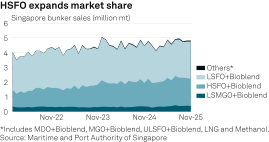
Growth trajectory persists, albeit slower
"Most people I speak with in the market seem to be very bullish for HSFO for next year... They're saying sell me your HSFO and we're very happy to take," said a Singapore-based trader, adding, however, that plentiful supplies of "grey cargoes" tend to dampen the market sentiment.
"HSFO demand will still see an increasing trend... Also, look at the number of ships on the water due to the new additions to the dark fleet... So, partly due to this dark fleet floating on the water, I think overall [bunker] demand will also not drop so much," one veteran Singapore-based fuel oil trader said.
The global scrubber-equipped fleet continues to grow, albeit at a slower pace than recent years, while shipping lines could increasingly return to plying through the Red Sea area if the geopolitical tensions and attacks on ships do not further re-escalate, which could dent a part of the incremental bunker demand that the market has benefited from longer voyages of vessels, avoiding the conflict zones
Ship diversions from the Red Sea have boosted bunker sales in Singapore and African ports in recent quarters at the expense of refueling ports in Egypt, the East Mediterranean and the Middle East, but the demand patterns could be reversed if vessels return to the waterway, Platts reported earlier.
Following China's reduction in fuel oil consumption taxes and higher import taxes at the beginning of 2025, which pressured refining margins among independent refiners relying on straight-run HSFO feedstock, Shandong authorities raised the tax rebates and adjusted import taxes lower in Q3 afterwards, which provided some relief to local refiners and feedstock buying appetite improved thereafter, according to traders.
However, looking ahead, traders expect Chinese feedstock demand to decrease slightly in 2026, amid more competition expected between Middle Eastern heavy and medium crude with sanctioned feedstocks.
Although reselling these straight-run fuel oil barrels to China could lessen supply pressures around the Singapore hub, buoyed inventories continue to limit valuation upswings for the complex, notwithstanding some seasonal strength during the Middle Eastern summer period or short-term turbulence from fresh sanction announcements earlier this year, the trade sources added.
Hi-5 spread continues to attract shippers
Although the spread between Singapore 0.5% sulfur marine fuel oil and benchmark HSFO cargo prices -- the Hi-5 spread -- has been narrowing over the last three years, it was still lucrative for shippers to invest in scrubbers as a Hi-5 spread of nearly $50-$100/mt is typically enough make the economics work as costs of scrubber installations have also reduced sizably compared with the initial phase following the International Maritime Organization 2020 regulations, according to market sources.
The spread has averaged $74.77/mt in 2025 so far, compared with an average of $125.94/mt in 2024, $147.48/mt in 2023, and an average of $261.09/mt in 2022, Platts data showed.
"Last few years, the way we have seen scrubber-installed ships boosting HSFO demand... That trend will still be there, but the uptake would gradually slow down," said a Singapore-based HSFO trader.
Going forward, HSFO bunker sales will not only be contested by the LSFO grades, but they will also have to increasingly compete with the bio-blended materials and sustainable fuels, he added.

Editor: