Refined Products, Diesel-Gasoil
November 07, 2025
US Midwest ULSD benchmark differential posts biggest 1-day gain since fall 2023

By Aaron Tucker
HIGHLIGHTS
Backwardation in NYMEX ULSD futures fuels volatility
Steep inventory draw likely behind differential spike
Lack of demand data exacerbates price movement
The Group 3 X-grade ULSD differential, assessed in Tulsa, Oklahoma, rebounded 14.75 cents/gal during the Nov. 6 session, following a sharp selloff in the prior two sessions, marking the biggest one-day gain since Oct. 19, 2023, Platts pricing data shows.
Market participants cited multiple factors for the swift price action, including strong backwardation in the NYMEX ULSD futures, the closing of the harvest season amid a lack of data due to the US government shutdown, and a sharp draw on inventories in the region.
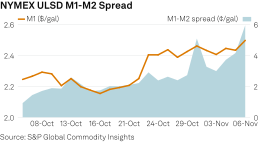
Over the past week, the backwardation in the futures market has intensified, settling at nearly 6 cents/gal between the December Mo1 and January Mo2 contracts Nov. 6. Platts data shows the Mo1-Mo2 backwardation was below 2 cents/gal as recently as Oct. 16, but from Nov. 3 to Nov. 6, the spread widened from 2.98 cents/gal to 5.94 cents/gal.
"The backwardation in the market has been causing this insane volatility because no one wants to hold too many barrels," a Midwest distillates trader said. "Whenever guys realize they are going to be short, it causes this whiplash we are seeing."
"Evidently, the harvest is done," said a refined products broker on Nov. 5 following the selloff.
However, at the outset of the Nov. 6 trading session, a bid was heard at an 8-cent/gal discount, and prior to the Platts Market on Close assessment process, the differential was bid up to a 4-cent/gal discount. There were four trades shortly after the MOC began at progressively stronger levels, and a couple of bids moved higher throughout the MOC. Eventually, two trades were completed at a 2.75-cent/gal premium before the close, where Platts settled the assessment.
A few X-grade 10th-of-the-month positions were also observed during the MOC, marking the first use of this instrument since July 2022. One offer was observed for November and two for December. The November 10th offer was flat to the prompt ULSD futures contract, while the December offer was 27 cents below it, suggesting that a sharp decline in the physical market could occur over the next four to five weeks.
Additionally, the latest December Group 3 ULSD swap was traded at a 30-cent/gal discount to New York Harbor ULSD futures, further supporting the expectation of a stronger selloff ahead.
The sharp move is likely driven by the absence of the US Department of Agriculture Crop Progress Report, which has been suspended due to the US government shutdown.
Midwest diesel traders, schedulers and end-users closely monitor this data, as the spring and fall harvest seasons significantly influence diesel demand in the region. Farmers require diesel to run tractors, combines and other heavy equipment needed for crop planting and harvesting.
Furthermore, in the Midwest, the Chicago Buckeye Complex traded twice at a 1-cent/gal discount, while Chicago Badger traded at a 3.25-cent/gal discount during the MOC. Platts called the assessments at their respective traded levels.
Inventory draw
After remaining below the preceding five-year average for most of 2025, nationwide diesel inventories rallied toward historical averages in early September, primarily due to a sharp increase in Midwest inventories around the same time, before the harvest began, according to weekly data from the Energy Information Administration.
However, from Sept. 24 to Oct. 29, ULSD inventories in the Midwest fell from 30.6 million barrels -- 1 million barrels above the historical five-year average -- to 23 million barrels, which is 2.9 million barrels below the five-year average and outside the previous five-year inventory range.
Multiple market participants expressed surprise at the latest EIA data, noting that the region could face a diesel shortage depending on how much longer the harvest continues. However, there are currently no reliable data indicators available due to the government shutdown.

Editor: