


Chemicals, Refined Products
November 07, 2025
South Korea's refining sector calls for realistic emission targets to stay competitive
HIGHLIGHTS
Government suggests “50-60%” or "53-60% cut compared to 2018 levels
Proposed targets exceed the 48% limit claimed by industries: KCCI
Refiners aim to maintain leading position in Asia oil products market
South Korea's industrial sector, particularly the petroleum refining and petrochemical industries, is urging the government to establish realistic 2035 National Greenhouse Gas Reduction Targets (NDC) to maintain competitiveness in their markets.
Eight industry associations, including the Korea Petroleum Association (KPA) and the Korea Chemical Industry Association (KCIA), submitted a joint letter to the government, expressing concerns that the current proposals from the Ministry of Climate and Energy could impose significant burdens on the sector's competitiveness, according to a statement from the Korea Chamber of Commerce and Industry (KCCI) on Nov. 6.
The Ministry of Climate, Energy and Environment held a public hearing on the 2035 NDC targets at the National Assembly Hall on Nov. 6. It revealed two options of either a "50-60% reduction" or a "53-60% reduction" compared to 2018 levels, according to the government's official policy briefing statement.
The two proposed reduction ranges are higher than the 48% that the industries have claimed to be the limit, according to the KCCI.
The KPA and KCIA highlighted that the proposed reduction scenarios for the 2035 NDC do not adequately reflect the current economic realities faced by the industry. The sector is grappling with challenges such as oversupply from China, rising tariffs from major economies, and prolonged domestic economic stagnation, KCCI said in the statement.
"The industrial representatives stressed the importance of establishing NDC targets that consider both national interests and the competitiveness of the industrial sector," KCCI said.
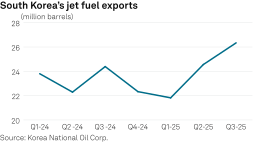
South Korea is Asia's leading supplier and exporter of clean oil products, including gasoline, jet fuel, and diesel, with oil products consistently ranking among the nation's top five export categories annually, Platts reported previously.
"Commitment to greener operations and emissions reduction is crucial, but refiners cannot afford to sacrifice too much of their overall margins; otherwise, the South Korean refining industry risks losing its leading position in Asia's oil products market," said a sales trading manager at a major South Korean refiner operating in Singapore during a market discussion with Platts.
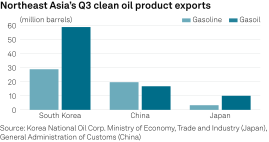
In the third quarter, South Korea exported 28.82 million barrels of gasoline, while China sold 19.64 million barrels externally and Japan shipped 3.3 million barrels, according to the latest data from the Korea National Oil Corp., Japan's Ministry of Economy, Trade and Industry, and China's General Administration of Customs.
As for gasoil, South Korea supplied 58.77 million barrels to international markets over July-September, compared to China's 16.75 million barrels and Japan's 10 million barrels of exports during the period, the KNOC, METI and GAC data showed.
Among the reduction scenarios and target ranges proposed by the Ministry of Climate and Energy, industry representatives expressed concerns regarding the lack of specific measures and justifications for achieving reductions beyond the suggested 48% target, according to the KCCI statement.
"Clear guidelines on sector-specific and industry-specific reduction amounts are essential for effective implementation," KCCI said.
Government support
KCCI indicated that the associations are actively seeking supportive measures, including government financial aid, the creation of low-carbon product markets, and the establishment of zero-carbon energy infrastructure, to facilitate the transition toward lower emissions.
As a response, the Ministry of Trade, Industry and Energy will provide Won 297.3 billion ($209.49 million) in loan support for 16 new projects that invest in facilities and research and development (R&D) for carbon reduction over the next three years, MOTIE said in a statement Nov. 7.
"This is expected to lead to a total of Won 963 billion ($679 million) in new private investment," MOTIE said.
Following the selection of nine projects in the first round in the first half of the year, an additional 16 projects were selected through a second announcement and review starting in August, with loans set to be officially offered from this month at 14 major banks, according to MOTIE.
The ministry indicated that the additional selected projects include S-Oil Corp. (refining and facilities), HD Hydrogen (fuel cells, facilities, and R&D), and SK Plug Hyverse (hydrogen storage and facilities) and Hanwha Ocean Ecotech (shipbuilding and facilities).
"Selected businesses will receive funding of up to Won50 billion ($35.2 million) at an interest rate of 1.3%," the Industry Ministry said.
