Refined Products, Jet Fuel
November 07, 2025
Easing aircraft delivery delays offer fillip for European jet fuel demand
By Ernest Puey and Aruni Sunil
HIGHLIGHTS
Airbus, Boeing report production uptick
Older, less fuel-efficient aircraft to remain in service
European jet derivatives show constructive Q1 26 curve
An easing of the delays to new aircraft deliveries that have dogged the aviation industry in recent years is giving a boost to the outlook for European jet fuel consumption, although fuel efficiency gains and the ongoing tariff uncertainty may limit any growth.
Latest quarterly reports from key European airlines have indicated renewed confidence in their aircraft procurement timelines, leading to a bullish outlook for capacity growth in the coming year.
Reflecting the healthier demand outlook, European jet fuel crack spreads and diesel-jet spreads are implying strength in the regional complex in 2026.
However, while 2025 may mark a turning point in aircraft production rates, the relationship between seat capacity and jet fuel demand growth may not be straightforward.
While a larger operational fleet would indicate greater demand for aviation fuel, supply chain disruptions from tariffs, along with fuel efficiency gains from new aircraft, whip up unpredictable crosswinds for the regional outlook on jet fuel consumption.
Jet fuel derivatives signal modest outlook for prices
European jet fuel prices are on track to log a third straight year of declines in 2025 -- a result of weaker crude oil prices, crack spreads, and tepid demand growth.
"I don't think the European market is growing very fast," a Europe-based jet fuel trader commented.
Yet, forward indicators are reflecting a firmer start to 2026 on a combination of tighter supply availability and downstream demand growth.
Platts, part of S&P Global Energy, assessed the front-quarter Q1 Jet CIF NWE Cargo against equivalent Brent swap crack averaged $24.75/b in October, up $6.76/b from the same month in 2024.
The forward crack spread reflects the expectation of an improving premium of European jet fuel from the crude that it was made from.
Platts assessed the front-quarter Q1/Q2 Jet CIF NWE Cargo vs ICE low sulfur gasoil frontline swap time spread at an average of minus 14.1 cents/mt through October, narrowing from minus 93.5 cents/mt in the same month a year prior.
The jet-diesel spread, which is also used by airlines as part of the fuel hedging strategy, reflected year-on-year gains despite expectations of a spike in related prices of low sulfur gasoil, a Europe-based middle distillates derivatives trader said.
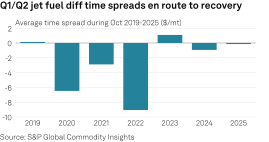
Jet fuel tends to move in tandem with its co-distillate diesel given that its supply availability largely depends on the blend the aviation fuel into diesel.
Yet, the relatively narrow jet-diesel time spread suggests that forward strength in jet fuel is also likely to be supported by downstream demand.
Aircraft deliveries gather pace, supports capacity growth
Aircraft delivery schedules, which were disrupted by the COVID-19 pandemic, have been cited by airlines across the world as a key limiter on seat capacity growth.
In Europe, year-on-year delivery growth by Airbus and Boeing declined during the pandemic and struggled to recover amid persistent and structural supply chain disruptions.
Yet, an improved pace of component manufacturing in 2025 along with higher regulatory production caps have injected fresh confidence in the trajectory of aircraft deliveries.
In its quarterly earnings report, Airbus reaffirmed its 2025 delivery target of 820 aircraft, up from 766 deliveries the previous year. The company delivered 73 jets in September -- a record figure for that month -- reflecting an uptick in production rates.
Meanwhile, Boeing has also reported a positive trend in output. Within the first eight months of 2025, the American company delivered as many planes as it did in the entirety of 2024.
The increasing confidence and clarity on deliveries by the two major manufacturers has cascaded into more bullish traffic projections among European airlines.
Ryanair, Europe's largest airline by passenger traffic, has increased its traffic forecast for the current financial year, citing earlier-than-expected aircraft deliveries.
Meanwhile, Lufthansa Group, one of the region's largest airlines in the long-haul segment, forecast capacity growth of around 4% in its quarterly results Oct. 30.
"I can already tell you that we expect the delivery of twice as much long-haul aircraft in 2026 than this year," said Till Streichert, CFO at Lufthansa Group during the earnings call.
This increase in aircraft deliveries comes at a critical juncture for global capacity and fuel demand growth, as current consumption drivers approach their limit.
Firstly, recent capacity growth has been driven by annual increases in aircraft utilization. This utilization rate is currently at record highs, according to the International Air Transport Association (IATA), indicating little spare capacity for further traffic expansion.
Secondly, aircraft delivery delays forced airlines to focus on improving their load factors to unprecedented levels, which translated into heavier flights demanding more fuel.
Thus, the impact of delivery delays on jet fuel consumption growth has been masked by these two factors, highlighted IATA's Manager of Industry Finance, Maciej Wardejn.
Unless production and delivery of new aircraft were to pick up substantially, seat capacity and aviation fuel demand growth may struggle.
"At some point, when the growth in [aircraft] utilization will not be that easy anymore, this problem might be uncovered with even stronger impact than we expect now because we might see the situation where airlines really want to grow and they have no chance to do it," Wardejn said.
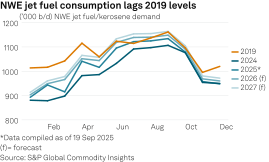
For now, jet fuel demand within Northwest Europe is projected to extend annual gains into 2026, rising 1.71% on the year, but lagging pre-pandemic levels, according to forecasts by S&P Global Energy.
Fuel efficiency gains will not be immediate
Fuel efficiency gains from new aircraft deliveries are another critical factor in the outlook for jet fuel demand.
The latest generation of aircraft are estimated to produce an improvement in fuel efficiency of between 15% to 20%, which may be a bearish factor for jet fuel demand, according to analysts.
Industry-wide gains, however, are unlikely to improve significantly within the next year, as airlines retain the services of older, and less fuel-efficient, aircraft in a bid to expand their networks.
"For 2025, we see 4% [growth] for the [available tonne-kilometers] and almost no gain in the fuel efficiency. That's why the fuel consumption focus is a bit higher than usual because you don't deduct this standard fuel efficiency gain," said IATA's Wardejn.
Further bolstering the jet fuel demand outlook, relatively cheaper outright jet fuel prices have enabled companies to absorb a higher level of fuel burn to retain the services of older planes.
"It's actually pretty good to hold on to your [older aircraft models] right now as long as the oil price stays docile," said Stephen Burnside, Head of Consulting at aviation analytics firm Cirium.
Tariffs in focus, potential downside for demand
Looking ahead, market watchers will be monitoring the state of manufacturing disruptions that continue to stifle aircraft delivery rates and jet fuel demand.
"The delays are not going to go away. You can't magic the way out of this situation," said aviation data company OAG's Chief Analyst John Grant, noting the threat that global tariffs place on manufacturers.
"Some [raw materials] are in countries that are no longer sharing their minerals with others. So that creates a part of the issue," Grant explained.
Even with existing tariff exemptions in the aviation manufacturing space, manufacturers remain exposed to an elevated cost environment from adjacent industries.
Cirium projects peak production to only return around 2028 as manufacturers continue to navigate the ongoing supply chain challenges.
"The concept of backfilling what would have been satisfying demand, that's gone in our opinion," said Cirium's Burnside.
Should delivery rates fail to maintain their positive trajectory, the prospects of capacity growth and thus jet fuel demand could struggle in the years ahead.
As the manufacturers look ahead to develop and market their next generation of aircraft, delivery of the current orderbook would set the stage for the industry's baseline jet fuel consumption and efficiency levels.
Taken together, the near-term performance of the manufacturers could reshape the growth trajectory for aviation fuel demand, which is itself forecast to be a key driver of oil product consumption growth for years to come.

Editor: