Refined Products, Maritime & Shipping, Chemicals, NGLs, Agriculture, Naphtha, Gasoline, Biofuels
November 02, 2026
European naphtha price climbs to multi-month highs in unstable market

Editor:
HIGHLIGHTS
Oct. 30 spot price closed at highest level since early April
Gains in chemical demand expected to be short term
Limited commoditization persists in sustainable naphtha
European naphtha values surged in October, cementing prices at elevated levels toward the close of a year dominated by geopolitical pressure and uncertainty.
Spot naphtha CIF NWE cargoes averaged $926.14/mt across October, up 9.8% month-over-month and 75.44% from October 2025 according to Platts, part of S&P Global Energy. Values peaked at $1,005/mt on Oct. 30, its highest level since April 7.
Supply-driven strength
Tight supply remains the key market driver, continuing the steep backwardation which has defined the market in 2026. According to Insights Global data, Amsterdam-Rotterdam-Antwerp naphtha stocks were at 34-month lows of 255,000 mt on Oct. 8, before rising to 270,000 mt by Oct. 29.
Three factors have driven the limited availability. Strong distillate production margins are keeping refineries maximizing distillate output, limiting spot naphtha availability. Logistical pressures from high freight costs and volatile Rhine water levels have also disrupted cross-continental product movement and access to material across the region.
"There is demand but logistics are causing issues," and will continue to do so until the end of the year, a naphtha trader said.
The export arbitrage from Europe to Asia also remains open, with favorable spreads pulling product East. Platts assessed the front-month spread between the CFR Japan naphtha cargo swap and the CIF NWE equivalent was at $82/mt Oct 30, in slightly from Oct. 9 when it was at $86/mt and its widest since March 31 when the East-West spread was at $100.50/mt on March 31. A total of eight cargoes, or 364,700 mt plied the route from the Med to Asia in October, according to S&P Commodities at Sea data.
Despite constrained supply, erratic demand has tempered upward pressure. Strong gasoline margins made gasoline blending the main naphtha outlet in 2026, but this has eased heading into Q4 as gasoline driving season wound down.
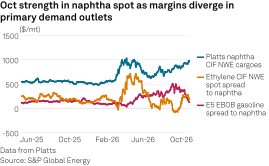
Subsequently, demand from the chemical industry has picked up and was supported by stronger prices in alternative feedstock markets like propane.
"I think the European picture is more constrictive; barrels are moving East," a second trader said. "What's helping a bit is gasoline margins are cooling off, so hearing more blending barrels ending up in the petrochemical pull... but seems market staying supportive short term."
Chemical industry, geopolitics
While chemical appetite has become the main short term demand driver, the market continues to mull longer-term pressures on the sector. An imminent seasonal slowdown in winter petrochemical demand, competitive imports and structurally weak demand from a shrinking sector provoked concerns surrounding longer-term chemical demand strength.
"There was a boom in chemical industry performance post-US-Iran war, as the European market turned to domestic supply with import flows constrained," another naphtha trader said. "But the pressure is returning ... a structural shift in demand hasn't materialized ... the whole downstream value chain is feeling pressure."
Beyond 2026, the chemical industry has initiated unit closures to combat ample supply levels across the continent and import supply from more competitive regions. With most of these units using naphtha as feedstock, the consumption base for the product has narrowed, leading sources to suggest that gasoline blending demand could persist as naphtha's long term demand driver.
| Status | Operator | Location | Capacity ('000 mt) | Feedstock | Timing |
| Shutdown | SABIC | Wilton, UK | 867 | Naphtha+ | 2020 |
| Geleen 3, the Netherlands | 575 | Naphtha | Q2 2024 | ||
| ExxonMobil | Gravenchon, France | 425 | Mixed | Q4 2024 | |
| Versalis | Brindisi, Italy | 490 | Naphtha | Q1 2025 | |
| Priolo, Italy | 490 | Naphtha+ | Q3 2025 | ||
| ExxonMobil | Fife, UK | 830 | Ethane | Q1 2026 | |
| To return | Dow Chemical | Terneuzen, the Netherlands | 592 | Mixed | Q2 2025 |
| To shut | Dow Chemical | Bohlen, Germany | 565 | Naphtha | By 2027 |
| TotalEnergies | Antwerp, Belgium | 550 | Naphtha | By 2027 | |
| Capacity Subtotal ('000 mt) | 5,384 | ||||
| Sale Agreed | LyondellBasell | Munchsmunster, Germany | 400 | Mixed | N/A |
| Berre l'Etang, France | 470 | Mixed | N/A | ||
| SABIC | Geleen 4, the Netherlands | 675 | Naphtha | N/A | |
| BP | Gelsenkirchen | 1,073 | Mixed | N/A | |
| For Sale | Versalis | Dunkirk, France | 380 | Naphtha | N/A |
Source: Company publications, S&P Global Energy CERA
Geopolitical tensions also remain critical. Conflict between the US and Iran in the Middle East, and attacks on Russian refinery infrastructure by Ukraine have disrupted trade flows in 2026, ensuring the conflicts will remain important factors into 2027.
"All eyes on the region here...escalation or resolution will define the next direction for this market," a trader said on the Middle East, with a second noting a minimum of six months delay in establishing more typical market conditions on the conclusion of either conflict.
Sustainable naphtha
Sustainable naphtha markets continue to see slow progress toward greater scale and stronger demand, with structural tightness across both bio-based and chemically recycled naphtha markets ensuring no change in premium levels to fossil material.
Chemical consumers cannot absorb higher costs in an already high-cost supply chain and production landscape. As a result, trading activity for sustainable materials remains limited to opportunistic deals at small quantities.
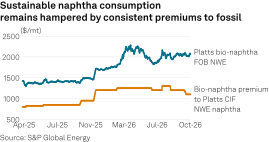
Stakeholders see two critical junctures for bio-naphtha demand: legislation and scale. With EU directives that mandate minimum recycled content levels in plastic packaging expected to ensure foundational appetite and increased investment into capacity, allowing for more competitive pricing against fossil products.
"There is a readiness to scale, but it's about the factors for acceleration; capacity ultimately needs to be in place for before 2030 [when legislative mandates begin]," one chemical recycler said. "Ultimately demand is pretty flat ... players need confidence that it's the right moment to move."
While environmental concerns and the search for alternative ways for European sellers to present a value case for their material have kept sustainability on the naphtha market's agenda, fundamental demand weakness and challenging broader conditions have ensured that commoditization remains limited.
"Commitments remain voluntary so ultimately demand remains weak," a second chemical recycler explained. "It's not black and white, but the industry has a variety of challenges to overcome."
