Refined Products, Diesel-Gasoil
October 16, 2024
Asian middle distillate marketers wary of Chinese, South Korean oversupply amid fragile cracks
HIGHLIGHTS
Ample South Korean exports pressure cracks
Narrower cracks hurt regional refiners' H1, Q3 earnings
Chinese gasoil exports at $4/b premium over domestic sales
Asian refiners are wary of Chinese middle distillate product export volumes over the next few trading cycles, as the downtrend in crack spreads persists amid weak regional industrial fuel demand and South Korean gasoil oversupply, with many market participants hoping Chinese refiners will limit their offers in the fourth quarter.
China's latest batch of clean product export quota volumes was widely considered reasonable and in line with analysts' expectations. However, if Chinese traders and refiners fully utilize their allocated quotas, the regional middle distillates market would remain oversupplied, hurting margins for the broader industry, according to oil product marketers and traders at Thai, Japanese and South Korean refiners, as well as Singapore-based trading firms.
Asia's biggest middle distillates exporter and supplier South Korea has increased exports this year, one of the major factors keeping crack spreads in a downtrend. China's sluggish economic activity and weak domestic oil demand could also lead to ample Chinese shipments, negatively impacting refining margins across Asia, according to a sales and marketing manager at a state-run Thai refiner and a trading manager at a major Japanese integrated trading company.
"Weakness in the South Korean currency this year encouraged us to make efforts to raise [middle distillate product] exports and increase dollar earnings," a sales and marketing executive at a major South Korean refiner said.
South Korea exported 202.4 million barrels of gasoil and jet fuel/kerosene combined in the first eight months of 2024, up 7% from 189.2 million barrels a year earlier, marking the highest shipments over the January-August period since 2019, the latest data from state-run Korea National Oil Corp. showed.
However, an official at the country's top refiner SK Innovation told S&P Global Commodity Insights that Q4 exports may retreat as weak cracks weigh on sales margins.
Ample South Korean supplies, combined with lackluster industrial fuel demand in major Asian economies, have consistently pressured Asian cracks and refining margins. Additionally, China's aggressive clean product exports in Q4 could further disrupt the market's supply-demand fundamentals, according to product marketers at Thai, Malaysian, Japanese and Taiwanese refiners.
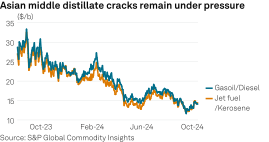
Platts assessed the second-month Singapore gasoil swap crack against Dubai crude swaps at an average of $15.58/b in the second half of 2024 so far, compared with $19.35/b in H1 and $22.82/b in 2023, Commodity Insights data showed.
Weak cracks have affected the earnings of many regional refiners this year. For example, Malaysia's Petron saw its H1 net profit fall 44% year on year to $19.3 million, despite a 6% year-on-year increase in sales amid growing domestic demand, particularly in the retail and aviation sectors, due largely to weaker crack spreads.
In the downstream market, Taiwan's Formosa Plastics Corp reported losses of T$3 billion (around $93.2 million) in the July-September quarter amid poor margins, while Vietnam's Binh Son Refining and Petrochemical saw a 41.7% year-on-year decline in H1 net profit due to narrower crack spreads.
"Crack spreads are ever so important because even if sales and revenues underperform, healthy cracks can still lead refiners to post profits," a sales and marketing manager at Japan's Cosmo Oil said.
China's export strategy
In the near term, traders said China may limit gasoil/diesel exports to focus more on higher-margin product sales.
"There may be fewer gasoil exports from China in October, not only because of more jet fuel exports but also because gasoline margins are somewhat better now," a Singapore-based trader said.
Market participants expect China to export approximately 230,000 metric tons (around 1.7 million barrels) of gasoil in October, far lower than the expected gasoline export volumes of about 720,000 metric tons for the same month, sources said.
Still, Chinese clean product suppliers may fully utilize the 41 MMt (around 326 million barrels) of allocated export quotas for 2024, favoring overseas markets due to weak domestic demand and selling prices amid sluggish industrial activities and consumer sentiment.
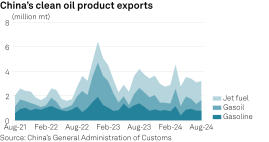
Over the first eight months, Chinese oil firms used up 26.17 MMt of the quotas for exporting gasoline, gasoil and jet fuel, leaving about 14.83 MMt of quotas for September-December, unless there is an additional round of quota allocation.
Meanwhile, spreads between export prices and domestic wholesale prices have widened to about $9/b for gasoline and $3-$4/b for gasoil, market sources said.
“These spreads encourage those quota holders with fewer retail outlets to lift exports,” a Shanghai-based trader said.
Chinese oil companies utilized about 50% of their quotas to export jet fuel, including for bonded refueling at China’s international airports, and the rest of the export quotas were almost equally split between gasoline and gasoil.
China’s domestic jet fuel prices typically move in line with Mean of Platts Singapore jet/kerosene assessment prices.