Maritime & Shipping, Wet Freight
September 24, 2025
Fragile growth, greater uncertainty, volatile freight rates for shipping: UN

HIGHLIGHTS
2025 maritime trade volume growth will slow on year
US tariffs, port fees will cause inefficiencies
IMO environmental rules raise compliance cost concerns
Global shipping is entering a period of fragile growth, rising costs and mounting uncertainty, which are reflected in volatile freight rates, the United Nations Conference on Trade and Development said in a report on Sept. 24.
Seaborne trade, which moves over 80% of the world's merchandise trade, recorded firm growth of 2.2% in volumes and 5.9 % in ton-miles in 2024, largely on the back of rerouting around the Cape of Good Hope as Red Sea disruption persisted. However, growth is forecast to slow in 2025, while maritime trade volume will expand by 0.5%, UNCTAD said.
From 2026 to 2030, UNCTAD projects total seaborne trade volumes will grow at an average annual rate of 2%, with a marginal increase 0.3% projected in ton-miles. These shifts largely reflect structural drivers, such as geopolitical realignment, industrial policy changes and the global energy transition, UNCTAD said.
"Freight rates that were relatively stable for years now swing wildly from month to month. Supply chains we thought were resilient have proven fragile," Rebeca Grynspan, secretary-general of UNCTAD, said in the report.
"This year's developments around the Strait of Hormuz – a passage for about 34 per cent of global seaborne exports of oil – have drawn renewed attention to the need for sustained dialogue on maritime security," Grynspan said.
Geopolitical factors, including the Red Sea and tensions in the Strait of Hormuz, have exacerbated freight rate volatility. The 2024 Red Sea crisis alone caused a dramatic spike in shipping costs, with ongoing geopolitical disputes raising fears of further disruptions. As a result, freight rates have become increasingly unpredictable, posing significant challenges for businesses and economies, particularly in developing regions.
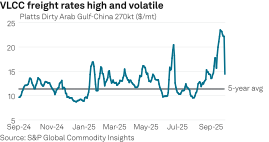
Platts assessed the rate to carry a 270,000 metric ton cargo of crude from the Persian Gulf to China at an average of $18.98/mt in September, when it reached its highest since March 2023.
The assessment started 2025 at $8.89/mt and the five-year average is $11.60/mt.
Tariff tensions
The rising freight rates are not merely a function of increased demand but are also a reflection of the complex interplay of trade policies. Recent shifts in US trade policy, including the introduction of new tariffs and restrictions on foreign vessels, have led to rerouting and longer shipping times, further inflating costs. The uncertainty surrounding these policies has left many exporters in a state of limbo, unsure of how to navigate the changing landscape.
Shipowners will need to segregate fleets and this will cause inefficiencies; the proposed fee under the US Trade Representative framework could render China-owned and China-operated vessels redundant for US trade. This likely triggers a shift in port calls, with non-Chinese vessels continuing to serve US ports, while Chinese-operated or owned ships are redirected elsewhere, maritime consultancy Drewry said in May.
China's recent trade patterns illustrate the value of multiple market opportunities, as trade policy uncertainty, not least from US tariffs, looms over global markets. This year has seen unprecedented levels of trade uncertainty, UNCTAD said in a separate update on global trade.
IMO in the spotlight
As the shipping industry faces increasing pressure to decarbonize and adopt greener practices, the economic implications of environmental compliance costs are also becoming more pronounced. The International Maritime Organization's (IMO) upcoming Net-Zero Framework, which will introduce a greenhouse gas pricing mechanism, is expected to further elevate shipping costs.
If the vote is carried, it could put in place strategic developments that will make a difference over time, Regina Asariotis, chief of the trade logistics branch, said at a press conference on Sept. 24. "If it is not adopted, then the question arises: what else will there be?... One of the concerns expressed by members of the shipping industry [at London International Shipping Week], particularly, was a proliferation of national solutions, which nobody is favoring because a global industry needs global rules," she said.
The report warns that without significant investment in fleet renewal and alternative fuel infrastructure, the burden of these compliance costs will fall heavily on already struggling economies.

Editor: