Crude Oil, Maritime & Shipping, Wet Freight
August 29, 2025
Crude demand, vessel supply to support crude tanker freight rates: Frontline

HIGHLIGHTS
OPEC+ output rise has yielded few extra cargoes thus far
More available cargoes expected in Q4
Sanctions limit available tonnage
An uptick in crude demand amid rising pressure on the pool of compliant tankers will support crude tanker freight rates through the remainder of 2025, shipping firm Frontline said Aug. 29.
In terms of cargo demand, the tanker market in the second half of 2025 is likely to be defined by crude supply and the market's capacity to absorb this, amid OPEC+ production increases, Frontline said in its H1 interim financial report.
"Strong expected seasonal demand supported by healthy refinery margins, and further tightness in compliant tonnage will likely support freight rates," Frontline said.
July was the fourth consecutive month in which eight OPEC+ members, who had implemented voluntary crude production cuts, raised quotas.
Looking ahead, OPEC+ has reaffirmed its intention to boost production in August and September and conclude unwinding the whole 2.2 million b/d tranche of voluntary cuts.
"Although OPEC continued their strategy of reducing voluntary production cuts, these reversals have so far only yielded modest increases in exports," Frontline CEO Lars. H. Barstad said in a statement.
The summer is a period of high domestic demand for large oil producers, and the company expects more volumes will come into the market as the fall approaches in the northern hemisphere, he added.
This follows a fall in freight rates in Q2. Frontline's spot Time Charter Equivalent for April-June in 2025 for VLCCs averaged $43,100/day, down 13% year over year.
Platts, part of S&P Global Energy, assessed the rate to carry a 270,000 mt cargo of crude from the Middle East to China at an average of $13.25/mt in Q2, down 3% year over year. The assessment has strengthened since, hitting $14.42/mt on Aug. 28. The five-year average is $11.39/mt.
Cargo outlook
Global oil demand will rise by 630,000 b/d in the third quarter of 2025, primarily driven by seasonal gains in transportation and power generation sectors, analysts at Energy said Aug. 28. On an annualized basis, global oil demand is projected to grow by 700,000 b/d in 2025 and 780,000 b/d in 2026, they said.
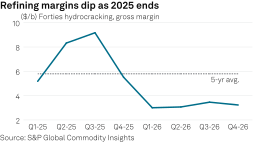
Key refined product margins surged in June as the Israel-Iran conflict sent shockwaves across the global oil trade, but the strength carried into July even as the conflict de-escalated. Analysts at Energy expect margins to recede in the fourth quarter of 2025 and first quarter of 2026 as weaker demand and capacity additions chart a looser course, with gasoline at risk of a sharp slowdown as the US driving season ends.
Frontline expects healthy refining margins to support upstream cargo demand for tankers, but these may follow a bumpy path. Energy expects refining margins based on hydrocracking Forties crude to rise from $8.33/b in Q2 to $9.17/b in Q3, but then fall to $5.51/b by the year-end, remaining below $3.50/b in 2026, against a five-year average of $5.80/b.
Limits to vessel availability
Barstad said the US, G7, and the EU continue to widen the scope of sanctions, especially against Russia, causing increased oil trade inefficiencies.
US threats of secondary tariffs on buyers of Russian crude have put further pressure on importers, especially India, a key customer of Russia. "While uncertainty persists, the announcement has already prompted some Indian refiners to increase their share of compliant barrels from the Atlantic basin and the Middle East, lending support to compliant tonnage," Frontline said in its results statement.
This raises sailing distances and limits the availability of existing tonnage.
It comes as new deliveries have slowed amid muted recycling activity. According to analysts at shipping industry body BIMCO, crude tanker fleet growth is forecast at 0.5% in 2025 and 1.5% in 2026. The Suezmax and VLCC segments are expected to drive this growth, although a slight reduction in the Aframax fleet is anticipated due to heightened recycling activity, BIMCO said.
As of June 30, 2025, Frontline's fleet consisted of 81 vessels owned by the company -- 41 VLCCs, 22 Suezmax tankers, and 18 LR2/Aframax tankers.
