Crude Oil, Refined Products, Naphtha
August 26, 2025
Iraq eyes end to refined product imports after refinery upgrades
By Charlie Mitchell and Faleh Al-Khayat
HIGHLIGHTS
Iraqi refinery capacity hiked to 1.3 mil b/d, PM says
Karbala, Basra and Baiji plants add capacity since 2023
SOMO reports throughput of just 425,000 b/d in July
Iraq is poised to stop importing refined products by early next year after hiking its refining capacity to 1.3 million b/d, according to the country's prime minister and a senior oil official.
In comments to state news agency INA on Aug. 25, prime minister Mohammed al-Sudani said the country had "achieved" a refining capacity of 1.3 million b/d, on its way to reaching the "strategic goal" of 1.65 million b/d he set in March.
"Self-sufficiency was very close in 2024, when Iraq refined [at] a rate of 1.1 million b/d," the report noted. "This increase will enable the Ministry of Oil to export the excess volumes."
Sudani's comments came days after Hussein Talib, Director General of the Oil Products Distribution Company, told INA that "the Ministry of Oil has developed a plan to end the import of petroleum products by the end of 2025 and the beginning of 2026, according to an advanced timetable prepared for this purpose."
Iraq previously imported 16 million liters/day of gasoline and 7 million liters/day of gasoil and jet fuel, Talib said, at an annual cost of $4.5 billion. However, since 2024 it has been self-sufficient in middle distillates and has slashed gasoline imports to 6 million liters/d, equivalent to around 51,000 b/d.
Estimates from S&P Global Energy analysts put Iraqi refinery utilization at over 800,000 b/d.
State oil marketer SOMO reported throughput figures of just 425,000 b/d in July, in line with figures it has published throughout 2025. That would imply Iraq is not using some two-thirds of its stated capacity, despite trimming its refined product imports.
According to the SOMO figures, the country's biggest plants, Al-Smood (Biaji) and Basra, processed 99,000 b/d and 94,000 b/d of crude respectively in July.
Additional volumes refined in the semi-autonomous Kurdistan region, whose refineries have a nameplate capacity of nearly 140,000 b/d, are not included in the total.
A senior official from SOMO, reached for comment by Platts, said Iraq's simpler refineries turn crude into fuel oil, which is then processed into a slate of products at more sophisticated plants, meaning the same barrel of crude could effectively be refined twice.
But the official, speaking on condition of anonymity because they were not authorized to comment publicly, did not address the disparity between SOMO throughput figures and refining capacity numbers provided by Baghdad.
Iraq's oil ministry did not respond to requests for comment.
Refinery turnaround
While technical and operational issues have blighted Iraq's refineries in recent years, dropping the utilization rate to 62% in 2024, according to estimates from Energy analysts, authorities in the Middle Eastern country have invested in new refinery projects, expansions and upgrades.
Between 2023 and 2024, the country developed the greenfield Karbala refinery, expanded the Basra plant and reconstructed Baiji 2 at the Baiji complex.
A survey conducted by Platts in August 2025 estimated current operating capacity at the Basra and Baiji refineries alone at a combined 250,000 b/d, while the Kerbala refinery is operating at 115,000 b/d. Overall nameplate capacity is 1.3 million b/d, the survey found, compared with operating capacity of 1.18 million b/d.
Meanwhile, the OPEC annual statistical bulletin released in July estimated Iraq's petroleum product production at 990,000 b/d in 2024.
It marks a strong turnaround for the sub-sector since the Iraq war, which left the country's refineries in state of disrepair, and has been reflected in the country's imports and exports.
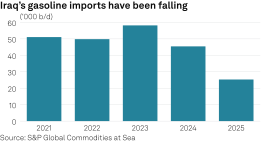
Data from S&P Global Commodities at Sea shows the OPEC member imported just 56,300 b/d of refined products in total in the second quarter of 2025, over half of it gasoline. That represents a dip since 2023, when imports averaged 90,000 b/d.
Meanwhile, Iraq also exported over 180,000 b/d of naphtha in the second quarter, most of it to the UAE, data from CAS shows. Fuel oil exports are around 300,000 b/d monthly, according to CAS, backing up claims from officials that simple refineries transform Iraq's crude into fuel oil.
OPEC compliance
Elevated refinery throughput could raise questions around Iraq's compliance with its OPEC quota, which sat at 4.122 million b/d in July following the fourth successive month of voluntary cut unwinding.
Persistent quota non-compliance has led Iraq to submit compensation plans this year, with the latest due to be submitted Aug. 22, OPEC said previously.
Secondary sources used by OPEC to estimate the output of its members showed Iraqi production at 3.902 million b/d in July 2025, inclusive of output from Kurdistan.
