Refined Products, Chemicals, NGLs, LPG, Olefins
August 12, 2025
China agrees to extend pause on 24% tariffs on US goods for 90 days
HIGHLIGHTS
China's GDP growth to slow in H2 despite extension
Agreement sustains China's LPG, ethane imports from the US
US crude imports dry out since June: GAC, CAS
China has agreed to extend the suspension of the 24% additional tariffs on US goods for 90 days, starting Aug. 12, according to a report by the government-backed Xinhua News Agency.
Meanwhile, China will continue to impose 10% tariffs on US goods and will take or maintain necessary measures to suspend or cancel non-tariff countermeasures against the US, in line with the agreements made in the Geneva Joint Statement, according to Xinhua.
This development follows US President Donald Trump's signing of an executive order Aug. 11, which postponed the implementation of increased tariffs on imports from China.
China and the US previously agreed to postpone the implementation of increased tariffs for 90 days, from May 14 to Aug. 12.
The latest agreements were anticipated, which is unlikely to further boost China's economy, but will help sustain China's imports of LPG and ethane from the US, according to energy market sources in China. In contrast, crude oil inflows from the US are expected to remain low.
"The impact of a 90-day extension on domestic GDP will not be significant, as demand has already been anticipated and addressed ahead of the schedule," said a senior principal analyst with S&P Global Energy.
Energy analysts said China's 5.3% GDP growth in H1 helps to ease the pressure to achieve the full-year expansion target of 5% in H2.
The state-run Sinopec's Economics & Development Research Institute on Aug. 8 projected the GDP growth to fall below 5% in the H2, reaching 4.9% in Q3 and 4.7% in Q4, due to reduced domestic stimulus, the impact of the trade conflict with the US, and a relative high base in the same quarters of last year.
Ethane
China's ethane imports from the US are recovering and likely to hit a fresh high of 663,000 mt in August, rebounding from a multiyear low of 191,000 mt in July, according to S&P Global Commodities at Sea. The previous low was 173,000 mt in March 2022.
The surge in August came as the US Bureau of Industry and Security in early July removed the export restrictions on ethane to China, which had been in place since late May.
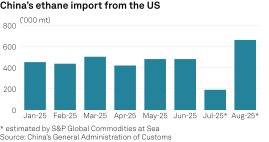
According to several ethane importers in Shandong and Jiangsu provinces, ethane has been exempted from the 10% additional tariff due to the heavy dependency on the US supplies. The imports are subject to 1% of general duty.
"Ethane imports would stay at 400,000-500,000 mt levels in the coming months, unless there are significant policy changes from Beijing or/and Washington," a Shanghai-based petrochemical analyst said.
LPG
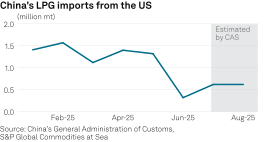
US LPG imports are also improving in July and August but remain below the usual levels of over 1 million mt/month due to the additional 10% tariff, market analysts said.
CAS analysts said in a report that there might be slight improvement in arrival of some LPG cargoes from the US to Chinese ports due to the extension.
"But since the costs of US and Middle Eastern cargoes are now quite similar, a further 90-day extension of tariffs is unlikely to increase purchases of US cargoes. Instead, there may be a preference for Middle Eastern cargoes that carry lower policy risks," a Beijing-based analyst said.
Thanks to the suspension of 24% additional tariffs since mid-May, China's LPG imports from the US rebounded to 623,000 mt in July, CAS data showed. The volume once reached the 61-month low of 317,000 mt in June, data from China's General Administration of Customs showed.
Crude
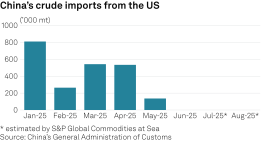
However, the 20% additional tariff on US crude has closed the arbitrage window the flow into China, according to feedstock procurement planners with state-run refiners.
China's US crude imports have been at zero since June, data from GAC and CAS showed, from the year-to-date high of 810,000 mt in January.
"Cheap crudes are everywhere, and crude prices are under pressure," a Beijing-based planner said.
Sinopec's research arm anticipated Brent price to fall to $68/b in Q3 and $65/b in Q4 from the average $70.8/b in H1.
The benchmark Dated Brent was averaged at $71.87/b in H1 and fell to $68.07/b on Aug. 11, data from Platts, part of Energy, showed.

Editor: