Refined Products, Agriculture, Energy Transition, Gasoline, Biofuel, Renewables, Diesel-Gasoil, Carbon
July 18, 2025
Brazilian fuels market on edge ahead of RenovaBio sanctions list
HIGHLIGHTS
Sanctions list targeting non-compliant distributors to be released
Potential disrupting of domestic supply chain
Petrobras preemptively warned it will cut deliveries to sanctioned companies
Market expects some firms to continue operating under court rulings
A sanctions list targeting Brazilian fuel distributors that failed to meet decarbonization targets under the national RenovaBio program, expected to be released July 21, is already casting a long shadow over the domestic fuels market, with participants across the supply chain bracing for potential supply/demand disruptions.
Regional fuel distributors association Brasilcom, however, said while the sanctions list may increase pressure on non-compliant players, it also risks deepening existing market asymmetries and damaging legal certainty.
Market sources told Platts there has been a flurry of defensive positioning ahead of the sanctions list's release by the National Agency of Petroleum, Natural Gas and Biofuels, or ANP. Buyers with a significant market share at the pump may soon face operational restrictions, raising questions over delivery schedules, available supply, and even the credibility of enforcement mechanisms.
According to filings available in ANP's electronic process system, 18 distributors failed to comply with their individual carbon reduction credit retirement targets for the RenovaBio 2024 compliance year by the Dec. 31 deadline. Collectively, these companies fell short by around 4.25 million CBIOs.
The distributors identified in these filings moved approximately 1.63 billion liters of diesel B, 370 million liters of hydrous ethanol (E100) and 755 million liters of gasoline C between January and May 2025, according to data from industry watchdog ANP.
Spread across major states, mainly São Paulo, Minas Gerais, Goiás, Mato Grosso and Mato Grosso do Sul, this trading volume amounts to nearly 5% of total retail sales in the country during that period, highlighting the regional weight some of these players have and underscoring the potential disruption their absence could cause.
| Companies issued primary notifications in April | 2024 CBIOs target | Retired CBIOs | Target not met |
| Royal FIC Distribuidora de Derivados de Petróleo S/A | 1,578,225 | 0 | 1,578,225 |
| Ciapetro Distribuidora de Combustíveis Ltda | 1,523,064 | 0 | 1,523,064 |
| Rumos Distribuidora de Petróleo Ltda | 372,496 | 0 | 372,496 |
| Rede Sol Fuel Distribuidora S/A | 162,837 | 56,998 | 105,839 |
| Araguaia Distribuidora de Combustíveis S.A | 129,642 | 0 | 129,642 |
| Petronac Distribuidora Nacional de Derivados de Petróleo e Álcool Ltda | 123,596 | 0 | 123,596 |
| Petrogoiás Distribuidora de Petróleo Ltda | 109,993 | 0 | 109,993 |
| Biopetro Distribuidora de Combustíveis | 68,104 | 0 | 68,104 |
| Mar Azul Distribuidora de Combustíveis Ltda | 64,528 | 0 | 64,528 |
| Petroworld Combustíveis S/A | 56,830 | 0 | 56,830 |
| Monte Cabral Distribuidora de Combustíveis Ltda | 33,677 | 1,675 | 32,002 |
| Centro Oeste Brasil Petróleo Ltda | 26,081 | 2,657 | 23,424 |
| Podium Distribuidora de Petróleo Ltda | 24,669 | 0 | 24,669 |
| Cruz de Malta Distribuidora de Petróleo Ltda | 17,004 | 0 | 17,004 |
| Braspetro Distribuidora de Petróleo Ltda | 9,007 | 0 | 9,007 |
| Phaenarete Distribuidora de Combustíveis Ltda | 5,362 | 0 | 5,362 |
| Petrosalvador Distribuidora de Combustíveis Ltda | 3,714 | 0 | 3,714 |
| Monvalle Distribuidora de Petróleo Ltda | 7 | 0 | 7 |
| Source: ANP Electronic Information System (SEI). Retrieved July 17 | |||
These companies were formally notified of non-compliance by the ANP in April and were granted a window to submit appeals and supporting documentation. As a result, there is still uncertainty over how many will ultimately appear on ANP's sanctions list — a decision expected to hinge on both legal maneuvering and the agency's final deliberations.
"Only distributors that were primarily notified and have not since accomplished their targets will be included in the list," ANP's media office said in an email to Platts, part of S&P Global Energy.
One of the distributors identified in regulatory filings, Biopetro, confirmed it had already complied with its obligations.
In a written response to Platts, Biopetro said it was "fully complying with its CBIO acquisition target, in accordance with the court injunction granted in our favor. We have already completed the purchase of the required credits and formally retired them, as stipulated."
Ciapetro, Royal FIC, Petroworld and Rumos Distribuidora, the four largest companies to receive the ANP notifications in April, did not return requests for comment. As of July 18, these and other potentially affected distributors were reported by sources to be operating without disruptions.
Shadow of a doubt
The use of court injunctions to delayor neutralize regulatory penalties — commonly called "liminares" in Brazil — remains a routine legal strategy among distributors facing RenovaBio-related sanctions. These legal protections have long frustrated biofuel producers and compliant competitors, particularly those with sizable retail networks, who argue that such mechanisms erode trust in the program.
While it remains unclear how many companies will ultimately avoid ANP's anticipated sanctions, the market is already bracing for impact. State-controlled oil giant Petrobras has notified clients via email that it will withhold fuel deliveries from any distributor named in the forthcoming sanctions list — regardless of volume or contractual agreements — according to emails from Petrobras reviewed by Platts.
Sources close to Petrobras said the company has begun adjusting its delivery "grids" in anticipation of the list publication, signaling a readiness to enforce restrictions immediately upon release.
"As a regulated entity, Petrobras is ready to take the necessary measures to fully adhere to ANP's guidelines concerning the fuel sales ban to non-compliant distributors within the RenovaBio framework," the company told Platts in a statement. "With respect to fuel supply, we reaffirm that Petrobras is ready to uphold the volume commitments it established with its customers. Demand adjustments among distributors will be addressed in light of regulations and contracts."
Brazilian ethanol producers are also taking precautionary steps. Some have paused spot market activity until there is greater clarity on which distributors may be sanctioned. Sources have also reported some mills requesting "return letters" for small volumes that had been sold but not yet collected — a safeguard against having product tied up with potentially listed buyers.
Regional distributors call for structural reform
In a written response to Platts, the regional fuel distributors group, Brasilcom, warned that ANP's move lacked a regulatory impact analysis and may expose companies currently protected by court injunctions to reputational harm. According to Brasilcom, that could lead to unjust penalties for distributors who are, at least temporarily, in legal compliance.
The lack of a regulatory impact analysis is also worrisome, according to Sergio Massillon, institutional director at Brasilcom. ANP filings show at least 18 companies might be targeted by the list, which could mean fuel supply security will take a blow, especially in small municipalities, he added.
Brasilcom also criticized what it sees as the disproportionate burden RenovaBio places on smaller, regional distributors. The association argues that these companies lack the financial tools and scale of larger competitors and are more vulnerable to price volatility and lack of transparency in the unregulated CBIO over-the-counter market.
The association is calling for a structural overhaul of the program through legislative changes such as Bill 2798/2024, which would shift CBIO purchasing obligations upstream to fossil fuel producers and importers.
"This would reduce the fragmentation of compliance and better align environmental responsibility with the true origin of emissions," Massillon said. Brasilcom believes this change would also ease regulatory monitoring and reinforce the polluter-pays principle, he said.
The association also defended its prior request during public consultation 171/2024 to extend technical review deadlines for RenovaBio rule changes, noting that legal stability and proportional enforcement mechanisms should come before coercive measures like public sanctions lists.
Looking ahead, Brasilcom voiced support for integrating CBIOs into Brazil's broader regulated carbon market under the new National Emissions Trading System, or SBCE, made possible by Law 15.042/2024. The association advocates for the creation of a fungible CBIO, recognized within regulated markets and potentially aligned with international standards such as Verra or the Gold Standard.
Despite its merits, the RenovaBio program remains imbalanced, Brasilcom said, citing over Real 29 billion in accumulated CBIO revenue flowing to biofuel producers — many of whom already benefit from tax and policy incentives.
"As it stands, RenovaBio risks becoming a transfer mechanism from consumers to biofuel suppliers, without delivering commensurate returns to society," Brasilcom said.
Muted prices, active backchannels
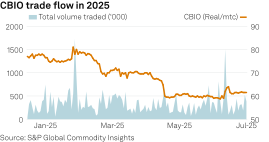
Despite the impending list, CBIO prices have remained relatively stable. Between July 1 and 15, Platts assessed daily prices between Real 61 and Real 64/mtCO2e, with an average of Real 61.85/mtCO2e — a 3.8% increase over H2 June, though still 10% below the year-to-date average and well below the program's historic average of Real 85.15/mtCO2e.
Even so, trading activity has improved — a possible sign that some market participants are acting in anticipation of the list.
"Prices are stable, but we're seeing stronger retirement and improved liquidity, which is a positive sign," said one trader at a major sugarcane ethanol producer. "Before the announcement that the list would be published, liquidity had dropped. Now we're consistently seeing daily volumes above 120,000 credits."
Across conversations with distributors, brokers and producers, a common narrative emerges: the list will be published, but most expect many of the major flagged companies to continue operating under judicial protection. That legal buffer — now a familiar feature of the RenovaBio enforcement landscape — may explain why CBIO prices have yet to react with the volatility some anticipated.
On the fossil fuel side, there was an expectation that spot appetite could increase ahead of the sanctions announcement, as there are concerns about supply coming from some of those regional distributors. However, not only did that not happen, but prices reacted more to external fundamentals, rather than the domestic noise.
"I spoke with large suppliers, and they told me they'll follow any decision they receive," said a trader at a big regional distributor, referring to CBIO purchases or the granting of liminares. "Even those who don't know their situation in an official capacity have signaled they want to comply."

Editor: