Crude Oil, Refined Products, Maritime & Shipping
June 16, 2025
South Korean government prioritizes energy security amid rising geopolitical tensions

By Gawoon Vahn
HIGHLIGHTS
Seoul to provide liquidity support to affected companies
Refiners concerned about surging Persian Gulf-Asia freights
South Korea could take up to 20 mil barrels/month of US crude
The South Korean government is prioritizing energy security and will monitor and manage financial market volatility amid rising geopolitical tensions following Israel's airstrike on Iran, given the country's status as the world's fourth-largest and Asia's third-largest crude importer.
A joint emergency response meeting was convened at 8:00 am Seoul time in response to significant market fluctuations following the June 13 airstrike, which triggered declines in stock prices across major economies and a rise in international oil prices, the Ministry of Economy and Finance said in a June 16 statement.
The meeting, held via conference call, brought together key agencies including the MOEF, the Ministry of Foreign Affairs, the Ministry of Trade, Industry and Energy, the Ministry of Oceans and Fisheries, the Financial Services Commission, the Bank of Korea, the Financial Supervisory Service and the International Financial Center.
The government is taking steps to manage energy supply and demand while minimizing impacts on exports and logistics. This includes providing liquidity support to companies affected by disruptions in the Middle East export sector and ensuring dedicated shipping space for small and medium-sized enterprises, according to the finance ministry.
In response to potential logistics bottlenecks, the government is also considering additional support measures, such as the deployment of temporary ships.
To ensure vigilance, the government will maintain a 24-hour monitoring system led by the joint emergency response team. If excessive market volatility deviates from South Korea's economic fundamentals, authorities are prepared to take immediate and decisive actions as outlined in their contingency plan.
As the situation evolves, the South Korean government remains committed to safeguarding the nation's economic stability and effectively addressing emerging challenges, the finance ministry said.
US, Middle East crude trades
South Korean and broader Asian refining industry participants are confident that tensions will not escalate to a level that disrupts Persian Gulf crude oil flows to the Far East, as both Iran and Israel are likely to avoid actions that could compromise East Asia's neutrality.
However, refinery feedstock managers and traders across Singapore, Japan, South Korea, India, China, Thailand and Taiwan said rising prices and shipping premiums are a more pressing concern.
Oil futures surged at the open late June 15 as Iran and Israel continued trading attacks, with Iran threatening to attack ships in the Persian Gulf and Red Sea. At 2200 GMT, NYMEX front-month crude opened $3.56 (5%) higher at $76.54/b, while ICE front-month Brent opened at $78.31/b, up $4.08 (5%).
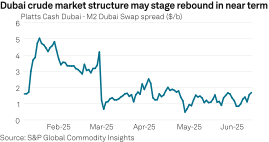
Platts, part of S&P Global Energy, assessed the spread between cash Dubai and same-month Dubai swap at $1.69/b on June 13, widening 14 cents/b day over day. The spread -- widely known as the Dubai market structure -- is considered a key component in the monthly official selling price calculations of major Middle Eastern producers.
South Korea received 51.236 million barrels of crude from the Middle East in April, accounting for 63.5% of its total imports of 80.676 million barrels -- a sharp decline from 73.5% in March, the latest data from state-run Korea National Oil Corp. showed.
However, given South Korean refiners' extensive North American crude trading networks, increasing monthly shipments of WTI Midland and other light, sweet US crude grades to around 20 million barrels -- or possibly more -- would not be difficult, according to feedstock inventory and logistics managers at two major South Korean refiners and analysts at the Korea Petroleum Association.
Asia's top US crude customer took in 14.92 million barrels from the North American producer in April, up 20.6% year over year and 54.9% month over month, KNOC data showed. This marked the highest monthly intake since August 2024, when it received 15.88 million barrels.
