Refined Products
May 22, 2025
FEATURE: San Francisco, Los Angeles CARB diesel prices show record disconnect
HIGHLIGHTS
California CARB diesel markets disconnect on recent refinery outages, pandemic conversions
San Francisco hits record 64-cent spread to Los Angeles benchmark in May
CARB diesel output tumbles to 37,000 barrels a week in Northern California, but jumps for other diesel grades
CARB diesel prices that once moved in near unison in San Francisco and Los Angeles have completely disconnected in 2025 due to unplanned refinery outages on top of recent refinery conversions in Northern California.
Platts, part of S&P Global Energy, assessed San Francisco at a 65-cents/gal premium to the underlying NYMEX June ULSD futures on May 22, where it had remained since jumping on May 7 to its highest premium since plus 75 cents/gal on Sept. 25, 2023. At $2.7675/gal, San Francisco shares with Portland the highest price of diesel in US spot markets.
The differential has been 20 cents or more above the futures since late February, while its Los Angeles counterpart was assessed up slightly to plus 8 cents/gal on May 22 and hasn't reached a NYMEX premium higher than 13 cents/gal this year.
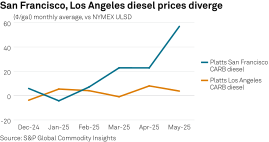
The divergence comes down to the usual story of California refined product movements: refinery issues. But it's also part of a longer-term trend pushing into renewable diesel production, especially in the north.
"The key driver of the SF-LA diff this year has been on the supply side, i.e., unplanned refinery outages," said SPGCI analyst Will Oneil.
He noted the spread between the two began to widen after a fire on Feb. 1 that shut PBF Energy's 156,400 b/d Martinez refinery near San Francisco. Martinez partially restarted in April, but the nearby 145,000 b/d Benicia refinery, which Valero already eyed for closure, then shut for a week due to a fire on May 5.
"In addition to limiting SF-area supply, the uncertainty around the damage may have boosted prices further due to temporary speculation that the fire could lead to an accelerated shutdown of the refinery, which is currently planned for April 2026. These outages created a tight market by mid-May," Oneil said.
"It's crazy," said one US West Coast trader who noted Chevron's more gasoline-centric 245,271 b/d Richmond refinery is the only one of the area's five refineries at full strength for petroleum fuels.
"It seems like Chevron is the only game in town," he said. "Marathon and Phillips 66 are making biofuels and Valero and PBF have mechanical problems."
California correlations weaken
California tends to be an island to the rest of the nation, showing a lack of correlation to benchmark Gulf Coast and other markets for all refined products due to tougher California specifications for gasoline and diesel, as well as a lack of pipelines into the region.
But an analysis between the two California-specific diesel assessments since Platts started assessing them in 1993 showed a correlation of 0.9978, a nearly one-to-one movement to each other. Similar correlations were seen from the beginning of the year through mid-May almost every year through 2023. But it dropped to 0.5552 in the year-to-date time frame in 2024 and then a near-random 0.1138 so far in 2025.
A correlation of +1.00 indicates movements in the two are positively related, while -1.00 indicates a perfect inverse relation and 0.00 indicates moves are unrelated.
San Francisco held a spread premium of 62.89 cents/gal over Los Angeles on May 22 and a record 64 cents on May 7-8. The previous record was 61 cents on Oct. 14, 2022. The historical average is a premium of slightly above half a cent, but it jumped to 16.45 cents so far in 2025.
Before the pandemic, Los Angeles was just as likely as San Francisco to be at a premium, depending on refinery issues in each region. Jones Act ships required for transport between US cities were also more common for various reasons, such as supplying Hawaii, which is now done mostly from Asia. There are no pipelines connecting the two cities, and volumes are too large to arbitrage out disconnects by rail and tanker trucks.
California's pre-coronavirus petroleum refining capacity of 1.91 million b/d dropped to 1.62 million b/d in recent years. Northern California prices reflect a tighter market, as the state's two major renewable fuels conversions were in the northern part, at Marathon's Martinez and Phillips 66's Rodeo plants, with renewable diesel output less than a third of the previous petrodiesel production.
Oneil saw just two Jones Act tankers in the San Francisco area, but "there doesn't appear to be much tanker movement between LA and SF," he said.
The two tankers were coming from Seattle-area refineries, and were just as likely to be carrying gasoline as diesel. The Pacific Northwest has its own issues, as Portland ULSD jumped this week to a similar 65-cent premium to the NYMEX.
"The Pacific Northwest has been busy with refinery problems," a second source said, adding he is seeing "ULSD by rail into PNW from landlocked sources."
Stocks slide, but mostly in Northern California
Ultra low sulfur diesel inventories held at California refineries dropped 364,000 barrels on the week to 2.507 million barrels for the week ending May 16, according to California Energy Commission data published on May 22.
Most of the decline came from CARB diesel stocks, dropping 318,000 to 1.009 million barrels, by far the lowest in five years of data published by the CEC. Northern California stocks dropped from 747,000 barrels to a record low 371,000 barrels, while Southern California rose from 580,000 to 638,000 barrels.
CARB diesel production fell 293,000 b/ds to 536,000 barrels, while production of other diesel fuels – renewable diesel, export-only ULSD and high-sulfur diesel – rose by 223,000 barrels to 921,000 barrels, the agency reported.
In Northern California, refiners made only 37,000 barrels of CARB diesel compared with 306,000 the week before, 154,000 last year and 631,000 barrels two years ago. Production of other diesel reached 479,000 barrels, one of the highest levels in two years, compared with 267,400 two years previous, 307,000 one year previous, 40,000 two weeks earlier and 147,000 one week earlier.
US Energy Information Administration data released on May 21 for the week ended May 16 showed ULSD stocks dropped to a nine-month low of 10.265 million barrels for the US West Coast, which includes six other states.
Traders and analysts expect the wide spread between the two California diesels to narrow once Benicia returns to regular utilization. A third trader said San Francisco is thinly traded, and prices can shift quickly.
"As illiquid as SF is, it wouldn't take much to crash it," he said.
Oneil also underscored the relationship between the volatility and the backdrop of refinery shutdowns in California.
"Within the next 12 months, California is losing two of its eight operational refineries larger than 30,000 b/d. After Benicia's closure next April, the San Francisco area will only have two major refineries -- Chevron Richmond and PBF Martinez," he said.
"With less operable capacity and fewer assets covering the same market (and the only major viable source of additional barrels over 5,000 miles away in Asia), unplanned outages like the several we've already seen this year will likely cause increasingly sizeable impacts on prices in the future."

Editor: