


Crude Oil, NGLs
May 08, 2026
Iranian crude floating storage builds in Asian waters in April despite US blockade
HIGHLIGHTS
SE Asian floating storage rises to 44 million barrels end-April
Iranian crude floating in Far East waters doubles in April
Chinese refiners boost Iranian imports, cut Russian intake
Floating storage of crude and condensate in Asian waters built up further in April while Chinese independent refiners lifted Iranian imports despite a US blockade.
As of the end of April, floating storage in Southeast Asian waters was about 44 million barrels, up slightly from end-March's 39.7 million barrels, with Iranian crude continuing to account for most of the volumes located around the Malaysia-Singapore Strait area at 31.3 million barrels, based on S&P Global Commodities at Sea data.
In the Far East, floating storage rose to about 5.4 million barrels at the end of April, rebounding from the end-March level of 4.6 million barrels as Iranian cargoes more than doubled in northern Asian waters.
According to CAS, a ship is considered floating storage if it is laden and does not move more than 10 nautical miles per day for at least seven consecutive days. Russian and Iranian oil exports to China frequently involve ship-to-ship transfers in east Asian waters as the countries' logistics networks are targeted by Western sanctions.
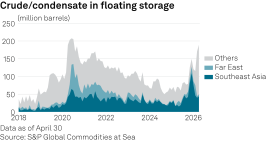
Iran's crude lifting has been substantial despite the US imposing a blockade targeting Iranian trades from April 13. Iran's crude exports reached 1.21 million barrels/day in April after averaging 1.35 million b/d in March, compared with the 2025 average of 1.68 million b/d, CAS data showed.
Meanwhile, China's independent refiners raised Iranian crude intake to an eight-month high in April. Data compiled by Platts, part of S&P Global Energy, showed that China's independent refineries' Iranian crude intake increased 6.7% over the month to 1.81 million b/d (7.39 million metric tons) in April, the highest since September 2025.
Russian oil
The increased Iranian crude intake coincided with a reduction in independent refiners' Russian crude imports to 4.21 million mt, down from March's 6.36 million mt, amid a competitive Russian crude market after the US extended a sanctions waiver.
The US issued a temporary waiver allowing Russian oil already loaded on ships as of March 12 to be sold and delivered through April 11, while also lifting sanctions on Iranian barrels loaded before March 20 for 30 days, in a bid to increase oil supply to global markets amid the Middle East war.
As the waiver on Iranian crude expired April 19, a fresh license by the US Treasury extended the waiver on Russian oil by nearly a month, allowing the purchase of Russian crude and petroleum products loaded on or before April 17 until May 16, effectively keeping the pool of eligible buyers for Russian barrels already at sea wide.
ESPO Blend cargo premiums into China have risen since the April-delivery cycle, reaching up to a $10/b premium over ICE Brent crude futures on a DES Shandong basis for May delivery. Iranian Light, however, was about $2-$3/b on the same basis, Shandong-based market participants said.
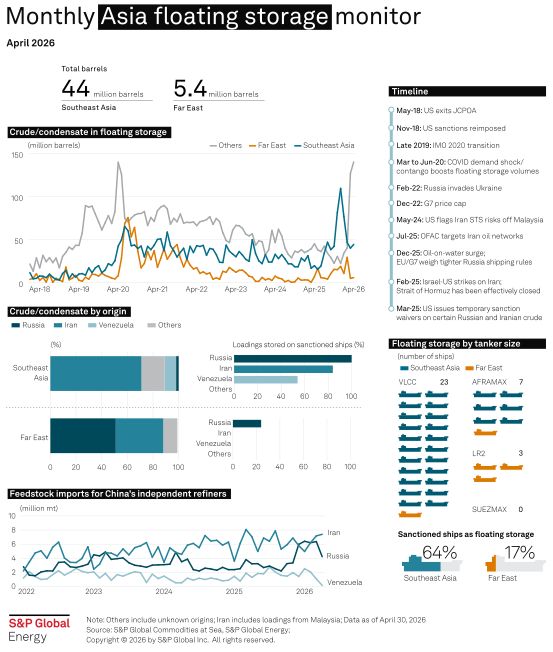
See interactive version (for subscribers) here.
