Electric Power, Coal, Natural Gas
April 21, 2026
Impact of Trump's Defense Production Act move to boost energy supplies uncertain: analysts
Editor:
HIGHLIGHTS
Legal challenges could threaten implementation
Impact on oil and gas sector unlikely
Funds appropriated for DOE projects but few hints for priorities
The Trump administration's invocation of the Defense Production Act was designed to accelerate US energy supply growth and lower consumer prices, but any impacts on domestic industry participants would be uncertain, subject to legal challenges, and likely to vary across sectors, analysts and trade groups told Platts.
US President Donald Trump on April 20 invoked Section 303 of the Defense Production Act, authorizing the Pentagon, Department of Energy and other agencies to make purchases, provide financial support and take other actions to expand domestic energy capabilities. A series of presidential memorandums — governing the grid, large-scale energy projects, natural gas, coal and baseload, and petroleum sectors — waived standard DPA requirements, citing a national emergency declared in January 2025 that found inadequate energy production poses threats to the economy and national security.
"The DPA provides broad, but temporary authority, subject to statutory controls, and pushing its mandates through Presidential Memorandum may expose it to legal challenges," GableGotwals attorney Scott Kiplinger, who specializes in energy and oil and gas law, told Platts, part of S&P Global Energy. "But for the time being, its invocation is intended to remove constraints on domestic supply where deemed necessary for national defense."
"The duration and scope of the memorandum will ultimately depend on future executive action and the finer contours of DPA statutory authority, but it certainly reflects the Trump administration's ongoing support for domestic energy production and energy infrastructure buildout," Kiplinger said.
Implementation
The memos said Trump had determined that financing risks and regulatory delays were preventing the energy industry from meeting national defense needs, and that agencies could now provide purchase commitments and financial instruments to enable projects that might otherwise face commercial obstacles.
"Each determination finds these areas essential to national defense and authorizes the use of DPA tools — including purchases, commitments, financial support, and other actions—to overcome financing constraints, regulatory delays, market barriers, and other obstacles that prevent timely industry response," the White House said in a fact sheet.
A White House fact sheet obtained by Platts, part of S&P Global Energy, said the order would be used to more quickly deploy funds allocated to the DOE in the Republicans' July 2025 budget reconciliation law. That legislation replaced the Inflation Reduction Act's Energy Infrastructure Reinvestment program, which carried emission-reduction requirements, with a new DOE "Energy Dominance Financing" program.
The new program gives the DOE $200 billion in appropriated loan authority through 2028, with priority given to projects that would increase US energy supplies and boost power generation capacity. The reconciliation law also expanded project eligibility to include critical minerals mining, processing, and production.
Separately, the budget law expanded the US Department of Defense's Office of Strategic Capital available loan authority by $100 billion for critical minerals production and related projects.
"In theory, purchases, commitments and support that provide capital to facilities which cannot access it otherwise, or cannot do so affordably, could change outcomes (e.g., life extensions that improve the profitability of due to-be-shuttered coal plants, and maybe some refineries)," ClearView Partners wrote in an April 20 client note.
Among the requirements waived April 20 is a Section 303 provision requirement to DOE to notify Congress before obligating funds above certain thresholds. The Center for Biological Diversity, which has sued to challenge multiple Trump administration agency actions, called the actions "unlawful" in an April 21 statement.
Sector by sector
How and to whom those funds would be distributed were key questions that would determine the effectiveness of the DPA waivers, analysts said. US oil and gas companies were probably unlikely to change their previous investment behavior, Kiplinger said.
"In terms of immediate impact on the oil and gas market, it is unlikely that yesterday's Presidential Memorandum will have an immediate effect on consumer prices," Kiplinger said. "Even before the escalation of the conflict in Iran, the Trump administration had been pushing for increased domestic energy production and energy infrastructure and regulatory and market conditions had created a challenging environment to address forecasted energy shortfalls."
In March, the Trump administration used an emergency DPA directive ordering Sable Offshore Corporation to restore operations of its Santa Ynez Unit and Santa Ynez Pipeline system. Transportation resumed March 16.
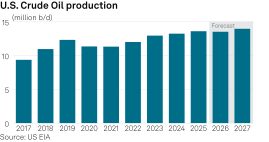
The US has remained the world's largest producer of crude oil in 2026, which the US Energy Information Administration forecasts will average 13.5 million b/d at the end of the year and 13.9 million b/d in 2027. In earnings calls throughout late 2025 and 2026, major upstream producers often expressed skepticism of further output growth and touted cost-cutting and efficiency gains instead.
While federal financing for upstream oil and gas projects was unlikely to attract widespread interest, government-backed purchase commitments could potentially prompt domestic producers to increase output more quickly than planned, though it was "unclear if that mechanism will be used," Kiplinger said.
Other parts of the energy industry, which face more onerous regulatory constraints, could receive more direct relief, sources said.
Rich Nolan, National Mining Association president and CEO, praised the actions for their potential impact on coal power production.
"This action recognizes the unique and irreplaceable attributes of coal to our nation's power system," Nolan said in a statement to Platts. The coal and baseload power memorandum specifically lists coal mining, rail and barge logistics, export and domestic terminals and on-site stockpiles as essential to national defense. Purchases, purchase commitments, financial support for the development of production capabilities and other actions pursuant to section 303 of the Defense Production Act are the most "cost-effective, expedient and practical alternative methods" to support national defense.
The Trump administration, via the DOE, has previously invoked emergency authorities to keep retiring coal plants in operation — including a March order directing TransAlta to keep Unit 2 of the Centralia Generating Station in Centralia, Washington, available to operate. The plant was previously scheduled to shut down in 2025.
The memos also covered expansive categories of natural gas infrastructure. The president declared the following to be essential to the national defense: natural gas and LNG capacity, including gathering and transmission pipelines, compression, processing plants, underground storage, LNG liquefaction, storage and marine load, export facilities and critical distribution infrastructure.
Without waiving the Section 303 limitations, Trump said the US gas industry would be unable to act fast enough due to financing constraints, long-lead equipment and construction schedules, permitting delays and infrastructure bottlenecks.
The Center for LNG applauded the president's action, saying the announcement highlights the importance of expediting the development of gas infrastructure. "With this memorandum, the White House has reinforced that the natural gas and LNG export industries are essential to the welfare of the United States and our allies," CLNG Executive Director Charlie Riedl said in a statement April 21.
Executives of large US gas producers have repeatedly called for more streamlined permitting reform. In December, a report from the National Petroleum Council, chaired by US oil and gas executives, said permitting logjams and extended legal reviews had made it too difficult to develop new pipeline capacity in a timely manner.
Another order invokes DPA procurement and financing authority for US grid infrastructure, including electric transformers, transmission lines, and conductors, as well as "related raw materials and manufacturing tools."
Former President Joe Biden invoked the DPA in June 2022 to specifically address an acute transformer shortage, but companies are still facing wait times of up to 40 months for the crucial building-sized grid components.
Funding, legal uncertainty
While the memorandums gave the administration sweeping authority in theory, their breadth also left it unclear how DOE and the administration would ultimately prioritize sectors or allocate funds, analysts and multiple industry participants told Platts. One oil and gas industry source told Platts that companies and their trade groups in Washington, D.C., would need more time to collect information before they could project any impacts.
"It's not clear how the Administration plans to direct spending, or whether funding activities such as engineering and permitting will prove sufficient to advance large-scale infrastructure projects that sponsors otherwise might not sanction," ClearView Partners wrote.
The moves are also likely to face legal challenges from environmental groups. Public Citizen, a progressive non-profit, called the moves a "wish-list for the oil, gas and coal industries" and hinted at a forthcoming lawsuit in a statement.
"Trump is once again abusing emergency authorities to treat his unlawful acts like they can't be stopped," said Tyson Slocum, director of Public Citizen's Energy Program. "But we will work to oppose this egregious abuse of emergency authority."
