Maritime & Shipping, Crude Oil
March 09, 2026
Southeast Asia floating storage falls in Feb as Iranian barrels clear before Middle East war
HIGHLIGHTS
Floating storage drops 25 mil barrels in Feb
Iranian crude draw-down drives decline
Middle East tensions shift barrel storage
Floating storage of crude and condensate in Southeast Asian waters has fallen sharply from the end-2025 record, led by a draw-down of Iranian barrels, according to S&P Global Commodities at Sea data.
As of end-February, volumes held on tankers stationary for more than seven days in Southeast Asia declined to 49.2 million barrels, a level last seen before the buildup that began in November 2025 and down more than 50% from the end-January level of 74.3 million barrels, CAS data showed.
The decline was driven by a 53% draw-down of Iranian crude, which stood at 26 million barrels in Southeast Asia as of end-February.
The pullback of Southeast Asia's offshore storage suggests that some of those Iranian barrels have since cleared into its biggest buyer. Chinese independent refineries imported 6.2 million metric tons of Iranian crude in February, up from 5 million mt in January. This was the highest level in three months.
However, several Shandong-based refiners said the February uptick in Iranian crude imports included some unsold cargoes. As Iran needed cash amid a sales slump in January, intermediaries advanced partial payments so the oil could be discharged into China's storage.
"The barrels moved from Malaysia to China, but not all of them have been cleared to end-buyers yet," a refiner source said.
Inventory management
Southeast Asia's offshore crude storage earlier surged to a record 112.6 million barrels at end-2025, surpassing pandemic-era peaks, with Iranian crude accounting for most of the increase. This coincided with a sharp reduction in Iranian crude held in ships floating in the Middle East.
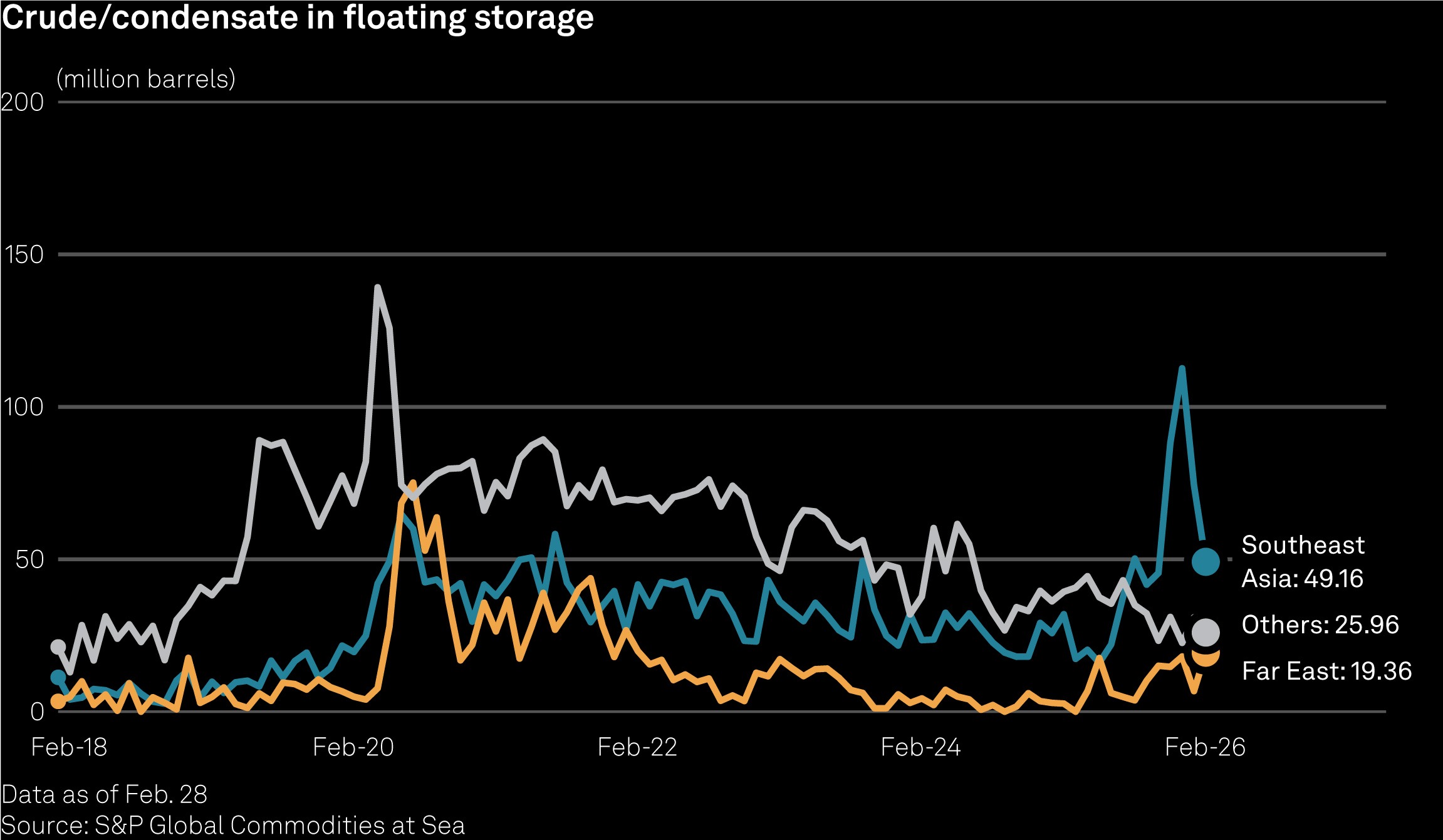
The shift of floating Iranian crude from the Middle East to Southeast Asia since November 2025 may reflect preemptive repositioning amid escalating Middle East tensions, market participants said.
Israel and the US launched coordinated strikes against Iran Feb. 28 and Iran has retaliated with attacks. Ship traffic at the Strait of Hormuz has since been nearly halted.
Southeast Asia remains a safe parking space for sanctioned crude from Iran, Russia and Venezuela. More than 70% of the crude and condensate in floating storage as of end-February were held by sanctioned ships.
Hamid Hosseini, spokesperson for the Iranian Oil, Gas and Petrochemical Products Exporters' Association, told Platts, part of S&P Global Energy, Feb. 23 that Iranian crude exports were normal in February, with consignments made via ship-to-ship transfers in the region near Malaysia.
Meanwhile, floating storage in Far East waters -- which refers to the oceanic region in east Asia covering China, Japan and the Korean Peninsula -- has rebounded, driven by Iranian and Russian crude. Some 19.4 million barrels of crude and condensate were floating in temporary storage as of end-February, more than doubled from 6.7 million barrels registered at end-January, but around the same level as end-2025, the CAS data showed.
Iranian crude, which includes Malaysian loadings, stood at 7.4 million barrels in Far East waters, up from end-January's 788,370 barrels and from end-2025's 1.2 million barrels. Russian crude floating in Far East waters stood at 3.2 million barrels, up 57% from end- January and up 10% from the end-2025 level.
The CAS analysis also showed that China overtook India to become the primary destination for Russian seaborne crude since December, mostly via direct shipments but sometimes via offshore transfers. Total STS transfer volumes of Russian crude reached 5 million barrels in Far East waters in February.

Editor: