Agriculture, Energy Transition, Maritime & Shipping, Biofuel, Renewables
March 04, 2025
INTERVIEW: Legislation is a key risk for biofuel bunker demand: FincoEnergies
By Thomas Washington and Max Lin
HIGHLIGHTS
Lack of consistent legislation dampens investment
Voluntary markets must ensure additionality to boost biofuels demand
Electrification in cars can redirect bio-feedstocks to shipping
Demand for bio-bunker fuels has been hindered by inconsistent legislation, and its growth will depend on voluntary carbon markets, particularly in Europe, an official at renewable fuels supplier FincoEnergies told Platts.
Changes to biofuel mandates across the transportation sector have occurred in different jurisdictions across Europe. A high-profile one for the marine sector was in the Netherlands, home to the world's second-largest bunker hub, Rotterdam.
"What we have found on an international level in the last few years is legislation is not consistent and that is killing investment," Johannes Schurmann, commercial director at FincoEnergies, said March 3 in an interview.
The Netherlands slashed the incentive for blending and delivering marine biofuels in 2024 by cutting the "hernieuwbare brandstofeenheden" (HBE) multiplier from 0.8 to 0.4. Effective in early 2024, the change boosted the costs for blending marine biofuel compared to sustainable aviation biofuel, thereby eroding the incentive to optimize marine blending in the country, particularly at the port of Rotterdam.
Bio-blended very low sulfur fuel oil sales fell sharply to 53,759 mt in the fourth quarter from 185,309 mt in the year-ago period, while bio-blended high sulfur fuel oil sales jumped to 36,209 mt from 9,704 mt, data from the Rotterdam port authority showed.
In Sweden, watered-down climate targets had drastic impacts on Swedish biofuel demand in 2024 and contributed to broader weakness across the European complex, analysts said. These primarily affected road fuel but drew the gaze of biofuel market watchers across transport sectors.
Lack of certainty ahead
"The spread between bio-bunkers and fossil bunkers is getting slightly smaller but it is not enough to cover the gap and from the legislative side Europe is not providing more push," Schurmann said.
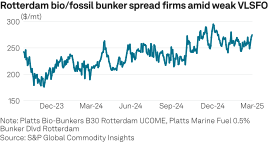
Data from Platts showed the spread is stable to slightly firmer amid bearish dynamics in very low-sulfur fuel oil. Platts, part of S&P Global Energy, assessed the premium of B30 bio-bunkers based on used cooking oil methyl ester at a $274.75/mt premium over delivered 0.5% sulfur fuel oil at Rotterdam on March 3, up 13% from when the assessment started in October 2023.
The European Union extended its Emissions Trading System to cover 40% of greenhouse gases from ships sailing to, from, and between EU ports in 2024. This proportion has risen to 70% this year and will increase to 100% in 2026.
A global carbon cost imposed by the International Maritime Organization would represent a legislative push and a key question to consider would be the distinction or relationship between the voluntary carbon markets and the mandatory ones, such as the EU ETS, Schurmann said.
The concept of additionality is therefore important, he said.
If companies are able to wrap Scope 3 emissions, those relating to transport, into the EU's FuelEU Maritime scheme or into a prospective levy by the IMO then the biofuels market will not grow significantly. "We can already satisfy most of the FuelEU Maritime target," Schurmann said.
Additionality is a key principle in voluntary carbon markets that ensures that carbon credits are used to reduce emissions that would not have occurred otherwise. A project's additionality is assessed by determining that the project activity is not required by law or regulation.
It means that for a shipping or biofuels project to prove additionality, it has to show that without it emissions would still be in the atmosphere.
"If shipping does follow this additionality principle, then the voluntary market could make a massive difference for increases in sustainable fuels in shipping, but the rules are not yet harmonized," he said.
Currently, shipping lines often participate in voluntary carbon trading via a book-and-claim system. They sell green freight services to customers willing to transport goods on ships powered by biofuels in the system. However, the methodologies for calculating such carbon credits are not uniform.
Capacity is a fluid concept
Biofuels are a ready tool for shipping companies to meet decarbonization targets but with growing interest across transport sectors, market players are concerned about the availability of suitable feedstocks.
This should not be a problem for shipping as the marine sector is relatively small compared to the road sector, in terms of biodiesel, Schurmann said. Redirecting biofuel to shipping could be a straightforward equation: "If the road sector moves toward electrification, then that should be possible," he said.
Schurmann noted that there is enough biodiesel production to meet the next 5-10 years of marine demand, and after that, it will remain to be seen how other transport modes develop.
"We never have problems in buying products in the Netherlands...The only thing is the premium might go up a bit."
Analysts at Energy expect 1.33 million mt of demand for renewable diesel and biodiesel as marine fuel in 2025, rising to 3.71 million mt in 2030.