Refined Products, Maritime & Shipping, Fuel Oil
January 17, 2025
COMMODITIES 2025: Headwinds to slow Zhoushan downstream growth, fuel oil dynamics pressured
By Nicholson Lim, Iris Leung, and Naomi Neoh
HIGHLIGHTS
Cautious optimism for Zhoushan’s bunker market expansion
Export quota, tax regulations pose downsides
Bio-bunker expansion anticipated with planned B24 quota
Trader sentiments were mostly favorable for further downstream bunker market expansion at the North Asian hub of Zhoushan, despite expectations of slower growth rates, while regulatory pressures on China's fuel oil dynamics could weigh on Asian fundamentals.
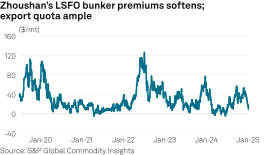
Although Zhoushan's downstream suppliers could compete for low sulfur fuel oil demand against regional hubs such as Singapore and Hong Kong, limited export quota allocations could pose downsides to cargo availabilities and overall sales volumes.
Sources also cited wider geopolitical uncertainties that could further dampen bunker demand.
"[Zhoushan's bunker] demand doesn't look positive as traders are expecting higher levies into US, and [any] retaliation would slow global trade ... Resolving Red Sea issues will ease supply of ships, [and cause] bunker demand to fall," a local ship charterer said.
"For the longer term, barge fleet availabilities and port efficiencies could be variables that bottleneck Zhoushan's bunker sales expansion," a China-based fuel oil trader said.
However, this spells opportunities for growth at other Chinese ports for 2025, with sources singling out Shanghai, Tianjin and Qingdao for faster expansion, expecting more callings from other freight segments at container-focused ports.
Over past couple years, thin export quota balances especially, throughout the fourth quarters, led suppliers to increasingly rely on LSFO imported from mostly Singapore hub, for Zhoushan's bunker sales.
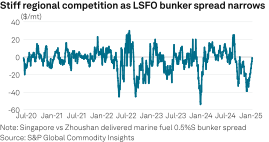
Chinese authorities issued an 8 million-mt bonded fuel oil export quota late December 2024, on par with the first allocations in 2024 and 2023, but traders mostly foresee overall export quota issuances to hold steady or slightly below the total of 13 million mt in 2024, which was down from 14 million mt for 2023.
Aligned with China's ambitions to transform Zhoushan into Asia's key refueling hub, bonded bunker fuel sales rose 3.2% year over year to record around 7.27 million mt across 2024, S&P Global Energy recently reported. HSFO accounted for around 31.5% of 2024 annual sales.
Despite sentiment that high sulfur fuel oil sales will benefit from an increase in scrubber installations at China's shipyards and buoy Zhoushan's growth, suppliers face price constraints as HSFO is typically an imported product and Singapore remains the world's largest HSFO refueling hub.
Some players expect HSFO sales to grow by about 5%, with premiums to remain supported.
"HSFO supply in Zhoushan will be slightly more this year, but not by much. But it's likely that China's refiners will buy less HSFO," a local bunker supplier said.
"Zhoushan's further growth rate might be limited, mostly due to stronger winds and high swells around its anchorages," according to an industry source based in Zhoushan Port Free Trade Zone, citing frequent disruptive weather events.
In upstream markets, traders see recent amendments to tax regulations detrimental to China's independent refineries' long term HSFO procurement appetite, further capping potential upsides in Asian markets.
China increased fuel oil import tariffs from 1% to 3% from Jan. 1, and earlier reduced tax rebates of some refined product exports from 13% to 9% from Dec. 1, 2024 onwards.
"Refiners' margins are definitely impacted in the long run as authorities' upwards revision of import taxes increases overall costs. There might still be further changes to policies in the future," a second China-based fuel oil trader said.
Export quotas to improve bio-bunker growth outlook
Due to blending restrictions, China's bio-bunkers supply is currently limited. Key ports like Shekou in Shenzhen, Lianyungang and Qingdao have seen supplies of mainly small quantities of B24 blend.
However, plans to allocate 500,000 mt of B24 biodiesel-blended bunker export quota this year, likely for Zhoushan port, will allow blending of bio-bunkers in China. B24 premiums could remain expensive amid high initial costs and limited blending volumes.
Zhoushan's bio-bunkers price outlook is mired in uncertainties due to a lack of prevailing bio-bunkering activity.
Gradually, Zhoushan's bio-bunker premiums may level against Singapore, as stronger demand may decrease suppliers' unit costs, a North Asia-based supplier said.
China's prevailing blending restrictions has seen demand flow to neighboring ports like Hong Kong, though traders expect China will soon catch up.
"We are still seeing a bit more upside [for B24] at Hong Kong since China is not able to blend their own B24," a Hong Kong bunker supplier said, noting sizable first-quarter term contract volumes and anticipating larger flows for rest of 2025.
Following antidumping investigations, Chinese biodiesel imports into the EU will be slapped with duties ranging from 12.8% to 36.4%, with effect from Aug. 16 this year. Regulatory complications could arise, particularly for European shipowners, who may also be wary of the credibility of bio-feedstock sourced from China, a Singapore biofuels supplier said.
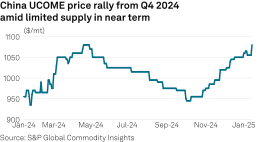
However, China's UCOME production has slowed since EU antidumping duties were implemented, and prices that rallied since the fourth quarter of 2024 are likely to stay elevated in early months of 2025.