Crude Oil, Maritime & Shipping
January 07, 2025
G7 crude tankers recover market share in Russia with Urals weakness

By Max Lin
HIGHLIGHTS
Russian flagship grade trades below price cap occasionally in December
Tanker operators seek employment as winter demand disappoints
Outlook uncertain as Urals recovers, Shandong bans sanctioned ships
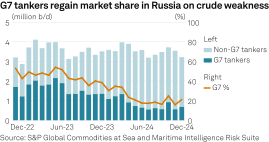
G7-linked crude tankers staged a strong return to Russia in December, taking advantage of non-sanctioned employment opportunities amid Ural price weakness in an otherwise lackluster freight market.
Data from S&P Global Commodities at Sea and Maritime Intelligence Risk Suite suggested 21.1% of Russia's seaborne crude exports last month were loaded by ships flagged, owned or operated by companies based in the G7, the EU, Australia, Switzerland or Norway, or insured by Western protection and indemnity clubs, up from a record low of 15.8% in November and the second highest in the past eight months.
Russia's overall seaborne crude exports fell to 3.2 million b/d in December from 3.5 million b/d in December, which S&P Global Energy analysts attributed to lower export availability due to the conclusion of seasonal refinery maintenance.
The recovery of market share by G7-linked tankers came as more companies based in China, the UAE and Turkey operated in Russia with Greek-owned ships or Western maritime services.
Meanwhile, tanker rates in mainstream markets disappointed in winter demand season, with soft Chinese oil demand and OPEC+ production cuts weighing on vessel demand, analysts said.
"The traditionally strong fourth quarter in dirty markets failing to materialize in most sectors ... the year ends with freight rates in most markets lower than in 2023," Gibson Shipbrokers said in a note.
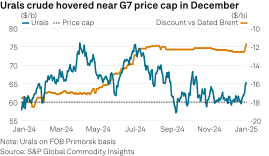
Based on Platts assessment of FOB Primorsk cargoes with 10-25 days of forward loading, the monthly average price of Urals fell from $61.348/b in November to $60.814/b in December, the lowest this year. Platts is part of S&P Global Energy.
Russia's flagship crude grade last month occasionally traded below $60/b, the threshold established by G7 members and their allies, below which maritime services firms subject to their jurisdictions could engage in Russian crude exports.
Price gains
Looking forward, whether G7-linked ships can continue to find trading opportunities in Russia remains uncertain amid recent gains of international crude prices and tightening sanctions.
Urals' flat price rose to $66.145 on an FOB Primorsk basis as of Jan. 6 from $59.640/b Dec. 23, according to Platts, while its discount to Dated Brent narrowed from $12.55/b to $11.40/b, the smallest since August, in the same period.
Market participants said the relative strength resulted from lower Urals exports and still-firm demand. "Turkey is coming back hungry post-[refinery] maintenance," one trader said.
Also, Western countries have continued to ramp up sanctions on price cap evasion to undermine Russia's war chest against Ukraine, putting ships trading in the country under further scrutiny.
In December, the UK and EU together put 72 ships on their sanction lists for evading the price cap regime in bids to disrupt their operations.
A group of 12 European countries have also vowed to check the insurance coverage of tankers with Russian oil in the English Channel, the Great Belt of the Danish Straits, the Sound between Denmark and Sweden, and the Gulf of Finland.
On the US side, Reuters reported the outgoing Biden administration plans to sanction over 100 Russia-trading tankers before President-elect Donald Trump takes office on Jan. 20, citing unnamed sources.
China -- the world's largest seaborne crude importer -- received 1.2 million b/d Russian crude in December, up 3.8% on the month despite overall falls of Russian exports, according to the CAS and MIRS data. More than 90% of them were transported by non-G7 tankers, many of which were used to circumvent sanctions.
But Shandong Port Group, which operates some of the largest Chinese crude import ports, has banned ships sanctioned by the US Office of Foreign Asset Control as of Jan. 6 -- a development that could force Chinese refiners to reduce intake of ESPO Blend, which has traded above the price cap, or use more G7 ships.
"Independent refineries in China will face the challenge of sourcing non-sanctioned crude oil ... if they struggle to find adequate non-sanctioned carriers for the final leg of sensitive oil deliveries," Energy analyst Zhuwei Wang said.
