LNG, Natural Gas
December 19, 2025
COMMODITIES 2026: EU gas market poised for inflection as crisis years recede

By Matt Hoisch
HIGHLIGHTS
Market response muted to lagging storage levels
Price expectations subdued amid swelling LNG supply, waning needs
Weather-driven demand spikes remain key risk
This is part of the COMMODITIES 2026 series, where our reporters bring you key themes that will drive commodities markets in 2026.
Even as the EU pushes to squeeze out its final dependencies on Russian gas, expanding global LNG production is positioning the continent for what could be its most comfortable winter in terms of gas prices in years, market watchers told Platts, part of S&P Global Energy.
While upside risks remain -- particularly from weather-related spikes in demand -- analysts agree Europe is entering the new year blanketed in bearish fundamentals, making 2026 a sort of inflection point between the crisis period after Russia's full-scale invasion of Ukraine and the LNG supply surge slated to hit the market through the end of the decade.
One harbinger of this shift is the muted response to lagging gas stocks.
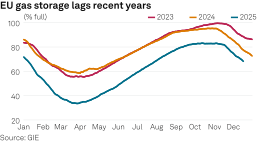
EU-wide gas storage was just 68.2% full as of Dec. 17, according to the latest data published by Gas Infrastructure Europe -- 8.9 percentage points lower than the same point last year and 20.4 percentage points lower than in 2023.
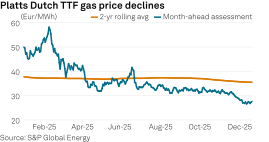
However, market participants are thus far shrugging off what would have been a major source of upward pressure in past winters. Gas prices are hovering at recent lows. Platts assessed the benchmark Dutch TTF month-ahead gas price at Eur27.61/MWh on Dec. 18, down some 12.5% from a month earlier.
Growing supply, waning demand
Burgeoning supply is a key driver of the shift.
With US LNG exports reaching record volumes, Atlantic basin LNG on the water surpassed 12 million metric tons (16.5 Bcm) for the first time on record in late November.
Jack Sharples, a senior research fellow at the Oxford Institute for Energy Studies, characterized the growth as part of "the first lapping at the shoreline of the coming wave of new LNG supply".
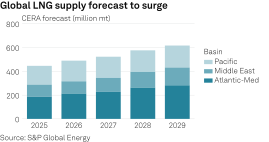
That wave is only set to swell.
"We expect the supply situation to improve further from 2026 onwards as a material step up in LNG liquification capacity comes onstream," analysts with HSBC wrote in a Dec. 11 research report.
S&P Global Energy CERA analysts forecast global LNG supply will grow nearly 10% over the next year, from some 446 million mt in 2025 to about 490 million mt in 2026.
Two major projects in particular, in North America and the Middle East, are scheduled to begin operations next year.
In early 2026, Golden Pass, co-owned by QatarEnergy (70%) and ExxonMobil (30%), is expected to begin production in the US.
QatarEnergy CEO Saad al-Kaabi said in December the first train of the 18.1 million mt/ year project was "hopefully" set to come online by the end of the first quarter of the year.
Kaabi also said in December that Qatar would "hopefully" start the first train at its North Field LNG expansion project by the third quarter of 2026.
As LNG production grows, European needs are waning.
"European gas demand has come down a ton in the past three years," said Ira Joseph, a senior research associate at Columbia University's Center on Global Energy Policy. "So, you're storing less gas for a smaller market."
European gas requirements are forecast to reach just under 449 Bcm in 2025, according to CERA data. This is about 11% lower than the 506 Bcm needed in 2022.
The International Energy Agency recently forecast a further 2% fall in European demand in 2026, as continued renewables growth reduces gas requirements for power generation.
Subdued risks remain
Some upside risks persist for the European gas market, however. But with the bulk of Russian imports already eliminated, they are significantly smaller than those faced amid the supply shocks of the past several years.
Instead, weather is the key uncertainty.
While LNG imports can meet Europe's base demand, storage remains vital for short-term spikes during cold spells.
"It's one thing saying that there's plenty of LNG out on the water, but of course it takes days to secure a spot cargo, get your [regasification] capacity, bring the cargo in, unload it, and then send it out into the system," Sharples said. "Storage is the first port of call when you need to balance your market very rapidly."
Columbia's Joseph agreed. "Even though overall European gas demand has fallen, peak gas demand is still a risk," he said. "If it gets really cold for an extended period of time, it can be a real risk to the market."
Europe's pivot to the intensely global LNG market also heightens its exposure to overseas dynamics.
"Growing reliance on LNG could expose the EU even more heavily to the global supply and demand dynamics of LNG," said Beatrice Petrovich, a senior energy analyst with the think tank Ember.
A European trader echoed the sentiment.
"Sure, we have a lot of [LNG], but it's an open market," the trader said. "Anyone can compete for it."
Consequently, European gas prices are also sensitive to temperatures in Asia, the world's other major LNG-consuming region.
Nevertheless, analysts doubt that cold spells would spur much of a price surge.
"This winter, you're going to need major weather events to hold prices where they are, whereas in previous winters, weather events were going to cause prices to go higher," Joseph said. "I think the price is going to continue to drift lower without weather events."
Europe's already relatively low gas stocks mean by spring and summer, the continent may face a repeat of the demand dynamics in 2025, with buyers seeking "substantial" LNG volumes to replenish dwindling storage, Sharples said.
Those buyers, however, will be met with more supply.
"With every year that goes by as we move through the wave of new supply, things get looser," Sharples said. "This is still a winter where there's a risk of some upside volatility to prices, but we are definitely not in crisis mode."

Editor: