LNG, Natural Gas
December 17, 2024
US sanctions on Gazprombank ignite surge in Turkish LNG imports ahead of 2025: sources
HIGHLIGHTS
Turkish LNG imports hit highest since February
Turkey tries to minimize supply risk for remainder of this winter: traders
Turkish procurement of liquefied natural gas has seen a sudden uptick this month, as the East Mediterranean hub seeks LNG for supply security in the event that Russian pipeline flows are disrupted this winter, sources said.
The Biden administration sanctioned Russia's Gazprombank, its six foreign subsidiaries, and numerous other financial institutions and officials to support Ukraine's war effort on Nov. 21. Gazprombank, Russia's largest non-designated bank, plays a key role in processing payments for the country's natural gas exports.
Turkey was seeking an exemption from US sanctions on Russia's Gazprombank to continue importing Russian gas, according to Energy Minister Alparslan Bayraktar on Nov. 26. The Turkish foreign ministry is negotiating with the US for a waiver ahead of the winter peak demand.
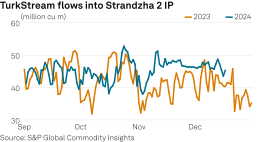
Flows of Russian gas through the TurkStream pipeline remain a critical part of supply for several Southeast and Central European countries, with imports entering into the continent via Bulgaria's Strandzha 2 interconnection point strengthening on the year recently.
S&P Global Commodity Insights data showed flows through this route at around 1.38 Bcm over November for a year-on-year increase of 15.4%, with flows over December thus far reaching 789.8 million cu m for an increase of 11.1% over the same Dec. 1-17 period in 2023.
Given the uncertainty over the sanctions on Russia's Gazprombank, Turkey has been looking toward LNG to secure supply during the peak winter demand period, sources said.
To meet domestic demand, Turkey could import gas from Russia, Iran, and Azerbaijan by pipeline, as well as LNG from multiple sources.
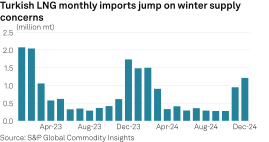
Turkish LNG imports so far this month have stood at 1.21 million mt, or 18 cargoes, according to data from Commodity Insights.
This represents the highest imports to Turkey since February 2024, when 1.50 million mt, or 21 cargoes, were recorded.
This also compared to the 910,000 mt, or 13 cargoes, imported in December 2023, over the same Dec. 1-17 period.
Of the current December imports, around 64% arrived from the US and nearly 17% from Algeria. Notably, 6% arrived from Russia.
Particularly, out of the 1.21 million mt, 990,000 mt was purchased via spot or short-term.
This quarter so far, Turkey has imported 2.43 million mt, the data showed. This compared to the 1.94 million mt imported in the fourth quarter of 2023 over the same period.
"On Turkey, I heard it was related to the sanctions against Gazprom, so they had to replenish with more LNG," an LNG trader said. "I did hear about the power cuts in Iran but not sure that's entirely the cause for the jump in buying."
Iran has recently been experiencing natural gas and fuel shortages which has led to power cuts, sources said, adding that this could potentially lead to less gas flows between Iran-Turkey.
"I guess because of sanction on Gazprom bank, BOTAS is trying minimize the risk in winter," another trader said. "They don't withdraw gas from storage now... They keep storage level at same level, and try buying more LNG because they don't know how this sanction thing will go."
The second trader added that, "[The] world is changing, we don't know possibilities for Russian gas yet [and] Turkey does buy some Russian cargoes, but I don't think directly."
Given the current uptick in demand and a relatively tight cargo market during this winter, traders are still expecting the East Mediterranean to be paying hefty premiums relative to the rest of Northwest Europe.
Lower supply from the Middle East and North Africa amid constraints at the Suez Canal and lower domestic production in Egypt have also kept premiums relatively elevated.
Platts, part of Commodity Insights, assessed the DES East Mediterranean marker for February at $12.249/MMBtu, an 8-cent/MMBtu premium versus the DES Northwest European marker or a 6.50-cent/MMBtu discount versus the Dutch TTF gas hub.
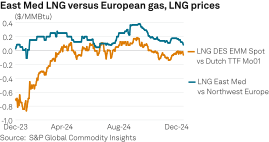
The recent BOTAS tender for February was also awarded around a 10-cent/MMBtu discount versus the February Dutch TTF gas hub, sources said, while the tender for March was awarded around TTF minus 20 cents/MMBtu.
One trader said, "while you'd expect March to be much weaker, prices [in the East Med] are still relatively high and [LNG-TTF] differentials are still narrow."
Turkey is expected to import four more cargoes for the remainder of December, totaling around 260,000 mt set to arrive for the rest of the month, Commodity Insights data showed.
Sources also expected some strong buying interest for January and February as Turkey aims to meet demand both domestically and from neighboring hubs.