Natural Gas, Electric Power
December 09, 2025
Cold snap boosts US EIA's spot gas price outlook for late 2025, early 2026
HIGHLIGHTS
Agency to 'modernize' Short-Term Energy Outlook
EIA raises Q1 gas marketed production forecast by 1.1 Bcf/d
The US Energy Information Administration raised its forecast for US spot natural gas prices in late 2025 and early 2026, citing a December cold snap that pushed up its estimate of gas used for space heating this winter.
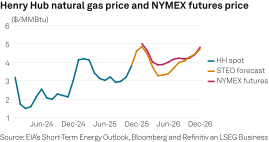
The agency, in its December Short-Term Energy Outlook, lifted its forecast for Q4 Henry Hub natural gas spot prices by 36 cents to $3.87/MMBtu. The Q1 forecast also rose 37 cents from the previous month's estimates to $4.35 /MMBtu.
The agency said the cold hitting the US this December will drive Henry Hub spot prices to average nearly $4.30/MMBtu this winter, more than 40 cents/MMBtu above the November forecast.
"Because of the colder weather, we now forecast the residential and commercial sectors will consume 6% more natural gas in December than we forecast last month, reducing the amount of natural gas held in storage."
While the US started the winter season with 4% more working gas in storage than the five-year average, the EIA expects withdrawals in December to be 580 Bcf, or 28% above the five-year-average.
However, the EIA expects rising production to continue into 2026, which will help moderate prices, compared to the expectations in the November outlook.
"We expect the Henry Hub spot price to average almost $4.50/MMBtu in 4Q26, down 5% from last month's forecast," the report said.
The agency forecast Henry Hub natural gas prices would average $3.56/MMBtu for full-year 2025 and $4.01/MMBtu in 2026, compared with the previous month's estimates of $3.47/MMBtu in 2025 and $4.02 /MMBtu in 2026.
On the supply side, the agency raised its gas production forecast from November estimates, citing its changed assumptions about gas-to-oil ratios (GORs).
"Specifically, we raised our expectations of GORs in the Permian region based on recent production trends, leading to more overall natural gas production in our forecast for 2026."
Dry gas production is forecast to average 109.1 Bcf/d in 2026, up from the November estimate of 107.8 Bcf/d.
The agency raised by 700 MMcf/d to 120.6 Bcf/d its natural gas marketed production estimate for the US in the fourth quarter of 2025. The Q1 2026 production forecast increased by 1.1 Bcf/d to 119.6 Bcf/d.
Gas inventories are now forecast to conclude the winter season at 2 Tcf, topping the five-year average by 9%.
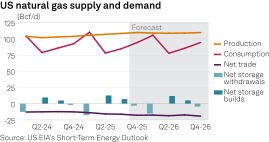
On the demand side, the EIA raised the natural gas consumption estimates by 500 MMcf/d to 94.3 Bcf/d for Q4, but lowered the estimate by 700 MMcf/d to 105.6 Bcf/d for Q1.
The increased natural gas price forecast also prompted the EIA to update its estimates for winter heating costs, with higher total costs expected for homes heated primarily by gas.
Average fuel expenditures for those heating with gas are now estimated to average a total of $671 for the November-March period, 3% above last winter's costs.
Those heating with electricity are estimated to pay an average of $1,144 this winter, up 5% from last year, according to the update.
Revamping the outlook
Alongside the STEO, the agency also announced plans to "modernize" its "core short-term forecast model," including "modern data architecture with automated data flows, internal visualization tools, and comprehensive documentation," according to a release.
The agency noted that the current model underpinning the outlook was "built a quarter-century ago." It plans to undergo the modernization process in stages, beginning with a new upstream model in the spring of 2026 and "full completion" in 2027.
"EIA is decisively accelerating toward a more integrated and timely forecasting system that better reflects the evolving role of the United States in global energy markets," EIA Administrator Tristan Abbey said in a statement.
The news came days after Abbey, appointed by US President Donald Trump and sworn in as the 11th EIA Administrator Sept. 25, outlined his wider plans for changes at the agency.
Speaking in an interview at the Center for Strategic and International Studies Dec. 4, Abbey said the EIA had "too many" products and "quite a bit of redundancy." He asserted the agency needed to update and streamline its data collection processes and discard unused tools, but reiterated the importance of the agency's monthly forecasts, market surveys, and Annual Energy Outlook.
"There are lots of things EIA does because we were asked to do so 10 years ago, 20 years ago, and we still do it, because that's what we do," Abbey said in the interview. "I think people have kicked the can down the road on modernizing our system architecture for far too long."
"EIA is very good about collecting missions like barnacles on the hull of a ship," he continued. "It is not so good at discarding them."
Electricity
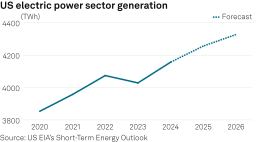
The EIA forecasts that nationwide electricity generation will grow by 2.4% in 2025 and by 1.7% in 2026. The generation growth forecast for 2026 is down from a roughly 3% year-over-year increase predicted in the previous month's STEO, a reduction driven by how much large-load electricity demand has come online so far this year and its implications for near-term growth, the agency said.
The updated projections for generation growth in 2025-26, should they come to fruition, would continue an upward trend seen in recent years after a decade of relatively flat growth, the EIA said. US electric power sector generation has grown by around 2% each year since 2021 after falling by an average of 0.3% annually between 2010 and 2020.
The bulk of the generation growth is a result of increasing power demand from data centers and other large-load customers in the Electric Reliability Council of Texas and the PJM Interconnection markets. The EIA forecasts that PJM power demand will increase by 3.3% in both 2025 and 2026, while ERCOT demand will rise by 5.0% in 2025 and 9.6% in 2026. The ERCOT demand growth forecast was notably revised downward from 6.0% in 2025 and 15.7% in 2026 in the November outlook.
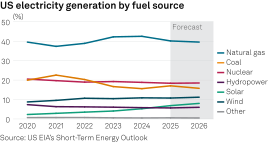
The surging demand in these regions is expected to have a significant effect on the mix of sources for power generation. Most of the growing demand in PJM is expected to be met by increasing generation from coal and solar, up 23% and 63%, respectively, between 2024 and 2026, the EIA said. The agency forecasts that solar power will be the fastest growing source of energy in ERCOT at an increase of 92% from 2024-26.
Natural gas is the large source of generation in both ERCOT and PJM and is expected growth by 2% in each between 2024 and 2026, the EIA said.

Editor: